
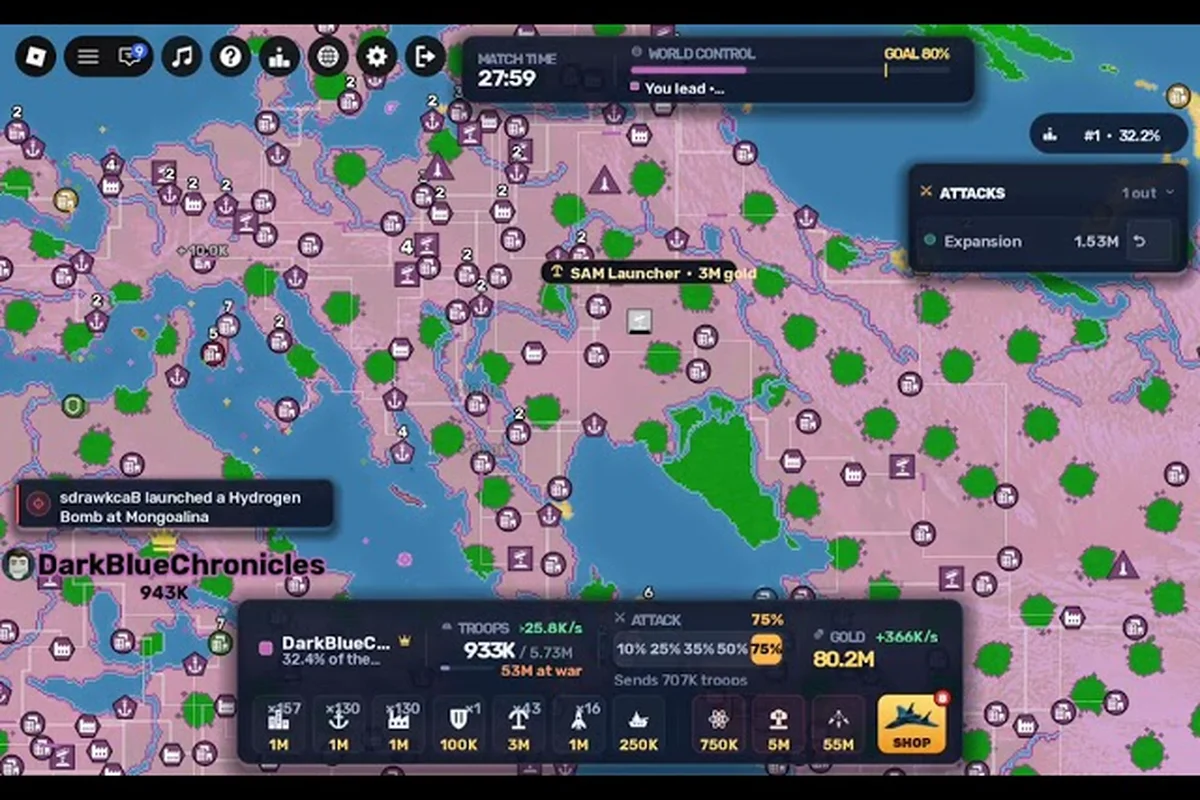
This roWorld gold guide shows how to build steady income, compare cities, and scale toward 100M+ gold without compromising your reserve. Learn the routes that turn early expansion into a sustainable economy by tracking roWorld gold income per city, prioritizing high-value roWorld gold farming targets, and reinvesting profits where production capacity is still the limiting factor.
RoWorld Gold Guide: Build Income Before You Build an Army
A strong RoWorld gold guide starts with one rule: income comes before military expansion. The official RoWorld game page lists cities, ports, factories, alliances, and nuclear weapons as core features, but it does not publish building costs, income rates, or upkeep values. That means the best approach is structural: build a balanced economy, protect your reserve, and expand only when your gold production can support the next move.
The official listing also identifies 88 player nations and hundreds of tribes sharing a map, with control of 80% of the world serving as the stated victory condition. In that environment, rushing ahead with an expensive army can leave your core economy exposed. A disciplined gold strategy instead creates several income layers, so losing one border or one city does not stop the entire operation.
| RoWorld economy priority | Immediate action | Strategic purpose |
|---|---|---|
| Survival income | Secure basic production and passive income | Prevent early bankruptcy |
| Network income | Connect useful cities and infrastructure | Improve the number and consistency of income sources |
| Reserve growth | Save gold before expansion | Keep repair and army options available |
| Territorial income | Add high-value cities and coastal access | Strengthen long-term economic scale |
| Military investment | Build only after the economy is stable | Convert gold into safe territorial control |
This priority order is more reliable than chasing a single expensive structure. For example, if a port and a factory would each improve your economy, the port’s gold income can fund factory construction while the factory increases long-term production, rather than committing all your reserves at once. It also gives you a practical framework for deciding what to buy, what to save, and what to postpone when an opponent attacks.
Three economic layers to establish
A complete roWorld economy guide should separate the economy into working income, reserve income, and territorial income. Working income pays for routine actions and maintenance. Reserve income is kept untouched for emergencies, while territorial income comes from cities and infrastructure that support your wider operation.
Do not treat every city as an equal purchase. A city near a productive network may support more expansion than a distant city with an impressive appearance. Likewise, coastal infrastructure can become strategically valuable when it connects ports, factories, and other income-producing structures, although the official page does not publish a numerical return for any one building.
Gold per city should be evaluated as a route, not a single stat. Check where the city sits, what it can connect, what it protects, and whether it creates a new revenue stream or merely adds land. The RoWorld money guide offers a useful framework for organizing city income, factory income, port income, and resource management.
RoWorld Gold Farming Routes by Game Phase
Your best roWorld gold farming route changes as the match develops. Early farming should emphasize dependable production and low-risk connections. Mid-match farming needs efficient city chains and protected reserves. Late farming depends on controlling multiple economic corridors while making only calculated military investments.
Community videos show a common progression: select a starting nation, place a capital, expand into available land, meet neighbors, establish an economy, and then negotiate or fight. This sequence matters because it shows that economic growth generally begins before large-scale territorial contests rather than replacing them.
Early match: create a repeatable income loop
The first route should be simple enough to maintain while learning the map. Start with buildings that support your current position, avoid opening several distant construction fronts, and direct income toward one connected economic cluster. This approach makes it easier to see which actions consistently produce more gold and which merely consume your reserve.
Prioritize connection quality over cosmetic expansion. A small network of well-placed cities can support a dependable loop, whereas scattered holdings increase travel time and create more targets. If your available space is narrow, concentrate on improving the area around your capital. If space is abundant, extend toward the nearest useful connection rather than claiming the farthest visible tile.
| Early-phase decision | Better economic choice | Cost of the alternative |
|---|---|---|
| Placing a new city | Extend toward an existing network | Scattered cities with weak links |
| Buying infrastructure | Support the active income route | Several unfinished projects |
| Responding to a threat | Preserve a defensive reserve | Spending every available gold on troops |
| Expanding territory | Choose one dependable direction | Racing across multiple borders |
A player who can repeat a short route each day will usually develop a stronger economic foundation than one who constantly makes a large, irregular purchase. Consistency also makes it easier to reserve gold for a sudden attack or a valuable city that becomes available.
Mid match: connect cities into economic chains
As the board fills, roWorld gold income should come from several connected routes rather than one central source. Ports, factories, and cities can support different strategic roles, so their value depends partly on adjacency and access. The official game page confirms that these features exist; it does not confirm any fixed income multiplier or building cost, so you should evaluate chains from what you can observe in your own match.
Look for opportunities where one expansion improves multiple parts of the economy. A coastal position may connect a port to inland cities, while a central city may be more useful for supporting factories and nearby structures. A border city may be less productive on its own but valuable because it closes a gap in your territory and limits hostile access.
Expansion synergy matters more than isolated building totals. Before starting a project, ask whether it feeds your main economy, protects a revenue source, or opens a new revenue corridor. If it does none of these, it may be a luxury purchase rather than a sound economic decision.
Late match: protect high-value economic corridors
Late-game gold farming is less about finding unclaimed land and more about preserving the value of what you already control. Defensive spending becomes part of income management when attackers can repeatedly raid a city, port, or factory. The exact repair and troop expenses are not published, so evaluate the risk through your own recurring losses rather than a fixed formula.
Community reports describe economies reaching beyond 100 million gold in focused matches. One Economymaxxing and 100M Gold community video reports accumulating more than 100M gold, although its exact method is not documented in text. Treat that figure as an example of possible scale rather than a guaranteed result. A larger treasury is useful only when it remains protected and actively supports your strategy.
RoWorld Gold per City: Choosing the Right Asset
There is no published formula for roWorld gold per city, so smart buyers evaluate each location by its economic role. A useful city supports production, connects assets, protects infrastructure, or opens access to territory. The strongest purchase often combines two or more of those functions.
This comparison avoids invented roWorld gold income figures while giving you a practical evaluation system. Instead of assigning an unsupported gold-per-hour value to each city, compare its contribution to the economic network: a production hub may strengthen gold farming, a central city may reduce travel between assets, and a border city may protect the routes sustaining nearby production. Before buying, check the city’s location relative to resource nodes, infrastructure, and connecting routes, then weigh that strategic value against the relevant risk shown in the table.
| City characteristic | Economic strength | Main risk | Best time to buy |
|---|---|---|---|
| Central location | Connects multiple nearby assets | Can become a priority target | When nearby production is stable |
| Coastal position | Supports port and trade-oriented plans | Exposure at the map edge | When a naval route is relevant |
| Border position | Creates a defensive buffer | May invite early fighting | When a reserve can absorb losses |
| Resource-rich area | Adds strategic production value | Requires infrastructure first | After the supporting route is planned |
| Isolated location | Grants territorial reach | Weak connection and high upkeep risk | Only with a clear long-term purpose |
A border purchase can make more sense than a central one even if its direct production appears less impressive, because it may protect a larger economic network. Conversely, a central city that creates repeated connections can become the backbone of a much larger system. Measure the route around the city, not the city in isolation.
Run a three-part city audit
Before buying a city, check its production links, defensive exposure, and expansion reach. Production links reveal what the city can feed or support. Defensive exposure shows how easily an opponent can interrupt it. Expansion reach indicates whether the location can connect another city or protect an important route.
You can also compare the city with your current reserve. If buying it leaves you unable to respond to a threat, the apparent economic gain may be illusory. If the city completes a route and your reserve remains intact, it may unlock more value than its local position suggests.
The RoWorld infrastructure guide can help with placement logic for economy, military, and defensive structures. Use it to understand how a new city supports the rest of your layout rather than treating it as an isolated purchase.
When to skip a city
Skip a city when it does not improve your network, creates an unfunded obligation, or simply exposes a distant area you cannot protect. A smaller, connected economy is easier to maintain than several disconnected projects. This becomes increasingly important as opponents can pressure multiple borders and force you to choose where gold is spent.
The RoWorld best gold strategy article expands on how to maximize income and plan expansion around resources. Its tier-based approach is especially useful for deciding whether a city belongs in your core economy or should wait until your financial position improves.
RoWorld Gold Income Tips for a Stronger Reserve
The most practical roWorld gold income tips focus on sequencing, not tricks. A steady reserve gives you freedom: you can repair damage, answer a border threat, or seize an opening without taking a destructive loan against future income. The key is to make spending decisions before the treasury becomes urgent.
Three principles improve most roWorld economies: protect the cash engine, avoid simultaneous projects, and require a clear payoff for every major purchase. In practice, route recurring city income toward repairs and high-value upgrades first, while delaying a second construction project until the current one visibly increases gold income. For example, if one city produces a reliable 500 gold per cycle and another upgrade costs 1,500, wait for roughly three cycles of the added income before financing the next project; this protects the treasury from simultaneous costs and keeps the roWorld gold economy growing instead of relying on emergency borrowing.
Separate working gold from protected gold
Divide your mental ledger into working gold and protected gold. Working gold funds ongoing construction and routine economic actions. Protected gold covers emergencies, repairs, and defensive needs. This is a management habit rather than a mechanic with a fixed threshold, which makes it adaptable to every match.
If a purchase is planned, define its purpose before opening construction. A city that completes a corridor has a clear economic function. A building placed in isolation may look impressive on the map, yet it can consume the capital needed for a more productive connection.
Stagger construction
Avoid starting every desirable project at once. Construction delays split attention and may leave several projects half-finished. Work in batches: finish the income connection, verify the route, then begin the next project. This rhythm creates clearer checkpoints and reduces the chance that a sudden attack exposes multiple unfinished investments.
| Reserve stage | Best use of available gold | Result |
|---|---|---|
| Thin | Core income and emergency defense | Prevents immediate collapse |
| Stable | One planned infrastructure project | Improves a specific route |
| Strong | Expansion with a remaining buffer | Creates territory without losing resilience |
| Excessive | Several high-confidence projects | Converts stored wealth into economic capacity |
A protected reserve is not idle money; it is the flexibility to defend, redirect, or capitalize when opponents commit elsewhere. For example, keep enough gold to cover an emergency defense need before starting another income route, then spend only the surplus on the next planned infrastructure project. In practice, treat the reserve as a deployment buffer: a larger treasury can support expansion, but poor timing may leave cities vulnerable, whereas measured spending on a verified route can turn stored wealth into gold income without sacrificing resilience.
Reinvest by diminishing returns
When a city or production route improves your network, consider where the next gold should go. If that route creates several better placements, finishing it may have more value than opening a distant city. If your current network is saturated, expansion can open a new income pool instead.
This is where the broader RoWorld strategy guide becomes useful. Military timing, expansion direction, and economic development should be considered together, because a large army on a weak revenue base can be less valuable than a smaller force supported by a resilient economy.
RoWorld Economic Strategy for Reaching 100M+ Gold
Reaching 100M+ gold is best understood as a capacity goal rather than a single farming trick. It requires enough production, a long enough match, controlled spending, and protection from repeated losses. Since RoWorld does not publish a fixed income rate, the most reliable path is to improve the number of dependable income channels while keeping waste low.
Think of 100M+ gold as four stages: stable base, connected network, protected expansion, and reinvested surplus. Start with dependable gold income and a manageable gold-per-city ratio, then add linked production sources so one weak channel does not expose the entire economy. Protect the next expansion by reinvesting only the surplus that remains after routine spending, because spending every available coin can force a return to inefficient farming. The final stage turns accumulated gold into a self-reinforcing economy: surplus funds additional production capacity, which should create more reliable gold per city and improve the next reinvestment cycle.
Stage one: stabilize the base
Secure enough production to cover ordinary needs and maintain a small emergency buffer. Prioritize completing resource connections over increasing the number of visible structures, since unfinished generators, mines, or storage links add capacity on paper but contribute nothing to actual gold income. For example, connecting one additional production chain to a functioning mine can improve city revenue more than buying several disconnected buildings. Every purchase in Stage one should either raise gold production per city or strengthen protection against losses, avoiding spending that creates a larger footprint without a corresponding income gain.
Stage two: connect the network
Add cities and infrastructure that have an obvious economic role. Compare central, coastal, border, and isolated locations. Favor routes that create repeatable value over one-time visual appeal. Your city portfolio should begin looking like a network rather than a collection of disconnected claims.
Stage three: protect expansion
As the economy grows, treat territory and gold as connected systems. Losing a production node can reduce income, while losing a defensive city can expose several economic routes. Before expanding, identify which part of your treasury and income network would be hardest to replace.
Stage four: reinvest the surplus
Only after essential production and the core city network are stable should you commit larger sums. In practice, reinvest surplus through a single protected expansion target: first secure a valuable corridor, then check whether its city links create a reliable new source of gold income. For example, connecting several production cities along one corridor can raise map value more than adding distant holdings, because useful links improve the economy without spreading your defense across multiple fronts. The exact sequence varies by match, but the economic logic remains consistent: spending should create a clear payoff, not merely increase visual scale.
| Growth stage | Primary gold objective | Expansion standard | Warning sign |
|---|---|---|---|
| Stable base | Finish essential production | One local direction | No emergency buffer |
| Connected network | Improve useful city links | Complete a corridor | Scattered holdings |
| Protected expansion | Secure valuable corridors | One clear target | Multiple active fronts |
| Reinvested surplus | Create additional income | Payoff is clear | Spending only for size |
A community run that started with a small position and later controlled a large part of the map illustrates the value of consolidation. The creator’s RoWorld world domination community video emphasizes smart expansion and territorial consolidation, although its result is an observation from one match rather than a guaranteed formula.
Common RoWorld Economy Mistakes to Avoid
Most gold losses come from poor sequencing rather than a lack of expensive buildings. The riskiest pattern is spending every available coin, then discovering that a border raid or unfinished project requires funds. A better economy keeps a buffer and prioritizes projects with transparent connections.
A visible land total is not the same as gold income: a compact city connected to resource chains can outperform several distant tiles that generate no meaningful gold per city. For example, if one city sits beside an active gold chain while another only expands map coverage, the latter may increase territory without improving roWorld gold income. Check the actual gold output from production buildings, tax collection, trade routes, and city connections before deciding where to invest.
Expanding before stabilizing
New territory can look exciting, but it adds construction demands, defense needs, and management complexity. Stabilize your existing income first, then expand along a route you can support. If every city depends on a different network, your treasury becomes harder to predict.
Treating upkeep as a separate issue
Army and infrastructure spending should be evaluated together with income. Even without published upkeep values, repeated spending will reduce the capital available for production. The correct question is not whether a purchase seems affordable, but whether it still leaves enough gold to maintain the rest of the network.
Chasing scattered buildings
A large map presence does not automatically equal high income. Before claiming distant land, compare the route with your existing assets. Sometimes the best economic move is to improve an interior connection, protect a city, or complete a port-and-factory chain.
Ignoring map pressure
Economy becomes less effective when opponents can repeatedly interrupt it. Watch border activity and protect the cities that support your main network, because an enemy capture near two connected cities can interrupt the same gold-income route twice. For example, if a border city sits beside your treasury and a high-yield city, prioritize reinforcement there before expanding toward a third outpost. This keeps gold income per city flowing through one stable cluster, reduces the need to retake disconnected settlements, and preserves reserves for responding to a new attack. Defense is not a separate hobby; it preserves roWorld gold income by reducing the likelihood of repeated losses.
| Mistake | What it changes | Corrective action |
|---|---|---|
| Spending the full treasury | Removes response options | Keep a protected buffer |
| Claiming distant cities | Creates disconnected overhead | Extend from a stable cluster |
| Building without a route | Wastes production potential | Define the connection first |
| Ignoring border threats | Allows repeated income disruption | Strengthen critical approaches |
| Chasing size alone | Confuses land with wealth | Track network quality and reserves |
RoWorld Gold Guide Checklist for Each Match
Use this checklist before major purchases, after a defensive victory, and whenever your income feels inconsistent. It forces a clear comparison without requiring unofficial formulas or exact income values. The process works because it separates the purpose of the purchase, the source of supporting income, and the risk created by a new commitment.
Before spending
Ask what the purchase accomplishes, whether it connects to the current economy, what it protects, and whether you can still respond to danger. If the answer is unclear, wait. A good opportunity will often become more valuable after your reserve grows or your network becomes stronger.
During expansion
Add only one major front at a time, finish projects before opening new ones, and review which city or structure is supporting the most important route. Keep the core economic corridor protected, because a chain of connected income is usually more valuable than isolated holdings.
After major battles
Recalculate the economy. A victory may have consumed gold, while a defeat may have damaged production. Reinvest only after your network is stable, and do not treat recovered territory as automatically productive. Some locations may require rebuilding or a new route before they contribute meaningfully.
The final test is simple: compare your current gold income with the cost of your next expansion, including rebuilding, route maintenance, and city upgrades. If a new use would consume the reserve needed to preserve your gold income, postpone it; for example, keep enough gold to cover several production cycles rather than investing every coin in a single city. When you can add productive gold use without draining that buffer, the economy is functioning as a system. If not, slow down and restore the income foundation before expanding again.
Frequently Asked Questions
How much gold does each city generate in RoWorld?
RoWorld does not publish official city income rates, so there is no reliable fixed answer for gold per city. Compare cities by their network role, nearby infrastructure, exposure, and expansion value. A connected city can be more useful than a distant one even when its direct output looks similar.
Can players reliably reach 100M+ gold in RoWorld?
Community gameplay reports describe totals above 100 million, but results vary by match duration, economy, spending, and survival. Reaching that scale requires stable income, protected reserves, efficient expansion, and repeated reinvestment. Treat the total as a possible outcome rather than a guaranteed farming rate.
Should I build factories and ports before expanding my cities?
That depends on the route you need. Build infrastructure when it strengthens a clear connection or prepares a plan you can complete soon. Avoid scattered projects that consume gold without creating a dependable network. In early matches, finishing a simple income route usually matters more than maximizing building variety.
How much gold should I keep in reserve?
RoWorld does not publish a fixed reserve requirement, so judge by risk and priorities. Keep enough to respond to border pressure, repair damage, or finish a project already underway. As threats multiply and your economy becomes more valuable, a larger portion of the treasury should remain protected.
Is rapid expansion better than focusing on existing cities?
Rapid expansion can help early, but it becomes dangerous when every project needs attention and your reserve disappears. Consolidate first by connecting nearby assets, improving city routes, and protecting your main economy. Add distant territory only when one clear expansion route can be supported without weakening the core.