
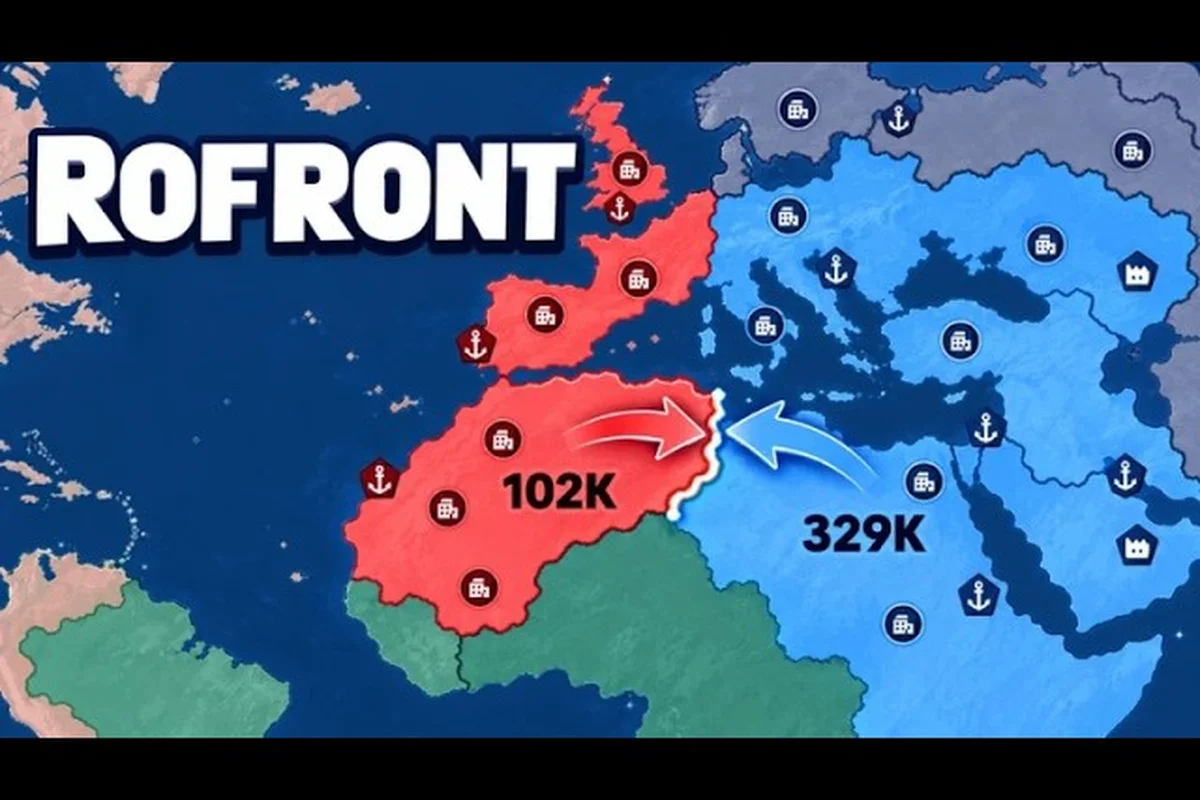
Early momentum in RoWorld depends on choosing a safe capital, building a sustainable economy, and expanding without overextending. This RoWorld early game guide shows how to turn a small base into a regional power before stronger rivals force a strategic choice.
RoWorld Early Game Setup and First Decisions
Your opening decisions determine how quickly you can gather resources, recruit troops, and claim useful territory. The official RoWorld game page identifies cities, ports, factories, alliances, and nuclear weapons as core features, while server structure can include up to 55 players alongside as many as 88 player nations and additional tribes sharing the world.
That scale matters because a capital is not merely a building location. It is the center of your economy, territory, recruitment, and eventual defense. A promising starting point can become a liability if it traps you between aggressive neighbors, exposes your production to attack, or forces you to spend every resource reacting to threats.
Assess the starting position
Begin by identifying the land around your capital, the neighboring powers, and the available empty space. A coastal position may provide a port and access to water routes, while an inland position can offer more secure borders. The right choice depends on the surrounding map rather than a universal rule.
| Starting feature | Immediate advantage | Main risk | Early-game response |
|---|---|---|---|
| Coastal capital | Access to a port and wider movement options | Exposure on one side of the base | Secure nearby land before exploring distant borders |
| Inland capital | Fewer direct approaches from the sea | Slower access to port benefits | Build a compact defensive position around the capital |
| Empty neighboring land | Room to expand without conflict | Reveals your direction of growth | Claim a useful block before a stronger nation arrives |
| Crowded border | A nearby opponent may become an ally or target | Immediate military pressure | Avoid an early war until your economy can support it |
| Weak neighbor | A possible early territorial gain | Their allies may intervene | Test only when you can absorb the consequences |
Community footage of RoWorld, which some creators still call RoFront, consistently shows players claiming nearby empty land before engaging stronger neighbors. Treat this as a recurring player strategy rather than a guaranteed rule, because the official page does not publish troop percentages, building costs, or income rates.
Claim a compact starting territory
Your first land purchases should create a defensible and economically useful core. Aim for a shape that protects the capital, contains several buildable spaces, and connects naturally to roads, ports, factories, or other infrastructure. Spreading thin across distant parcels may look impressive on the map, but it divides your attention and leaves every position harder to support.
The capital-first expansion pattern is more reliable than random land grabbing. Secure the capital’s immediate ring, identify the most important local connection, and only then consider additional territory. This approach also makes it easier to recognize which buildings should remain near the center and which sites are worth defending farther out.
Pick one opening goal that fits your neighbors
Different matches require different opening plans, so pick one primary objective instead of trying to optimize everything simultaneously. A capital surrounded by experienced players may require a defensive opening, while a quiet corner of the map can support rapid economic growth and early recruitment.
| Opening objective | Best when | Main priority | Avoid |
|---|---|---|---|
| Build economic strength | You have safe neighbors and room to grow | Secure income and maintain reserves | Expanding before production is stable |
| Establish a defensive core | Your capital has several close borders | Connect territory and strengthen the center | Taking distant land too early |
| Make one limited conquest | A nearby target is exposed and weaker than you | Concentrate troops and use one front | Fighting on multiple fronts at once |
| Prepare for diplomacy | Several nearby nations appear organized | Gather information and maintain leverage | Assuming alliances remove the need for defense |
As the roWorld early game guide continues, remember that the first hour is about optionality. Keep a reserve of income and military capacity rather than committing every advantage to a predetermined plan. For example, if a limited conquest becomes favorable, you can concentrate troops on that one exposed neighbor; if diplomacy develops instead, you can redirect resources toward defense or economic growth. Preserving reserves costs less than expanding into multiple fronts, where divided armies can be defeated piecemeal and leave your capital vulnerable.
RoWorld Early Game Economy for Steady Growth
A resilient RoWorld early game economy gives you money, capacity, and flexibility at the same time. Since official building costs and income rates are not published, the most useful approach is to evaluate structures by the role they play in your nation rather than inventing a fixed build-order cost.
Your economy should support three recurring needs: producing income, maintaining your territory, and preparing troops for defense or expansion. If spending absorbs nearly all incoming resources every cycle, the apparent growth in land may not correspond to stronger military capacity.
Match each building to its function
Start with the capital, connect the surrounding area, and add the infrastructure that your current phase requires. Avoid placing every available structure simply because it appears in the build menu. A compact network of useful buildings generally supports clearer decision-making than scattered projects that do not reinforce one another.
| Building role | Best placement | Strategic purpose | Early priority |
|---|---|---|---|
| Capital | Central, protected position | anchors territory and national growth | Establish first |
| City | Near a productive or defensible area | supports expansion and population | High after capital |
| Port | Alongside an active coastal connection | improves access to maritime movement | High in coastal regions |
| Factory | Close to the power network you want to serve | supports military or industrial capacity | Depends on neighbors |
| Supporting structure | Between useful destinations | strengthens the network | Add after core needs |
| Outpost | Stable frontier position | extends influence and creates a buffer | Add when a border is secure |
For a more detailed look at how construction affects spending, see the RoWorld building and upkeep overview. It can help separate essential infrastructure from optional projects, but the better foundation remains clear: every structure should support a larger plan.
Spend without creating a deficit
Before purchasing land, troops, or a building, ask whether the purchase preserves operating capacity. A common early mistake is treating available gold as a budget for one purchase. In a territory game, money that disappears immediately cannot respond to a border raid, a missed opportunity, or an urgent defensive need.
Use three mental buckets: one for gold tied to operating income, one for money held for expansion, and one for reserves that protect military readiness. For example, if a border raid appears after you buy a troop batch, a single spending pool can leave you unable to recruit reinforcements or repair damaged structures. Separating the buckets lets you judge each purchase by its actual purpose, so gold remains available for an opportunity or crisis instead of disappearing into a nonessential upgrade.
-
Operating income covers the structures and obligations required to keep your nation functioning.
-
Expansion reserves remain available for valuable land, a capital improvement, or another purposeful purchase.
-
Military reserves are not normal spending money. They represent readiness when a rival tests your border.
Community reports frequently describe players hesitating before early wars because troop reserves and income determine whether a nation can continue expanding afterward. Although exact reserve percentages are not published, the principle is clear: a reserve is valuable because you can choose when to use it.
Improve placement before adding volume
A better-placed building can make an entire region more useful, while another structure in an isolated corner may contribute little. Review connections, nearby territory, and the route troops will need to travel. If a new structure has no clear link to your capital or another priority, it may be premature.
| Review question | Positive sign | Warning sign |
|---|---|---|
| Is the structure connected? | It reinforces an existing network | It sits alone without a clear purpose |
| Does it have nearby space? | Future growth remains possible | It is boxed in by rivals or poor terrain |
| Can you defend it? | It lies behind stable territory | It requires several exposed fronts |
| Does it support a plan? | It fits economic or military goals | You chose it only for visual completion |
| Can the economy absorb it? | Other essentials remain funded | Construction consumes nearly every resource |
Treat the roWorld early game guide as a sequence of build priorities rather than a shopping list. First establish your capital’s core production and resource flow, then make the nearest territory productive, and only afterward add structures with a clear payoff. For example, extending economic coverage near the capital can improve resource income before you commit resources to a distant structure that merely completes the visual layout.
RoWorld Mid Game Expansion Without Overextending
The early base becomes a mid-game force when it can produce enough strength to influence more than one border. That is the transition described in a good roWorld mid game guide: the goal is no longer simply to occupy land, but to connect a capital-centered network that can support deliberate expansion.
Expansion should answer a strategic question. Are you gaining a resource-rich connection, neutralizing a threatening border, opening a second stable front, or creating a buffer against a stronger nation? If the land has no useful role, growth may only enlarge your defense bill.
Choose expansion by strategic function
Different kinds of land create different opportunities. A coastal route may support trade or troop movement, while a neighboring capital can provide a defensive buffer. A remote territory may offer space but also create a long and expensive supply line.
| Expansion target | Strategic function | Main benefit | Main warning |
|---|---|---|---|
| Empty inland land | Core growth | Space for cities and industry | Weak access to distant fronts |
| Coastal territory | Network connection | Port options and movement routes | More exposed borders |
| Neutral city | Economic or military hub | Adds a meaningful strategic node | Higher immediate resistance |
| Weak capital | Political victory | Removes one nearby rival | Can trigger wider retaliation |
| Buffer territory | Defensive depth | Gives early warning and room to absorb pressure | Costs resources before it pays off |
| Distant land | Long-term expansion | Opens a new direction | Splits focus and stretches supply lines |
The official game page lists ports and cities among the available features, but it does not publish a universal territorial value scale. Read the map instead of relying on a fixed formula: for example, an empty inland tile may provide room for cities and industry, while a coastal territory can connect trade and troop movement through a port. Compare each target’s position, adjacency, and supply cost before committing, because a weak capital may deliver political victory but trigger retaliation, whereas a buffer territory can delay an enemy advance.
Keep one main front
Community videos repeatedly show successful players concentrating on one front rather than attacking several neighbors simultaneously. While this is an observation, not a verified rule, it reflects a sound strategic constraint: every new front can divide attention, income, and troop readiness.
Before opening another conflict, confirm that the current one has reached a stable point and that expanding the war will not expose your capital, economy, or troop reserves to immediate counterattack. For example, if an enemy border is still threatening your occupied tiles, finish that connection and strengthen the defensive line first; only then should you redirect income and troop readiness toward a neighboring front. This sequencing preserves the gains of the early game and gives the roWorld early game guide a practical rule: consolidate one objective and one border before committing to further world conquest.
-
Secure the objective so the enemy cannot immediately retake it.
-
Stabilize the line with connected territory and a defensible capital.
-
Restore reserves before committing to another front.
-
Assess the map to identify which new connection offers the greatest strategic value.
This sequence marks the shift from conquest to consolidation: stabilize the secured objective, connect the occupied tiles into a defensible line, and rebuild troop reserves before opening another border. For example, if a captured region borders a threatened capital, route additional income and troop readiness into repairing that connection rather than chasing a neighboring target; the new acquisition should strengthen the next phase of the roWorld world conquest plan, not expose the core to a counterattack. This approach also keeps the roWorld mid game guide focused on positional value rather than a simple checklist of targets.
Use map knowledge as a multiplier
The RoWorld map strategy overview can help you evaluate coastlines, chokepoints, inland space, and neighboring capitals. Map knowledge is most valuable before committing resources, because terrain can reveal whether a route is secure, congested, or likely to become contested.
Community creators demonstrate a visible before-and-after pattern in matches where a small base eventually controls a large portion of the map. Those examples are useful for understanding tempo, not for setting a promised result. One match is not a benchmark, and the number of land tiles does not automatically represent military strength.
RoWorld Troop Preparation and First Conflicts
Military readiness in RoWorld is an early-game resource, not a late-game decoration. You need troops to protect construction, answer border pressure, and exploit a favorable opening. The trouble begins when every available unit is committed before you understand whether the war will remain local.
The official page confirms that troops and nuclear weapons exist, but it does not publish unit costs, damage values, attack percentages, or income rates. Any claim that a particular troop count guarantees victory should be treated as community opinion, not a confirmed mechanic.
Depth around the capital and border warnings
A sensible defense has depth. Your capital represents the final layer, nearby territory creates space to react, and border structures provide earlier warning. Even a quiet start benefits from this arrangement because it gives you options if a neighbor becomes unexpectedly aggressive.
| Defense layer | Function | Preparation priority |
|---|---|---|
| Outer border | Detect pressure and create distance | Early |
| Secondary territory | Absorb movement and support a counterattack | Early to middle |
| Capital perimeter | Protect the most important national assets | Essential from the start |
| Troop reserve | Provide active response capacity | Before a likely war |
| Strategic contingency | Support an unexpected front or emergency defense | As resources permit |
Your reserve is especially important when a nearby opponent begins building strength. A nation that spends every troop on an offensive may have no reliable answer when a second player tests another border. Keep enough capacity to protect the core, even if the exact reserve ratio changes with the situation.
Judge a target beyond raw strength
A large opponent may have exposed borders or divided attention, while a smaller opponent may occupy a position that threatens your economy. Compare the purpose of the war, the route to the target, likely allied responses, and what happens if the attack stalls.
| Target signal | Strategic meaning | Recommended response |
|---|---|---|
| Weak border with a clear route | A favorable local opening | Prepare one concentrated attack |
| Strong border backed by allies | High retaliation risk | Improve defense and seek another option |
| Enemy distracted by another front | Temporary opportunity | Move quickly, but keep reserves |
| Target surrounded by neutral land | Harder supply and reinforcement | Improve connectivity first |
| Enemy capital exposed | High-value but concentrated target | Avoid a reckless rush without preparation |
| No clear strategic payoff | Expansion for its own sake | Refocus on economy and borders |
The best roWorld early game guide does not teach reckless aggression. It teaches patience: attack only when a target offers a concrete strategic payoff, concentrate enough force to create a breakthrough, and keep reserves for reinforcement or consolidation. For example, a weak border with a clear route justifies one prepared strike, while an exposed enemy capital does not. If the push stalls, stop reinforcing a losing front, protect your economy and borders, and redirect troops toward a safer opening instead of committing every unit.
Negotiate from strength
Alliances are a listed feature, but their exact conditions are not publicly documented in the available sources. Treat cooperation as a dynamic tool rather than a permanent solution. A useful agreement can reduce pressure on one border, but your capital and local forces still need protection.
Community footage shows both negotiations and attacks, which suggests that diplomacy can create as much room for strategy as combat. A nation with reserves and secure borders can negotiate from a stronger position because it can absorb a broken promise. That is another reason to treat troops as insurance as well as offensive power.
RoWorld World Conquest Guide for Long-Term Expansion
A roWorld world conquest guide should focus on coherent national development rather than a guaranteed path to controlling the entire map. The official page lists 80% world control as the victory condition, but territorial control alone does not guarantee that result. A large nation can still be divided, overextended, or destabilized by internal pressure.
The later stages of a match also differ from the early game. Your opponents may be stronger, your borders may be wider, and every new project can affect a distant front. This is where the roWorld late game guide becomes relevant: simplify priorities, reinforce strategic corridors, and avoid treating every available action as equally valuable.
Build strength along connected fronts
Large empires are easier to manage when their important regions are connected. A disconnected patch may look impressive on the map, but it can become vulnerable if supply and reinforcement routes are unreliable. Prioritize links between capitals, productive regions, and frontline territory.
| Long-term priority | Why it matters | Better than |
|---|---|---|
| Connecting capital regions | Improves cohesion and response time | Isolated prestige land |
| Protecting vital infrastructure | Preserves economic and military capacity | Expanding without a defensive plan |
| Maintaining strategic reserves | Enables a response to sudden threats | Committing every unit to one front |
| Reducing weak borders | Limits opportunities for a coalition | Defending every minor edge equally |
| Consolidating conquered zones | Turns occupation into durable control | Chasing scattered targets |
This approach also informs the transition from a roWorld early game guide to a roWorld mid game guide. Early play establishes the base; middle play turns that base into a network; later play ensures the network remains stable while it contests the largest regions.
Watch for signs of overextension
Overextension appears in many forms: a capital surrounded on too many sides, a large economy with weak reserves, construction projects scattered across the map, or military spending that never creates a durable result. Track these symptoms before they become obvious to your opponents.
| Warning sign | Likely problem | Corrective action |
|---|---|---|
| Several borders require attention | Too many active fronts | Consolidate and choose one priority |
| Income rises but troop readiness falls | Spending imbalance | Restore a military reserve |
| Distant regions have weak links | Disconnected territory | Build a strategic corridor |
| Construction slows core development | Too many simultaneous projects | Finish essentials before extras |
| New land produces no clear benefit | Aimless expansion | Stop and define the next objective |
| Borders become harder to patrol | Excessive perimeter | Favor compact, defensible territory |
A large empire should not measure progress by counting every captured tile. Judge expansion by four linked capabilities: keeping the capital secure, moving troops between regions, funding infrastructure, and absorbing a second attacker without collapsing. For example, if distant provinces require a long strategic corridor but troop readiness is falling, that territory is adding upkeep faster than it adds value. Pause further captures, restore the military reserve, and prioritize defensive links; one weak connection can allow two enemies to pressure the same region and stretch the empire’s troop deployment beyond what its economy can sustain.
Preserve a fallback plan
Even a strong nation should maintain a reserve route. Keep a secondary economic or military priority, avoid committing every troop to the largest offensive, and retain enough flexibility to defend an unexpected front. A fallback is not a sign of indecision; it is the basis of consistent decision-making.
This is where the roWorld late game guide and the broader roWorld world conquest guide meet. Conquest is not merely taking land. It is controlling that land in a way that preserves growth, security, and the ability to keep choosing your next objective.
Practical RoWorld Early Game Checklist
The following checklist turns the broader strategy into a repeatable opening routine. Its purpose is to prevent small mistakes during the busiest part of the match, when a player may be expanding, defending, and checking construction at the same time.
First actions
- Place the capital in a defensible position with usable expansion space.
- Identify nearby empty land before distant targets.
- Connect the capital to the first group of important structures.
- Add a port or factory when the region makes that structure relevant.
- Keep enough resources to maintain operations and prepare troops.
- Record the strongest neighboring power and the weakest border.
- Avoid a second major war until the first front is stable.
- Consolidate conquered territory before opening another front.
- Review distant projects whenever the main capital comes under pressure.
- Treat community tactics as useful patterns, not confirmed numeric rules.
Mid-session review
During the middle of the session, assess whether your capital is still protected, whether your territory forms a usable network, and whether the national economy can support the next phase. If all three are weak, stop expanding and repair the core. If they are stable, choose one border where improved infrastructure or focused military pressure would produce the greatest advantage.
A good roWorld early game guide therefore ends with a repeatable decision process rather than a fixed list of purchases. Observe the map, identify the strongest constraint, and select the action that removes it. That habit remains useful whether the match is approaching its middle or late stages.
Frequently Asked Questions
What should I prioritize first in RoWorld?
Prioritize a secure capital, connected nearby territory, and enough economic capacity to maintain your base. Avoid distant expansion and immediate wars until you understand your neighbors. The goal is to create a stable core that can support troops without leaving your capital exposed.
Should early players expand or build troops first?
Expansion is usually safer when nearby land is empty and your border is stable, but troops should be prepared before you fight a real opponent. A practical early approach is to claim useful land, build essential infrastructure, and keep a reserve so an aggressive neighbor cannot catch you completely unprepared.
Can a small capital win against a larger nation?
A small capital can win through positioning, focus, and superior timing, but raw expansion alone rarely provides enough strength. Attack a clearly favorable target, avoid multiple fronts, and preserve the ability to defend your core. No official win-rate data establishes a reliable rule for small bases.
When should I start a second war?
Wait until your first front is secure, conquered land is consolidating, and your economy can support additional commitments. Opening several conflicts at once may stretch attention and reserves. The community-recurring pattern of fighting one front at a time offers a sensible default, though match circumstances should guide the decision.
How do I prepare for mid-game expansion?
Build a connected regional network, strengthen the capital, identify valuable ports or cities, and maintain enough reserves to respond to threats. Review the map for routes that improve defense or economy rather than claiming isolated land. This foundation makes the transition into a roWorld mid game guide and later conquest plans more reliable.