
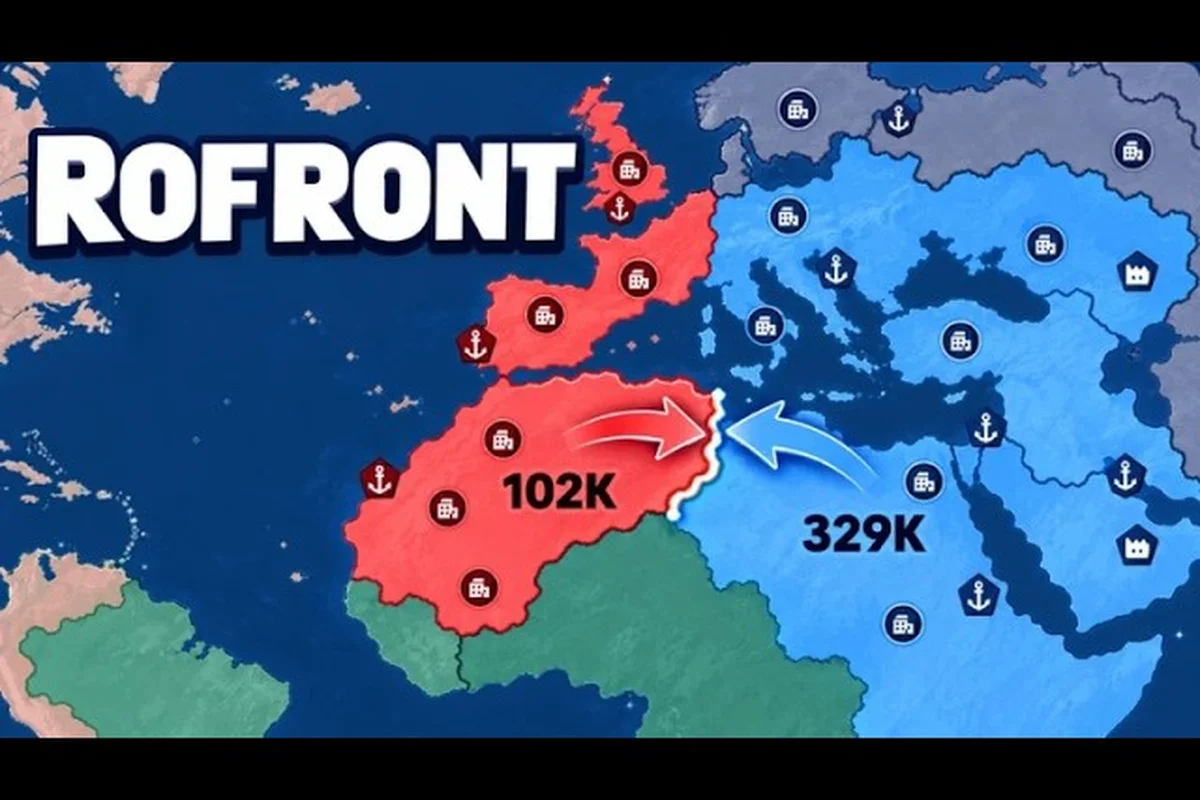
This roWorld game mechanics guide explains how territory, economy, troops, alliances, and survival shape each match. Capital placement should support nearby territory rather than sit exposed, because controlling resource-producing land gives your nation a stronger economic base for troop upkeep and further expansion. In practice, a defensible capital connected to a supply route creates a clearer growth loop than scattered captures: secure a region, use its resources to strengthen the center, and protect that investment while building alliances or preparing a counterattack. Knowing these cause-and-effect relationships turns individual actions into a coordinated strategy for steady national growth.
The official Roblox page describes 88 player nations, hundreds of tribes, servers of up to 55 players, and an 80% territory victory condition, while community footage shows the practical rhythm of expansion, defense, and resource management. Use the following breakdown to build a stronger foundation without relying on unpublished costs or unit statistics.
Understanding the roWorld Game Mechanics Guide
RoWorld is a real-time territory game built around a simple competitive loop: establish an economy, secure land, protect nearby territory, and expand toward rivals. The official Torrey Pines community page identifies Torrey Pines as the game's creator group, making it the most reliable verified source for announcements and balance changes.
The map combines 88 player nations with hundreds of smaller tribes, and individual servers can include as many as 55 players. A match ends when one faction controls 80% of the world, according to the official game information. This means that victory does not require eliminating every opponent. The practical objective is to become the faction whose territory becomes impossible for rivals to contest.
| Match element | What it means for players | Practical consequence |
|---|---|---|
| Nation capitals | Major territorial anchors | Protect the capital while expanding outward |
| Tribes | Smaller territorial settlements | Useful for securing local space or dividing a front |
| Cities and ports | Economic and territorial objectives | Contest them when they support a coherent plan |
| Factories | Industrial infrastructure | Strengthen the economy supporting military growth |
| Alliances | Cooperative territorial arrangements | Share pressure without surrendering strategic control |
| Nuclear weapons | High-impact strategic options | Reserve them for decisive moments because timing and availability may vary |
Territory is the central score
Land controls income, military capacity, and strategic reach, so territory control is the foundation of the entire match. A large nation with a weak economy may be less secure than a smaller nation that produces enough resources to keep troops active and repair pressure away from its capital.
The official 80% condition is the clearest published win rule. A 79% faction has not won merely because it leads, while a 60% faction may already be in a stronger position than an 40% opponent with nearby territory exposed. Keep the map mentally divided into secure core, developed interior, and vulnerable border when judging your progress.
Resources create options, not automatic victory
Resources convert playstyle choices into action. A strong economy can support several active fronts, reinforce threatened settlements, or fund an offensive push. Weak income makes every expansion decision more expensive because the nation has less flexibility when another border breaks.
Do not treat the first visible income number as a complete measure of strength. Income resilience also depends on how many useful settlements remain active, whether the core is protected, and whether the player can redirect attention when a rival attacks. The developer has not published exact income rates, upkeep values, building costs, or troop multipliers, so any precise economic calculation should be treated cautiously.
Troops and alliances are relative tools
Military strength matters when it can be concentrated at the right place. Front-load control is more useful than spreading a force across the map, because a player who attacks on two fronts may weaken both. Alliances can make a larger coalition viable, although every partner creates another border to monitor.
For an overview of opening choices and controls, use the roWorld beginner guide. It covers the early-game decisions that shape troop production, alliance coordination, and territorial expansion, making it useful before applying the front-loaded control strategy discussed here. For example, understanding when to reinforce a border rather than launch a second attack can prevent a nation from overextending its troop capacity.
Territory Capture and Border Control
Territory capture works as a chain of connected objectives rather than a single button press. You first secure nearby land, establish a defensible center, improve the settlements in between, and then attack outward when the economy can support another front. The order matters because every advance creates more border to watch.
Start with the closest empty land
The early opening seen in community gameplay consistently favors nearby unclaimed space. Taking a close settlement reduces travel exposure, creates a usable buffer, and gives the player something to defend without immediately entering a contested region. It is also a low-risk way to learn how construction, income, and troop movement interact.
| Opening choice | Immediate benefit | Main risk | Better when |
|---|---|---|---|
| Claim nearby empty land | Creates a protected starting buffer | Reveals your expansion direction | You are still establishing your core |
| Approach a weak neighbor | Removes a nearby competitor | Can trigger an early defensive response | Their border is already exposed |
| Challenge a strong neighbor | Potentially gains valuable land | May overextend before the economy develops | Your economy and army are already stable |
| Seek an alliance | Shares pressure and borders | Creates coordination obligations | Trust and terms are already clear |
Create depth, not a scattered chain
A straight line of settlements looks larger on the map while remaining fragile in practice. If the front settlement falls, everything behind it may become exposed. Build depth by securing the capital, filling nearby gaps, and establishing a second controlled area before stretching toward a distant objective.
Layered expansion has three practical layers: secure the capital, link nearby settlements, and project controlled power toward a frontier. For example, if the capital is threatened, reinforce nearby settlements before capturing a distant port; this preserves internal defense while reducing the risk of losing an isolated outpost. Treat each new claim as part of a connected network, because a settlement with no dependable link can expose resources, troops, and expansion routes without strengthening the nation.
-
Core layer: The capital and closest settlements, which should be treated as the most important defensive assets.
-
Connection layer: Intermediate territory that links the core to a port, city, factory, or frontier.
-
Frontier layer: Newly claimed settlements used to pressure rivals or prepare the next advance.
A compact territory gives you more useful control than scattered outposts because connected settlements reinforce the same core: troops can protect the capital, nearby gaps can be filled before a flank collapses, and a frontier settlement can pressure a rival without becoming an isolated target. For example, after linking two settlements to the capital, prioritize repairing and defending that connection before sending another force toward a distant city; if the connection fails, the farther claim may consume resources without securing the nation. This approach supports roWorld territory capture and nation growth even when the interface does not explicitly label the core, connection, and frontier layers.
Attack one front at a time
A recurring community strategy is to concentrate military attention on one border. Fighting two enemies at once may appear efficient because both are losing land, but it can also leave the home territory exposed and force continuous troop movement. The roWorld strategy guide expands on attack sequencing, diplomacy, and defensive positioning.
Single-front pressure means selecting one objective and directing resources toward it until the front changes. If the opponent redirects troops elsewhere, the original attack can continue; if the attack stalls, the player can commit more resources without automatically opening another front.
Check the whole border before committing
Before an offensive move, inspect both land and sea access. Ports and coastal settlements may create alternate approaches, while a short inland border can be defended with fewer distractions. Also check the distance between your target and the nearest allied or enemy settlement, because a threat can arrive from behind if you ignore the wider map.
| Capture check | What it reveals | Decision influenced |
|---|---|---|
| Border density | Whether many settlements need attention | Whether to attack now or stabilize first |
| Objective value | Whether the target supports income or access | Which front deserves priority |
| Enemy response | Whether rivals are reinforcing nearby | Whether to continue or redirect |
| Retreat space | Whether defeated troops threaten the core | Whether risk is acceptable |
| Allied overlap | Whether partners are contesting the same area | Whether communication is needed |
Growing a Nation Through Territory and Economy
Nation growth is a feedback loop. More territory can support more economic activity, stronger defenses, and additional troop capacity, but those benefits matter only if the player connects settlements intelligently and protects the center of the network. The objective is not to own disconnected patches; it is to create a land area that compounds value.
Treat the capital as the economic anchor
The capital is more than a starting point. It anchors the early network, organizes nearby territory, and represents the most sensitive settlement in the nation. Protect it by developing interior land before pushing the outermost frontier. A distant victory with an exposed capital can be less valuable than a compact victory position.
Capital security depends on three layers: nearby friendly territory, warning time when a border is crossed, and enough military capacity to respond. Players who rush far ahead often lose the ability to distinguish an emergency from a manageable border skirmish.
Develop settlements in a deliberate order
Not every settlement has the same strategic role in roWorld, so development should reflect the phase your nation is entering rather than a fixed building order. Stabilize the capital and nearby holdings first, because secure income and defended borders make later expansion possible; then connect interior territory to reduce dangerous gaps between settlements. After that network is secure, specialize ports, cities, and factories to boost trade and production, and only afterward pressure rivals from frontier holdings. In practice, capturing territory without protecting supply routes can leave a nation exposed despite a larger map, so the sequence is stabilize, connect, then specialize.
| Development order | Settlement role | Main purpose | Common mistake |
|---|---|---|---|
| First | Capital and closest holdings | Establish a defensible core | Scattering troops too soon |
| Second | Connected interior territory | Improve income and reinforce borders | Leaving dangerous gaps |
| Third | Port, city, or factory network | Expand economic and strategic value | Developing isolated objectives |
| Fourth | Frontier holdings | Pressure rivals and prepare attacks | Treating the frontier as safe |
| Later | Consolidation and alliances | Stabilize gains and reduce threats | Expanding before the core is secure |
Use the economy to create choices
A healthy economy does not need to be explained with a precise number to be useful. It should provide several choices when a border is threatened. The player should be able to defend the capital, reinforce a front, or keep developing a settlement without depending on one fragile source.
Community reporting often describes economy building and military strength as connected systems, particularly when discussing the transition from early expansion to larger offensives. The useful conclusion is not that a specific percentage produces a specific troop, because no official troop multiplier is published. It is that stronger income generally gives a player more timing options.
For a deeper look at income structures, territory growth, and unit behavior, see roWorld economy mechanics. That analysis explains why economic development and territorial strength should be monitored together rather than treated as separate systems.
Balance expansion with consolidation
Every new settlement creates at least two obligations: defend the new land and support its connection to the core. If those obligations exceed available attention, reduce the pace. Consolidating existing territory can be more valuable than claiming another district when the existing network contains gaps.
A practical review question is: If the strongest neighbor attacks today, which settlements become vulnerable? If the answer includes several isolated holdings, rebuild cohesion before starting another war. If the answer is only the frontier, the nation may have enough space to prepare the next objective.
Surviving Pressure in World PvP
Survival in RoWorld depends on preserving income and troop readiness while making only necessary commitments. Because the world remains contested, a defensive stance is not passive. It allows the player to identify a dangerous rival, protect the capital, and choose when pressure becomes favorable.
Watch the borders, not just the chat
Incoming information may come through visible troop movements, changed ownership markers, or pressure on a connected settlement. Confirm the source of danger before responding. A small probing attack may distract from a larger operation elsewhere, and a distant threat may be less urgent than the one already weakening a border.
| Threat signal | Likely interpretation | Best response |
|---|---|---|
| Repeated small attacks | Probing or testing defense | Hold a reserve and reinforce selectively |
| Troops massing at one border | Concentrated offensive preparation | Defend that front and consider disrupting it |
| Two borders become active | Attempt to split attention | Stabilize the more damaging front first |
| Internal settlement loses status | Network fragmentation | Reconnect the area if strategically valuable |
| Opportunity appears near a rival | Short opening for expansion | Attack only if the core is secure |
Keep a response reserve
A standing reserve protects against surprise and prevents every border event from consuming the entire active army. The exact percentage of troops should remain flexible because official troop values are not published. A reserve should be sufficient to answer a genuine emergency without committing every unit to one uncertain battle.
Operational readiness also means watching income. If a player can produce resources consistently, temporary troop pressure becomes easier to absorb. If income is weak, even a successful defense can leave the nation unable to repair losses or develop the next objective.
Avoid automatic escalation
Winning a skirmish does not always require occupying every adjacent tile. Sometimes the better result is a controlled retreat by the opponent, giving the defender time to restore its network. Conversely, when an enemy loses a critical settlement, a limited follow-up can be more valuable than opening multiple new fronts.
| Result of contact | Sensible response | Strategic reason |
|---|---|---|
| Minor border gain | Consolidate nearby land | Reduces exposed border length |
| Enemy troop loss | Reinforce the threatened sector | Prevents a quick counterattack |
| Major territorial loss | Defend connected settlements | Preserves the economic core |
| Clear local advantage | Make one focused push | Turns temporary strength into lasting space |
| Defensive disadvantage | Trade land for time | Rebuilds income and military readiness |
Use diplomacy without depending on it
Alliances can deter aggression and reduce the number of borders you must monitor. They work best when both sides understand who controls which territory and when cooperation ends. Even a temporary understanding can be valuable, but it should not replace secure borders or a functioning economy.
Avoid making aggressive promises early in a match. A compact nation with reliable income can matter more than a large nation that repeatedly overextends. This is especially important when considering a starting faction; the roWorld nation list can help compare territory, coastline, and neighboring pressure before a match begins.
A Practical Match Plan for roWorld Players
A reliable match plan turns the mechanics into a sequence, with territory capture, nation growth, and survival forming the decision loop rather than three separate objectives. For example, expanding into an exposed resource node may accelerate nation growth, but it can also pull troops away from a threatened border and make territorial capture harder to defend. The plan should therefore assign priorities by current pressure: reinforce a vulnerable border when opponents contest nearby territory, secure food and wood production before a larger expansion push, and avoid sending every unit into one capture attempt without a defensive reserve. This creates a repeatable opening framework without prescribing the same build order for every server, because each map’s resources, starting position, and opponent activity can change the correct sequence.
Phase one: establish a secure base
Begin by placing or securing the capital, then claim the closest empty land. Develop enough nearby territory to understand income generation and troop movement before approaching a rival. The first priority is a functioning core, not an impressive map marker.
During this phase, ask whether the player can identify three things immediately: where income comes from, which border is easiest to defend, and how quickly troops can reach the capital. If any answer remains unclear, spend a little more time consolidating before taking risks.
Phase two: connect and specialize
Fill the gaps between the capital and nearby settlements, then develop the objective that best supports the player's intended route. A coastal strategy may prioritize ports, while an inland approach may focus on cities, factories, or connected settlements. The map should reveal a route toward a useful objective.
| Match phase | Main objective | Secondary objective | Avoid |
|---|---|---|---|
| Base establishment | Secure the capital and nearest land | Learn income and troop controls | Attacking a strong neighbor |
| Core development | Connect and strengthen territory | Prepare a response reserve | Scattered, isolated claims |
| First expansion | Pressure one exposed border | Capture a useful objective | Fighting on two fronts |
| Consolidation | Repair the network and stabilize income | Adjust alliances | Rushing for map percentage |
| Final contest | Exploit a decisive local advantage | Protect the capital | Chasing an unsafe victory |
Phase three: choose the first opponent
The best first opponent is not necessarily the weakest visible nation. Consider border access, economic value, and current distraction. An opponent fighting another player may offer a temporary opening, but their allies or nearby strong faction could still make the attack dangerous.
Use community footage as observation rather than official rule. A RoFront beginner guide community video shows the broader pattern of earning money, developing strong strategies, using nuclear weapons, expanding territory, and improving military play. Treat the exact tactical choices as player experience because the creator is not the official developer.
Phase four: expand one coherent front
Choose an objective that advances the network instead of one that creates a detached outpost. Move troops, capture land, and connect the new area to the core in a sequence. Stop if the response becomes stronger than expected, and redirect toward a safer economic priority.
Coherent expansion has three signs: the target supports the next strategic plan, the route back to friendly territory remains viable, and the nation can still protect its capital. If all three are present, the attack is easier to justify even when it is difficult.
Phase five: prepare for the decisive phase
The final stage may involve a local war, a sudden enemy collapse, or a broader contest for the 80% condition. Improve logistics, preserve a military reserve, and avoid assuming that map lead equals victory. If a faction controls much of the world, opponents may concentrate on the most valuable connection points and weaken the network from within.
The last principle is deliberate consolidation. Map control with connected territory is more resilient than a larger collection of disconnected claims, because connected territory can reinforce supply lines, protect a single staging area, and let one force threaten several objectives at once. For example, two neighboring regions that funnel troops through one junction may be more valuable than three isolated regions requiring separate garrisons; holding that junction lets you rotate the reserve, intercept a counterattack, and preserve the logistics needed to reach the 80% condition.
Common roWorld Mistakes and Better Alternatives
Most early mistakes come from treating a single visible indicator as the whole game. A large territory looks strong, but a solid network is more useful. Understanding the incorrect approach helps players correct habits before they compound into a larger defeat.
Expanding before the core works
Claiming land quickly can feel productive, but each claim adds responsibility. If nearby settlements are not yet connected, the player may end up with several vulnerable points. A compact core developed before expansion usually creates a better base for the next stage.
Dividing troops across unrelated borders
Two active fronts can force impossible choices. If attention keeps switching, neither front receives enough support. Choose the front that threatens the core or the most valuable economic objective, and let the other remain a lower priority until conditions improve.
Treating every settlement as identical
A port, factory, city, and ordinary territory can have different strategic roles. Develop what supports your route rather than spreading resources evenly. The best choice depends on your capital, borders, neighboring powers, and the objective you hope to control next.
| Mistake | Immediate signal | Better alternative |
|---|---|---|
| Expanding with an unstable core | Repeated border pressure and weak defense | Consolidate nearby territory first |
| Maintaining two major wars | Troops constantly changing direction | Commit to one prioritized front |
| Ignoring settlement roles | Disconnected upgrades and unclear progress | Develop a coherent economic network |
| Assuming map lead guarantees victory | The capital or key links remain exposed | Protect structural weaknesses |
| Reacting without reserves | Every emergency consumes the whole army | Maintain flexible military readiness |
Ignoring the value of time
Not every available action should be taken immediately. A player who attacks while the economy is recovering may create a permanent weakness. Sometimes the strongest move is to secure an interior settlement, improve readiness, and let the opponent commit troops first.
Time also changes diplomacy. An alliance that forms during a crisis may be useful, but rushing into permanent arrangements can remove future options. Confirm the practical terms of cooperation and keep the nation able to operate without assuming permanent protection.
Frequently Asked Questions
How do I capture territory safely in roWorld?
Start with nearby unclaimed land, build a connected core, and attack one border at a time. Secure the route from your capital before taking a distant objective, because isolated settlements create extra defenses to manage. Safety comes from concentration, preparation, and preserving enough resources to respond to an unexpected counterattack.
What is the best way to grow a nation in roWorld?
Grow a compact network before chasing distant land. Improve the capital, connect nearby settlements, and develop economic objectives that support your chosen route. Add frontier territory only after the core can survive pressure. This creates stronger local value and reduces the number of exposed borders, although the best route depends on your map position and opponents.
How should new roWorld players survive their first match?
Avoid fighting a strong neighbor during the opening phase. Claim nearby land, learn how income and troops operate, and keep the capital protected. Watch for pressure on two separate fronts, respond to the more damaging threat, and avoid committing every troop to a distant assault before your economy is stable.
Does controlling 80% of the world automatically win in roWorld?
Yes, controlling 80% of the world is the victory condition listed on the official game page. Leading the map does not by itself guarantee that condition, because another faction may control more land. Focus on connected territory and protect the settlements that prevent rivals from reversing the balance.
Are nuclear weapons always the best option in roWorld?
Not necessarily. Because their timing, strength, and cost are not published in the official information, relying on them for every conflict is risky. Community footage treats them as a major strategic option, but economy, positioning, alliances, and a maintained troop reserve may matter more depending on the situation.