
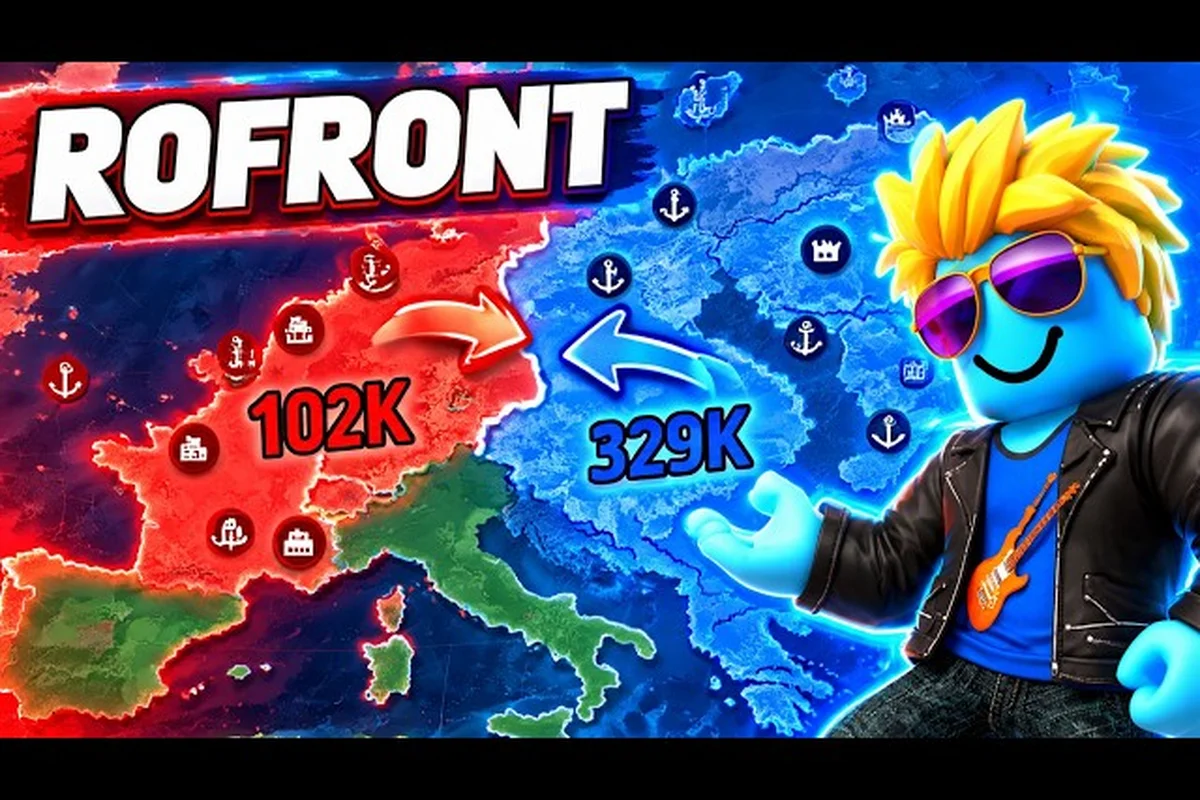
RoWorld economy mechanics determine whether conquered territory can support a sustainable nation, not merely a temporary military foothold. Gold funds city and factory upkeep, while troop pressure raises the cost of holding borders; connecting these systems to the roWorld 80 percent territory rule is essential for advancing toward the roWorld win condition. A practical example is prioritizing a connected territory cluster: its cities can share infrastructure, factories can offset long-term upkeep, and a defensible border reduces the gold lost when troops must repeatedly retake disconnected land.
How the RoWorld Economy Creates Strategic Pressure
RoWorld is a territory-control game in which expansion depends on resources, borders, and military readiness. The official RoWorld page on Roblox describes 88 player nations, hundreds of tribes, and a shared world where 80% control determines the winner. That scale matters because a nation cannot simply collect every tile: its economy must support the land it takes, the troops it fields, and the infrastructure it wants to operate.
The roWorld economy mechanics form a continuous loop. You begin with limited economic capacity, secure land that improves your position, use income to support the army, and use the army to obtain more land. Weak spending can leave you wealthy on paper but unable to defend what you own. Conversely, excessive military spending may produce a strong army without enough gold to maintain the settlements that make expansion worthwhile.
| Economic element | Primary purpose | Strategic question |
|---|---|---|
| Gold | Funds development and military activity | Is this purchase strengthening the next stage of expansion? |
| Cities | Support economic activity | Does this location improve income or support my core? |
| Factories | Support military production | Can I defend what this funding produces? |
| Ports | Extend trade and connection options | Is this useful for my current network? |
| Troops | Claim and defend territory | Is this force strong enough for the intended border operation? |
| Territory | Generates access, income, and strategic value | Can I hold this land without overextending? |
This article focuses on the decisions between those elements rather than invented formulas. RoWorld does not publish exact building costs, income rates, troop multipliers, attack percentages, or upkeep values, so any guide claiming precise numbers without verification should be treated cautiously.
Gold, Cities, Factories, and the Economic Core
Gold is the central planning resource because it links nearly every part of the map. It is not merely a score displayed beside your nation; it is the resource that turns plans into settlements, infrastructure, and military capacity. A practical approach is to classify spending as either productive, defensive, or experimental. Productive spending strengthens income or long-term capacity, defensive spending protects an existing position, and experimental spending should remain small until its value is proven.
The roWorld economy mechanics are easier to understand when cities, ports, and factories are treated as complementary parts of one network. A city is the central settlement component, a port changes economic connectivity, and a factory supports military output. Their exact costs and production values are not publicly confirmed for RoWorld, but their strategic roles are listed on the official page. The useful question is therefore not “Which building always produces the most?” It is “Which investment removes the largest constraint on my next move?”
Reading a city as a strategic anchor
City placement is a long-term commitment. Although a city can support a broad operation, its value depends on the territory around it and the routes connecting it to the rest of your nation. A well-placed settlement can serve as a stable center, while an exposed one may consume resources without improving your strategic position.
Before committing to a city location, evaluate how its position affects both the roWorld economy and the 80 percent territory win condition. A central settlement may be easier to supply and defend, but a peripheral city can secure territory that helps you approach the 80 percent control threshold; compare the resource and troop travel required from each candidate, then prioritize the site that strengthens territory growth without exposing your economy to costly multi-front defense.
-
Border relevance: It can support nearby expansion and defend a threatened edge.
-
Network position: It sits near useful connections rather than behind unnecessary bottlenecks.
-
Operational safety: Your forces can reach it even when distant fronts are busy.
-
Expansion value: It can support new settlements or protected routes later.
These are qualitative considerations rather than a placement formula. Community reports often describe using connected clusters because isolated development can stretch a nation’s defenses, but exact distances and coverage values are not published. Treat those reports as player experience, not official rules.
Ports, factories, and economic reach
Ports improve strategic reach when your nation needs to interact with a wider trade network. They are especially relevant when your economy depends on several separated settlements, because connectivity can make income and supply more coherent. The official listing confirms ports as a core feature, although it does not provide a RoWorld-specific income multiplier or cost schedule.
Factories convert economic investment into military capacity. A factory should therefore be evaluated alongside the border it is meant to protect. Building several factories without enough troops to use their output can leave your nation vulnerable elsewhere. A more disciplined order is to identify the front that needs support, build enough capacity to respond, and avoid expanding production beyond the army’s ability to deploy it.
| Building role | Best immediate use | Common overextension | Smarter test |
|---|---|---|---|
| City | Strengthen a core settlement | Spreading across too many weak hubs | Can this city anchor a defensible cluster? |
| Port | Extend network access | Building for a route you cannot use | Does it connect a relevant part of your nation? |
| Factory | Support troop production | Producing capacity without deployment plans | Can your army use the output? |
| Military force | Capture or defend border tiles | Sending troops beyond support range | Is the target worth the commitment? |
A broad overview of how cities, ports, and factories function in RoWorld can help connect these roles, but the crucial skill is matching investment to the current phase of the match rather than copying one fixed build.
Territory Growth, Borders, and the 80 Percent Objective
The roWorld how territory grows process is adjacency-based: conquered tiles extend your border and create new potential fronts. That simple structure produces complex decisions. Every captured tile may bring economic opportunity, yet it can also add a border that must be defended. Expansion is therefore a chain of commitments rather than a single victory move.
Border adjacency is the central expansion constraint. Land farther from an established core generally demands a longer operation and stronger force continuity, while adjacent land integrates more directly with the nation. This is a strategic pattern, not a published distance formula. The official material confirms the world-control objective but does not publish values for tile income or border effects.
Why expansion creates a second economy
Territory is both output and liability. A larger nation can have more economic potential and more defensible fronts, but every added section demands attention. A player who expands rapidly may find that troops are always committed, gold is continually spent, and newly claimed land lacks protection.
The roWorld 80 percent territory rule should therefore shape the entire economy, not merely the final assault. A 20% target is a practical milestone, while 80% is the official winning threshold, so each threshold should alter how income, settlements, infrastructure, and troop deployment are funded. For example, a player can use early expansion to build a stable gold base, then avoid spreading construction costs across disconnected territories; otherwise, the economy may grow in raw territory but lack the resources needed to hold borders.
| Control milestone | Economic emphasis | Military emphasis | Main risk |
|---|---|---|---|
| Early expansion | Establish income and core infrastructure | Secure nearby borders | Overextending before a stable base exists |
| Mid-match growth | Connect settlements and balance spending | Build repeatable attack capacity | Spending on many disconnected priorities |
| Late game | Concentrate resources on the decisive front | Move enough troops to finish the push | Defensive losses elsewhere |
| Victory push | Commit remaining income efficiently | Hold the approach and complete the threshold | Losing momentum or exposing the core |
The RoWorld territory system overview explains the border geometry in greater detail, but the economic consequence is what expansion changes first: each phase needs a different balance between income, infrastructure, and troops. For example, a player can fund early expansion with income from a compact settlement network, then redirect that gold toward connecting threatened regions before the 80 percent territory rule turns isolated gains into a final victory push. This prevents captured land from becoming a liability while the army is still tied to the core.
The best time to expand
The best time to attack is not determined by a universal timer. It is determined by preparation, opposition, and your ability to recover afterward. Strong expansion windows share several traits: a protected rear, sufficient economic momentum, a focused target, and enough troops to handle resistance plus any counterattack.
Conversely, a dangerous window often follows a string of attacks with depleted forces. If your army cannot replace losses, each captured tile may become a promise you cannot keep. Community videos show players building a base, meeting neighbors, and then choosing between negotiation and conflict, but those decisions are strategic observations rather than fixed rules.
Troops, Combat, and the Cost of Expansion
Troops are the currency of territorial change, and understanding roWorld how troops work is essential for avoiding an economy that cannot support its own army. The official page confirms troops and combat as central features, yet it does not publish attack coefficients, defender multipliers, unit capacities, or exact reinforcement timing. As a result, sound strategy should rely on concentration, preparation, and battlefield priorities instead of fabricated formulas.
Combat pressure changes economic behavior. When nearby opponents are strong, a player may spend more on defense and postpone expansion. When the border is quiet, more income can be redirected toward factories and future attacks. A stable nation does not treat the army as a separate minigame; it treats troop readiness as the final layer of the economic system.
How the combat loop affects spending
A committed attack consumes attention as well as troops. The attacking force leaves some front, exposes routes, and may create a new border after victory. Even when the operation succeeds, the army may need to rotate, heal, rebuild, or return to another threat. That recovery period is an economic phase because troops that are not ready cannot perform their intended role.
The roWorld how combat works can be reduced to four practical questions, each tying battlefield decisions to the economy: what the target is worth, whether it can be reached and supported, whether the same troop force is already committed elsewhere, and whether the state can absorb defeat. Their order matters because a high-value border gain still weakens income if the attack leaves the capital exposed, while a distant victory may cost more in troop readiness and support than the captured territory returns.
-
Is the target valuable? Compare the economic or strategic benefit with the force and exposure required.
-
Is the target reachable? A distant front can be harder to support than a border gain of similar size.
-
Is the army committed elsewhere? A second front matters if the same troops must cover both.
-
Can you absorb failure? If defeat would expose your capital, improve the plan before attacking.
| Combat situation | Best economic response | Troop priority |
|---|---|---|
| Enemy is near a weak border | Reinforce and improve local income | Hold the threatened connection |
| A short border target is exposed | Prepare a focused operation | Concentrate enough force for capture |
| The front is stable and income is strong | Build production capacity | Save a credible attack reserve |
| Several enemies are active | Avoid broad overextension | Defend first, then select one target |
| The enemy is distant but weak | Compare travel exposure with payoff | Move only with a support plan |
Battlefield concentration is the most transferable tactic because it does not require unpublished numbers. Sending a large force toward one objective is generally easier to support than splitting it among scattered targets. A reserve is also valuable: without one, a limited engagement can become a catastrophic loss. Further military analysis appears in the guide to winning a war in RoWorld.
The gold-versus-troops balance
Gold and troops should be balanced rather than separated. Gold without troops cannot secure the territory that generates income, while troops without gold may disappear after the first serious loss. The best ratio changes with the match, and RoWorld does not publish a universal number to copy.
A practical approach is to maintain three budgets, but treat them as a single spending loop rather than fixed allowances. For example, if a border settlement produces enough income to fund the core budget, surplus gold can temporarily raise troop readiness before a neighboring attack; if that defense fails and a city is lost, reassign funds immediately to rebuilding and restoring territory income. This matters because territory growth, unit availability, and the roWorld 80 percent territory rule can turn a temporary spending choice into a direct win-condition problem.
-
Core budget: Reserves that keep essential settlements and the most important border operating.
-
Force budget: Resources assigned to current troop readiness.
-
Expansion budget: Surplus intended for a specific operation and its aftermath.
Revisit these budgets whenever you capture territory, lose troops, lose a city, or face a new active neighbor. A static plan becomes wrong as soon as the map changes, and roWorld economy mechanics reward players who adjust spending instead of building one economy and never revising it.
A Practical Economy Plan for Each Match Phase
A strong roWorld economy mechanics strategy is not a shopping list. It is a sequence of decisions that keeps income, territory, and military capacity aligned. The official game page confirms that cities, ports, factories, alliances, and nuclear weapons exist, but it does not rank them in a mandatory build order. The sequence below is a practical framework based on the map’s strategic requirements, not a claimed official recipe.
Opening: establish a defensible economic core
Early priorities should reduce uncertainty. Place or strengthen a capital area, identify nearby expansion paths, and choose a city position that can anchor your first cluster. Avoid spreading every early resource across distant land. Your first goal is not maximum territory; it is a core that can produce, defend itself, and support the next operation.
| Early action | Why it helps | What to watch |
|---|---|---|
| Strengthen a central city | Creates a base for income and defense | Enemy access to the core |
| Secure a nearby border | Gains useful land with lower exposure | New front lines |
| Establish basic production | Supports future troop needs | Idle funds after the investment |
| Map nearby opponents | Clarifies the first strategic choice | Forcing a fight before readiness |
Middle game: connect the economy to force
During the middle phase, network effects become more important than isolated buildings. A city in a disconnected pocket may look impressive on the map but fail to support a coherent war effort. Ports, stronger routes, and connected settlement clusters can make your economy more responsive, although the value of each route depends on where enemies are active.
Community experience suggests that players benefit from prioritizing the area they can actually protect. Rather than building in every promising region, pick the two or three settlements that matter most, connect them, and treat those areas as the military core. Then place factories where their output can support a realistic attack or defense plan.
Late game: concentrate resources on the decisive front
Late-game economy management is about opportunity cost. Every gold committed to one front is unavailable elsewhere, and every troop committed away from a vulnerable border creates another risk. Compare each possible purchase against a simple question: does it help hold the approach to 80% control, protect a resource that supports the advance, or prevent a rival from taking the territory you need?
Avoid building speculative capacity merely because resources are available. If your army cannot use the output, a factory may add little immediate value. If the front is stable but your capital is exposed, defense spending can preserve the entire economic plan. The correct choice is contextual, which is why copying a late-game build without reading the map tends to produce fragile results.
A repeatable spending checklist
Before confirming a major purchase or attack, run this check: compare the action’s immediate resource cost with the income needed to support it across the next turn or action cycle. In roWorld, troop stacks, city maintenance, and territorial expansion can drain treasury faster than a single income tick replenishes it, so a purchase that looks affordable now may become unsustainable later. For example, if a new front requires another stack, calculate the added upkeep before committing, and verify that the expansion still advances the roWorld win condition rather than locking resources into a distant border.
-
Strategic purpose: Name the specific objective this action supports.
-
Coverage: Confirm that the target front is not relying on troops assigned elsewhere.
-
Sustainability: Ask whether income and upkeep can continue after the action.
-
Fallback: Define what happens if the attack fails or the border is counterattacked.
-
Delay cost: Compare the benefit now with the benefit of waiting one turn or action cycle.
-
Map change: Reconsider the plan if a new neighbor, captured city, or lost troop stack changes the situation.
Economic discipline is the ability to cancel or redirect a plan when those checks fail. In a large match with 88 player nations and hundreds of tribes, competition can appear anywhere. A flexible economy can respond to a distant threat without abandoning its main objective.
Common Economy Mistakes and Better Alternatives
Mistakes usually come from confusing visible land with secure value. Capturing several tiles may look impressive, but if they lack economic support, connect poorly, or create impossible defense demands, they can weaken a nation. Recognizing that distinction makes the difference between expansion and uncontrolled growth.
| Common mistake | Why it hurts | Better alternative |
|---|---|---|
| Expanding in every direction | Creates too many fronts and weak clusters | Expand from one stable cluster |
| Building without a purpose | Wastes gold and fragments attention | Tie each purchase to a goal |
| Treating the army as permanent | Leads to underestimation after losses | Maintain recovery and reserve plans |
| Ignoring enemy ports | Misses a major trade or attack route | Map ports before committing plans |
| Chasing distant land | Adds exposure and travel requirements | Prefer useful adjacent gains first |
| Waiting for every building | Misses strategic windows | Invest when the next move is ready |
| Fighting without a fallback | One defeat can expose the core | Define a retreat or defense plan |
Another common error is treating the victory threshold as a percentage added to a stable base. The roWorld win condition becomes clearer when control is treated as a path with dependencies. A tile near your capital may be easier to defend, while a distant tile may be surrounded by opponents. A broad numerical gap can therefore hide very different strategic costs.
The same principle applies to alliances. The official game lists alliances as a feature, but agreement terms and enforcement are not described in enough detail to promise that an ally will remain neutral or assist in a specific fight. Treat an alliance as part of your strategic environment, not as a substitute for your own defensive capacity.
Finally, do not confuse community observations with confirmed rules. Player reports can reveal effective strategies, but they cannot establish official costs, multipliers, or damage values. The most reliable facts are the map scale, listed features, territory-control objective, and 80% victory threshold published on the official page. Everything else should be tested in the live game and described with appropriate uncertainty.
The Fastest Route to the RoWorld Win Condition
The roWorld win condition is reached by controlling 80% of the world, but the economy must make that journey possible. Begin with a protected economic core, grow through connected territory, convert stable income into military capacity, and concentrate troops when a decisive border opportunity appears. Preserve the ability to respond when another nation attacks, because defending a prepared core can be as valuable as taking new land.
The central lesson of roWorld economy mechanics is that gold, troops, and territory cannot be optimized separately. A stronger economy supports stronger forces; stronger forces create controlled territory; and controlled territory can widen the economic base. The best strategy is the one that preserves this loop instead of sacrificing one part of it for a short-term gain.
Frequently Asked Questions
What is the roWorld win condition?
The official RoWorld game page states that controlling 80% of the world wins the match. The roWorld 80 percent territory rule is therefore the central objective, while the surrounding 88 nations, tribes, cities, ports, and factories determine how players compete for that control. You do not need every tile, but stalled or divided expansion can slow progress.
How much gold does a building or troop cost in RoWorld?
The official listing does not publish exact gold prices for cities, ports, factories, troops, or upkeep, so a reliable universal cost table is not available. Instead of relying on invented figures, compare each purchase with your current income, protected territory, and next military objective. In-game interface values and current player testing are more reliable than unsourced community calculators.
Does controlling more territory always increase income?
More territory can improve economic potential, but the relationship depends on the quality and usefulness of that land. A newly claimed tile may sit behind a weak border, lack useful infrastructure, or add defense demands without producing meaningful value. Because RoWorld has not published a universal tile-income formula, treat territory as an economic asset only when it is connected, secure, and useful to your build.
Should I buy factories before expanding territory?
Factories are valuable when you have enough economic stability and a clear military use for their output. Expanding first can be better when adjacent land establishes a stronger, safer base, while buying factories early can be better when enemies threaten your core and you need reliable troop support. The best decision depends on your map position, not a universal opening order.
How do troops and combat affect the economy?
Troops convert gold and productive capacity into territorial control, but committed soldiers also temporarily reduce what they can protect elsewhere. Attacking may create new borders, while losses can limit future operations and force reconstruction. For more detail on formations and operational priorities, see the RoWorld military strategy analysis, while remembering that exact combat multipliers are not published.