
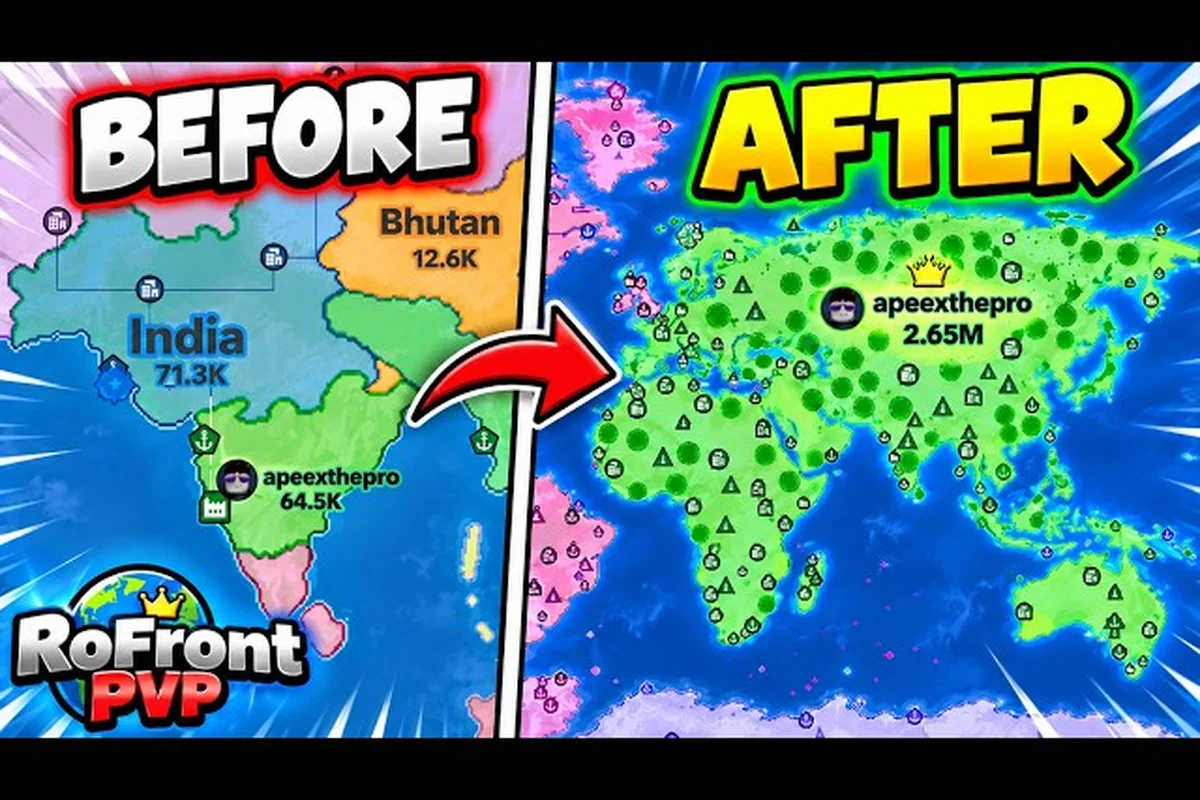
RoWorld alliance mechanics determine how efficiently separate nations can combine research, transport ships, missiles, nuclear weapons, and building queues into one coordinated conquest force. Shared missile and nuke timing can multiply a fleet’s pressure, while transport ships preserve that momentum by moving troops and resources. Buildings should be upgraded around the operation’s needs—such as missile production, ship capacity, or nuclear facilities—so allied members reinforce one another instead of duplicating priorities. A coordinated plan can therefore turn a numerical advantage into synchronized attacks and more reliable territorial expansion.
RoWorld Alliance Mechanics and Shared Objectives
RoWorld is built around territorial expansion, and alliances give players a way to coordinate that expansion instead of competing over every border at once. The official RoWorld page on Roblox describes a world with up to 88 player nations, hundreds of tribes, and a victory condition of controlling 80% of the map. Alliance planning therefore matters on both a small scale and across the full server.
The official page lists cities, ports, factories, alliances, and nuclear weapons among the game’s features. These systems suggest that an alliance is more than a social label: members can divide responsibilities, combine forces, and support a larger territorial objective. Still, the exact bonuses, permissions, and numerical benefits of an alliance are not published, so they should not be presented as confirmed rules.
What an Alliance Can Organize
Players can approach an alliance as a coordinator of roles rather than a single commander issuing identical orders to every member. A useful plan assigns clear goals, keeps communication focused, and leaves room for members to defend their own territory.
| Alliance role | Main responsibility | Best time to act |
|---|---|---|
| Expansion leader | Identify border targets and direct joint claims | When several members can attack nearby tiles |
| Economy coordinator | Balance city, factory, and port construction | During the middle phase of a match |
| Naval transport lead | Move land troops by water | When an ally controls ports and coastal access |
| Defense commander | Monitor threats and reinforce vulnerable borders | After enemy expansion becomes visible |
| Technology planner | Coordinate missile, nuke, and warship readiness | Before a major combined offensive |
Territorial adjacency is the foundation of coordinated expansion. Because territory grows by taking tiles that touch a nation’s border, an attack has a geographic purpose. Allies can cover one another by focusing on a connected front, creating local numerical pressure, and preventing enemy forces from attacking every exposed side simultaneously.
The RoWorld military guide provides useful context for troop roles and attack planning. Within an alliance, however, those same roles become more valuable when each member is assigned a clear mission rather than sending everyone toward the same target without direction.
Shared Objectives Versus Solo Expansion
Before a large operation, an alliance should define a clear objective rather than merely agree to “expand.” A useful plan identifies the target area, the order in which allied territories are secured, and the intended result. For example, a resource-corridor operation can specify that allied transport ships must protect connected cities, ports, and factories before another member commits troops to a pincer movement. This level of detail reduces wasted missile, nuke, and warship deployments, gives commanders a shared priority, and makes success measurable when the alliance captures its named city or region.
| Objective style | Example | Advantage | Main risk |
|---|---|---|---|
| Border consolidation | Connect several allied territories | Creates stronger mutual defense | Can delay pressure on a distant enemy |
| Pincer movement | Pressure two sides of an enemy region | Splits the enemy’s attention | Poor timing can expose allied flanks |
| Resource corridor | Secure connected cities, ports, and factories | Supports sustained operations | Members may overextend individually |
| Defensive shield | Reinforce a threatened member | Prevents a quick collapse | Leaves another frontier open |
| Strategic objective | Capture a named city or region | Creates measurable success | Becomes contentious if priorities differ |
One shared target is usually easier to coordinate than several unrelated goals. Members can agree on who leads, who supports, and what each side avoids doing. This prevents a common alliance failure: everyone contributes resources, but no member is responsible for carrying the operation forward.
Joint Wars and the roWorld Warship Mechanics
The roWorld warship mechanics add a logistical dimension to alliance warfare. Naval units are not merely extra troops on land; they depend on coastal access, transport capacity, and routes that connect friendly territory. A warship plan therefore starts with geography, not with the fleet itself.
Warship Planning Sequence
A reliable joint naval operation follows a simple sequence: secure a friendly port, assemble the necessary ships, move the fleet, protect the landing route, and only then commit troops to a useful objective. The exact unit requirements and travel conditions are not published officially, so the sequence is more dependable than any invented cost or damage calculation.
| Stage | Alliance task | Failure prevented |
|---|---|---|
| Port preparation | Confirm a usable coastal base and defend its approaches | Fleet separation from land support |
| Fleet assembly | Bring ships into a shared operating area | Scattered attacks on different fronts |
| Route planning | Identify safe water and landing points | Exposure to coastal defenses |
| Escort arrangement | Cover transport and vulnerable ships | Loss of the operation’s logistical link |
| Landing coordination | Move troops to a connected target | Fragmented landings and isolated units |
Fleet concentration should be judged by mission, not by a displayed “ideal fleet” value. A smaller force that can protect the transport route and land together may be more useful than several large groups pursuing unrelated targets. That is a strategic principle, not a claim about unpublished unit multipliers.
Player experience in similar large-scale strategy games also suggests leaving a response force behind. An alliance that commits every ship and troop to one assault can lose its home territory while the expedition is underway. Reserve troops should protect cities, ports, and factories because the loss of a logistical asset can disable the offensive plan.
For broader naval context, the naval invasion guide explains how landing operations and defensive threats interact. Alliance coordination improves those operations by assigning separate commanders to transport, escort, landing, and home defense. This division matters because transport ships, escort warships, and landing troops face different failure points: transport ships preserve the logistics link, escort warships shield the route, landing commanders secure the objective, and home-defense troops prevent enemy attacks on cities, ports, and factories. For example, an alliance that sends its fleet away without protecting a coastal base may lose the port before the landing force arrives, turning a successful transport run into a disconnected operation.
Missile and Nuclear Support Roles
The roWorld missile mechanics and roWorld nuke mechanics can change how an alliance approaches a defended objective. The official listing names nuclear weapons as a feature, but it does not publish launch requirements, damage values, cooldowns, or area-of-effect rules. Any guide that states exact nuke or missile numbers without a verifiable source risks sending players into a fight based on fiction.
Assigning High-Value Support
Missiles and nuclear weapons should be treated as support assets with defined triggers, not buttons pressed whenever an ally begins attacking. A strong alliance defines when high-impact support is appropriate, who authorizes it, and what happens if the target is already falling.
| Support option | Best assignment | What the alliance should verify |
|---|---|---|
| Missile support | Pressure a defended border or support a limited push | Available launch points and current interception threats |
| Nuclear support | Target a strategic position that ordinary attacks are not overcoming | The weapon’s current range and activation requirements |
| Combined support | Coordinate naval, land, and support units on one front | Timing so multiple elements arrive together |
| Reserved support | Keep one option for a major defensive collapse | Who can request it and how quickly it can arrive |
Trigger-based support reduces waste. Before committing a nuke, the alliance should ask whether the target is worth disrupting, whether terrain limits the attack, and whether the target can be taken through a safer route. The same restraint applies to missiles: a concentrated salvo is more meaningful when it is synchronized with a land push or a fleet movement.
Community reports and player videos can help players recognize common deployment patterns, but they are not substitutes for current official data. The game may be adapted from the upstream OpenFront project, yet mechanics and values can differ between versions. For that reason, this guide avoids importing OpenFront costs, damage formulas, or unit statistics into RoWorld.
Communication Cues for Coordinated Strikes
An alliance needs a short communication vocabulary before a combined attack. The commander should identify the target, the intended arrival point, the action window, and the fallback condition. Because the game interface may change, the team should also agree on visible markers such as map pings or named zones.
| Cue | Meaning | Commander responsibility |
|---|---|---|
| Primary target | The objective all forces understand | Avoid changing it casually |
| Support window | When support assets should be used | Prevent premature or late activation |
| Fallback point | Where forces regroup if blocked | Keep the alliance from scattering |
| Defense alert | A home threat requiring withdrawal | Identify which member responds |
| Hold order | Stop advancing and preserve positions | Maintain cohesion under pressure |
A fallback point matters because a coordinated assault can still fail. Enemy positions may be stronger than expected, land routes may collapse, or a home-front emergency may require part of the force to return. An alliance that agrees in advance where to regroup can preserve its army and continue the larger campaign.
Transport Ship Planning and Strategic Mobility
The roWorld transport ship mechanics determine how land forces can cross water, but transportation is also a planning problem. The transport fleet, escort fleet, destination port, landing force, and home defense must operate within the same timetable. Treating the transport ship as a separate command from the army often produces isolated units that cannot reinforce one another.
Build a Route Around Mutual Support
A useful transport route connects a friendly coastal base with a landing area that supports the next objective. It should include a safe staging area, an identifiable destination, and a response plan if the route is interrupted. The exact loading limits and travel times are not officially listed, so players should confirm the current interface rather than rely on uncited numerical rules.
| Route element | Role | Common mistake |
|---|---|---|
| Loading port | Receive troops and equipment | Leaving without a protected departure area |
| Naval corridor | Connect departure and destination | Choosing a route away from allied coastal support |
| Landing zone | Place troops where they can advance | Landing near unrelated enemy pressure |
| Escort group | Protect transports during movement | Sending escorts ahead without protecting the route |
| Follow-up force | Reinforce after the first landing | Treating the initial landing as the entire battle |
Synchronized movement is the key principle. The transport group should not race ahead of its escort, and the landing force should not reach the destination before the route is secure. If the alliance splits into several unplanned movements, it loses the strength that made cooperation worthwhile.
Transport also has a strategic cost. While ships and troops are away, fewer forces may be available to defend home cities and factories. A practical alliance should therefore maintain separate expeditionary and defense duties, even if each member only contributes a small reserve. The RoWorld war guide can help connect naval movement with broader front-line planning.
Choose Landing Locations by Purpose
A landing site can serve conquest, reinforcement, access to a strategic city, or creation of a second front, so the alliance should select it by operational purpose rather than distance alone. For example, a transport ship carrying troops to a contested border should land where a land unit can secure a connection quickly, while a supply transport may prioritize a route near an allied city under pressure. The key is to match the landing location to the next objective: a forward landing that exposes transport ships without a viable advance wastes their cargo capacity and leaves the force vulnerable.
| Landing purpose | Desired location | Main advantage |
|---|---|---|
| Direct conquest | Adjacent to the intended border | Shortest connection to the attack |
| Defensive reinforcement | Near an ally under pressure | Restores the front quickly |
| Resource access | Connected to useful production territory | Supports longer operations |
| Diversion | Useful only when a second front is credible | Divides enemy attention |
| Strategic foothold | Near a route that joins other allied territory | Improves future mobility |
Purpose-first landing prevents transports from becoming expensive landmarks. A unit standing offshore without a clear next objective can become vulnerable and consume attention. Before loading, the alliance should state what the landing party will accomplish and how it will receive support.
roWorld Building Mechanics for Alliance Development
The roWorld building mechanics determine the economy that supports long campaigns. Cities, ports, factories, and other structures listed by the official page create the infrastructure needed for expansion, transport, production, and defense. Although no official building prices, income rates, maintenance costs, or construction times are available, the strategic priorities are clear: build what enables the current phase, then expand when the objective changes.
Match Construction to the Alliance Plan
An alliance’s construction program should reflect the kind of operation members intend to conduct. A naval alliance needs coastal and logistical readiness, while a land-focused alliance needs connected territory and border strength. Trying to build everything at once can leave every project incomplete.
| Current goal | Construction priority | Reason |
|---|---|---|
| Secure nearby territory | Cities and border support | Creates a stable base for expansion |
| Protect a member | Factories and local defenses | Restores the ability to produce and respond |
| Launch a fleet | Ports and coastal infrastructure | Supports assembly and transport |
| Sustain a long campaign | Connected city network | Reduces distance from the active front |
| Contest a major region | Mixed support across the alliance | Avoids one-member bottlenecks |
Phase-based construction keeps priorities understandable. Early buildings should support survival and secure claims; later buildings should match the alliance’s chosen theater. A coalition that plans to attack across water, for example, cannot treat ports as a secondary objective when transports are central to the strategy.
Because the official page links RoWorld to OpenFront and contributors while noting modification by Snick, upstream strategies may offer ideas but not guaranteed RoWorld values. Building layouts, costs, and production rules should be tested in the current version. The RoWorld SAM launcher guide provides a closer look at how defensive infrastructure can fit into a broader building order.
Shared Construction Priorities
| Shared priority | Individual build freedom | Main benefit |
|---|---|---|
| Core city network | Moderate | Supports connected territorial growth |
| Strategic port access | Limited | Prevents naval fragmentation |
| Factory resilience | High | Preserves each member’s production |
| Border defense | Moderate | Reduces easy counterattacks |
| Technology support | Member-specific | Keeps support units versatile |
Parallel development is often better than identical development. Every member does not need the same building mix, but every major asset should reinforce the alliance plan. One player may specialize in coastal logistics while another protects the inland production network, provided both understand where the main campaign is headed.
A Complete Alliance Coordination Cycle
Successful alliance play is a cycle rather than a single order. Assess the battlefield, assign roles, prepare the economy, coordinate the movement, and reassess after the operation. This cycle can be applied whether the alliance is expanding a border, defending a city, or launching a naval invasion.
| Phase | Core question | Alliance output |
|---|---|---|
| Assessment | Where can the group create leverage? | Chosen target and protected assets |
| Assignment | Who owns each part of the plan? | Clear roles and fallback points |
| Preparation | Are cities, factories, ports, and troops ready? | Operational support for the campaign |
| Execution | Are movements synchronized? | Concentrated force at the objective |
| Review | What changed after contact? | Adjusted priority for the next phase |
Before the Operation
Before committing troops, alliance leaders should compare the intended target with each member’s obligations. A member near the enemy may need to hold a border, while a member with spare forces can lead. This prevents the alliance from pressuring one person to abandon a critical responsibility simply because everyone has a shared title.
Written objectives are valuable even when communication happens through voice chat. They should identify the target, the order of operations, the support window, and the condition that triggers a retreat. A short plan can prevent two fleets from heading in different directions or an accidental friendly obstruction near a port.
During the Operation
Coordination must remain flexible without becoming chaotic. The commander should watch for changing threats, but routine units should act without waiting for confirmation. For example, defenders can respond to an immediate incursion while the main force continues toward the agreed target.
| Situation | Recommended adjustment |
|---|---|
| Target is lightly defended | Preserve support assets for a later phase |
| Target is heavily defended | Coordinate nearby pressure before committing reserves |
| Allied member is under attack | Redirect only the designated response force |
| Transport route is threatened | Pause the landing and secure the corridor |
| Home front deteriorates | Use the agreed fallback and regroup |
Distributed authority keeps an alliance functional when conditions change quickly. One person should coordinate the main objective, while trusted members handle local defense and contingencies. This is not a published game rule; it is an organizational practice that helps players avoid idle orders and conflicting movements.
After the Operation
Every major operation should end with a short review. Did the alliance capture useful territory? Did transport and support work together? Did the team spend more resources than expected? Were responsibilities clear? The answers should adjust the next cycle, especially the building priorities and division of roles.
A review does not require invented statistics. Track observable events such as captured territory, exposed cities, unused support options, delayed landings, and unclear commands. These details are more reliable than community estimates because they describe what happened in the player’s own match.
Practical Alliance Agreements and Common Failure Points
Strong agreements are short, specific, and easy to apply during a match. They should cover the alliance’s objective, member roles, commitment rules, and how disagreements are settled. Overly formal rules that assume unlimited communication may fail when players must react quickly to a border breach.
A Lightweight Agreement Template
An alliance can agree on six points before its first major campaign: the immediate objective, the lead member, required contributions, support timing, fallback behavior, and the next planning time. This creates coordination without turning every decision into a prolonged vote.
| Agreement point | Clear example |
|---|---|
| Immediate objective | Secure the connected eastern border |
| Lead member | Handles initial target selection |
| Required contributions | Troops, ships, or local defense as assigned |
| Support timing | Missiles and nukes follow the commander’s trigger |
| Fallback behavior | Units regroup at the nearest allied port |
| Review time | Reassess after the operation or major counterattack |
Clear ownership is especially important for support weapons. If multiple members can launch a nuke at once, the result may be wasted or aimed at a conflicting objective. A designated authority can coordinate use without requiring every member to receive permission for ordinary troop movements.
Failure Points to Prevent
| Failure point | Warning sign | Correction |
|---|---|---|
| Unclear target | Members attack different locations | Name one priority and one fallback |
| Overcommitment | Every member leaves home exposed | Keep a response force and protect key cities |
| Split fleet | Ships move in unrelated directions | Assign one route and landing plan |
| Support waste | Weapons used on a weak target | Define meaningful activation triggers |
| Building mismatch | The plan lacks the needed port or defense | Align construction with the next campaign |
| Blame loop | Disagreement consumes the operation | Record decisions and focus on recovery |
Mistakes should trigger adjustment, not paralysis. A failed landing or contested border can still provide useful information about the enemy and the alliance’s readiness. The practical question is how to restore supply lines, recover units, and choose a more workable next step.
The official Roblox group page for Torrey Pines, RoWorld’s official creator group is one of the few verified community channels. Because no standalone official website, Discord, X account, Reddit community, or official YouTube channel was verified during research, balance changes and patch details should be confirmed on the official game page or through direct play rather than attributed to an unofficial channel.
Frequently Asked Questions
What is the main purpose of an alliance in RoWorld?
An alliance helps members coordinate territorial expansion, defense, construction, and attacks. Its practical value comes from assigning roles and choosing shared objectives, although the official page does not publish numerical alliance bonuses. Players should coordinate around borders, resources, and timing rather than assume a hidden multiplier.
Can an alliance launch a nuke and a missile strike together?
The official listing confirms that nuclear weapons exist, but it does not publish missile details, shared launch rules, or exact weapons values. A combined strike may still be organized strategically, yet players must verify current requirements in-game. Assign one support coordinator, choose a meaningful target, and define the trigger before using either option.
How should transport ships support a joint attack?
Transport ships should land troops at a location that advances the shared objective, while escorts protect the route and the destination remains linked to allied support. Because load capacity and travel details are not officially published, confirm them in the current interface. Keep a fallback point in case the route is blocked or the landing becomes trapped.
Should every alliance member build the same structures?
No. Parallel development can make the alliance stronger when members specialize while still supporting the same campaign. Coastal members can emphasize ports, interior members can protect factories and cities, and exposed members can strengthen borders. The key is that each build supports the current alliance objective rather than simply copying another player’s layout.
What is the best way to coordinate a large alliance operation?
Use a shared objective, named roles, clear support triggers, and a fallback location. Keep routine local decisions decentralized so commanders can react quickly, but designate responsibility for the main target, reserve force, naval route, and high-impact support. Review the result afterward and adjust the next building and combat priorities.