
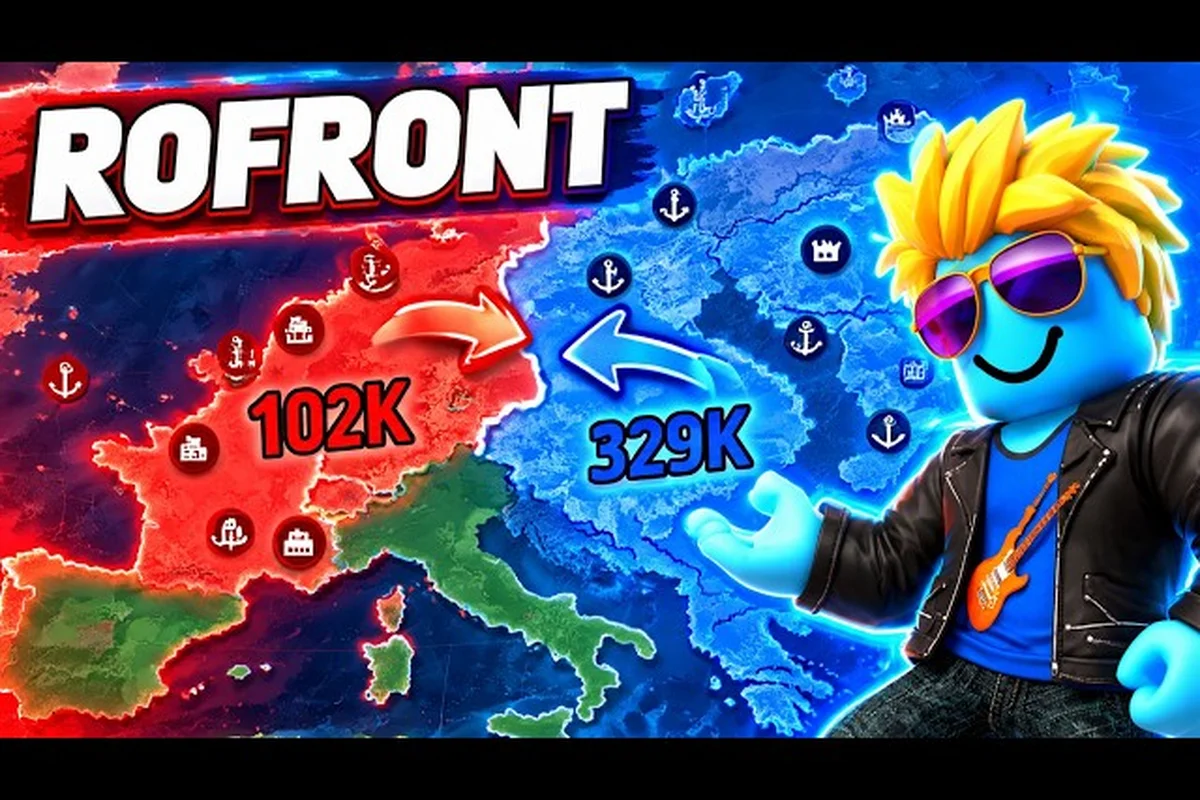
roWorld tribe behavior turns each match into a shifting contest between expansion, capital drops, and elimination. A tribe that expands aggressively may gain more territory and stronger early momentum, but it also risks spreading its capital too thin and becoming vulnerable when rivals counterattack. Capital drops matter because they can restore resources needed to hold ground, while repeated eliminations can trigger the roWorld victory screen before a steady climb develops. Tracking tribe decisions within the roWorld game loop helps players anticipate match length, identify which groups are gaining control, and respond before the final outcome is locked.
В сообществе roWorld поведение племён описано в видео на YouTube.
How roWorld Tribe Behavior Shapes the Match
RoWorld adapts the territory-control structure of OpenFront.io, where nations place a capital, claim nearby land, develop their economy, and confront neighboring players. The official Roblox listing describes servers containing as many as 55 human players, with 88 player nations and hundreds of tribes sharing the map, although not every nation can control territory at once.
That scale creates the central roWorld game loop: establish a capital, gather resources, extend your border, strengthen your position, and then decide whether to negotiate or attack. A tribe can appear successful while its capital remains isolated, but it becomes dangerous when its territory supports further growth and its borders reach vulnerable neighbors.
| Match element | Confirmed scale or rule | Strategic meaning |
|---|---|---|
| Server capacity | Up to 55 players | Many potential threats can develop elsewhere on the map |
| Map factions | 88 player nations plus hundreds of tribes | Competition depends on positioning, not merely individual strength |
| Victory condition | Control 80% of the world | Territory percentage matters more than isolated military wins |
| Territory growth | Capture adjacent land | Expansion is constrained by the current border |
| Capital | Core of a nation's territory | Its safety determines how confidently the nation can expand |
| Elimination | A nation can be removed after defeat | Losing the capital can end a run before the match ends |
The crucial distinction is between map presence and territorial relevance. Hundreds of tribes may exist, but only a faction with a functioning capital and connected land exerts pressure on its neighbors. New players should therefore watch borders, resource infrastructure, and capital stability rather than treating every distant player as an immediate threat.
The official listing also names cities, ports, factories, alliances, and nuclear weapons as features. It does not publish building prices, income rates, troop ratios, or attack percentages, so those details should not be treated as fixed rules. For the broader land-conquest process, the roWorld game mechanics guide explains how territory, economy, and survival interact.
Capital Drops, Expansion, and Border Pressure
A capital drop begins a nation's practical presence on the map. The placement is not merely cosmetic because expansion begins from the land around that capital. A well-connected capital allows a player to reach multiple directions, while a confined placement may force every new claim through the same narrow approach.
Choosing a capital tile with fewer fronts
No official formula defines the ideal capital tile, so position should be evaluated through several qualitative factors. A central location may expose the player to several fronts, while a coastal or corner position can reduce the number of direct approaches. The best option depends on nearby land, the density of active nations, and whether infrastructure can be placed without leaving the core exposed.
| Capital setting | Advantage | Risk | Best use |
|---|---|---|---|
| Open inland position | Several potential expansion routes | Can face attacks from multiple directions | Balanced territorial growth |
| Coastal position | Fewer inland approaches | May have a constrained land corridor | Defensive early development |
| Corner position | A smaller set of obvious borders | Can be boxed in by a stronger neighbor | Holding a stable secondary region |
| Near a cluster of tribes | Early access to weak or abandoned land | Creates immediate pressure and conflict | Opportunistic expansion |
| Near valuable open space | Room to build a connected territory | Requires sustained defense | Economically focused start |
When judging roWorld tribe behavior, watch the first few minutes rather than only the final scoreboard. If a neighboring capital is far away but another tribe is already pushing into nearby tiles, distance alone does not equal safety. An early capital surrounded by playable land may be easier to defend than a distant position that remains vulnerable along one exposed flank.
Expansion as a connected system
Territory grows by taking tiles adjacent to an existing border. That rule makes the connected border more important than an isolated conquest. Capturing a distant region might look impressive, but it can leave gaps, weaken logistical links, and force a player to defend a long front. A compact block is usually easier to protect and gives new buildings a more coherent area in which to operate.
A practical roWorld game loop begins with capital placement, since the capital anchors settlement, border defense, and access to cities, ports, and factories. From there, claims should expand through adjacent tiles rather than jumping to isolated targets; for example, securing a narrow strip between the capital and a productive resource area can shorten troop travel while leaving a defensible connected border. Resource development, income, and infrastructure should keep pace with expansion, because claiming additional tiles before the base can support them increases the cost of defending scattered territory and can expose the capital to counterclaims.
-
Place the capital in a defensible location.
-
Claim enough adjacent land to create a stable starting base.
-
Develop resources and avoid spreading faster than the economy can support.
-
Examine neighboring borders for weak targets or immediate threats.
-
Expand in a direction that reduces competition or improves connection.
-
Defend the capital and core infrastructure before overcommitting.
-
Expand again as income, troops, and infrastructure recover.
This sequence explains why roWorld mechanics have a strong snowball effect. Secure land supports the base, the base supports further claims, and stronger territory creates more options. The effect is not guaranteed because troop costs, income formulas, and combat values are not published, but the structural advantage of connected and developed land is clear.
Capital and border details are covered more directly in roWorld border mechanics, including how cities, ports, and factories fit around the capital. Their placement matters because each type extends the capital’s practical support network differently: cities anchor dense settlement and income, ports widen trade or troop movement, and factories add production value to connected territory. A capital surrounded by a single city may therefore function differently from one linking two cities, a port, and a factory, even when their total tile areas are similar. This comparison is structural rather than numerical, since exact roWorld income formulas, troop costs, and combat values are not published.
Reading Expansion Through the roWorld Game Loop
The roWorld game loop is not a fixed quest list. It is a recurring set of decisions whose pressure changes as the map develops. Early play tends to reward local expansion because players are still finding reliable territory. Mid-match play adds competing borders, while late play makes each capital and remaining land cluster more consequential.
Match phases and decision priorities
| Match phase | Common tribe behavior | Best decision priority |
|---|---|---|
| Opening | Capital placement and first claims | Choose connected land with several viable routes |
| Early development | Small border consolidation | Build a stable economy before distant expansion |
| Mid-match pressure | Contact with nearby nations | Fortify weak borders and identify weak neighbors |
| Expansion phase | Multi-directional growth | Connect new land instead of creating isolated pockets |
| Late contest | Fewer safe neutral spaces | Secure capital, exploit exposed borders, preserve options |
| Endgame | Direct competition for the remaining world | Convert territorial advantage into a majority position |
This phase model describes the shape of play rather than an official timer. The official materials do not provide a fixed roWorld match length, and community videos show that match duration varies with the decisions of players in that server. A quick match can end when one faction expands rapidly, while a cautious server may continue as smaller tribes consolidate and attack one another.
The difference between activity and control
Many players can be active without controlling meaningful land. A distant battle may produce a temporary score change without shifting the match, while a border capture adjacent to your capital can weaken a competitor immediately. This is why the roWorld elimination condition is not equivalent to simply defeating one army.
Elimination happens when a nation loses the ability to continue as an active territorial power, generally through the defeat of its capital and territory. A successful attacker does not necessarily receive every tile at once, but the result can remove an entire faction from the contest. Before a major attack, identify what happens to the capital and whether nearby land remains connected after the defender’s collapse.
The useful question is not “Can I win this fight?” but “What does this fight change?” A battle may damage a rival’s army without altering its capital, territory, or elimination status, or it may force a tribe’s capital and connected land out of the map and remove that faction from the roWorld elimination race. For example, an attacker who wins a border skirmish but leaves the defender’s capital intact has created only a temporary score change; the same attacker may need to threaten the capital, sever territorial connection, and sustain pressure for the roWorld victory screen to change. The strategic target is therefore a lasting change in territorial control, not a single combat report.
-
Remove a threatening neighbor.
-
Open a route into valuable land.
-
Expose the attacker’s capital to retaliation.
-
Consume forces needed for a larger capture.
-
End with a temporary advantage that disappears after the defender rebuilds.
Because no official combat formula is available, players should avoid claiming that one troop ratio guarantees a result. Community reports and player videos are useful for recognizing patterns, but their observations are not published balance rules. The roWorld territory system provides more detail on the relationship between expansion, troops, economy, and combat.
Why Nations Get Eliminated Before the End
RoWorld elimination can be understood as a chain of connected failures rather than one isolated mistake. A capital under pressure often indicates that a nation's border or economy has already weakened. The final collapse may happen suddenly, but the conditions usually developed over several decisions.
Risk chain in a losing nation
| Early warning | What it may signal | Corrective action |
|---|---|---|
| Capital has few adjacent routes | Expansion is being funneled through one front | Reinforce the exposed side or free another border |
| Territory is disconnected | Captures are harder to support | Connect new land before taking more |
| Resources cannot keep pace | The nation is expanding beyond its economy | Pause aggressive claims and stabilize the base |
| Every attack exposes the capital | Offensive actions are not creating safe gains | Avoid attacks that require a long exposed retreat |
| Neighbors expand toward the same corridor | Multiple powers are competing for one route | Secure alternative land earlier |
| Internal attention turns outward too often | Administration and defense suffer | Check capital, border, and infrastructure priorities |
A nation can also be removed because its capital is surrounded or isolated. That means expansion has a defensive dimension: every new border can either support the core or make it easier for enemies to cut it off. The most dangerous moment is often not when an enemy arrives, but when the defender has no safe tile to fall back toward.
Players worried about this failure state can use the roWorld survival guide to organize their priorities. The best response is rarely an immediate counterattack if the base is unstable. Protecting the capital, reconnecting territory, and reducing pressure usually creates more options than chasing a temporary score.
Alliance behavior and temporary cooperation
Alliances are a listed feature, but their exact agreement terms are not published. Treat an alliance as a strategic arrangement rather than a permanent guarantee. One player may value early expansion, while another wants a stable border or time to establish infrastructure. Those priorities can conflict later.
When considering cooperation, focus on observable behavior: track whether an ally’s border movement, expansion, and military timing align with your own needs, especially when one tribe is securing infrastructure and the other is pushing a contested frontier. A temporary alliance is credible when both sides gain territory without exposing their capital to an immediate counterattack; for example, sharing a border can absorb pressure, but only if neither tribe becomes the obvious weak point in the roWorld elimination order.
-
Which border is the ally currently helping defend?
-
Does the ally benefit from my expansion or from my weakness?
-
Are both sides gaining connected territory?
-
Is the agreement creating a shared threat, or only making one target easier to eliminate?
-
What happens if one side loses its capital?
Because roWorld’s exact alliance terms are unpublished, cooperation should be judged from observable tribe behavior rather than labels. A reliable partner coordinates border movement and expansion timing, divides responsibilities, and avoids letting the alliance become a chain reaction in the roWorld elimination order. For example, if one tribe is building infrastructure while another holds a contested frontier, a shared border can absorb pressure without exposing either capital to an immediate counterattack. The arrangement is less dependable when one side treats alliance membership as permission to ignore its own borders, especially after its territory shifts and exposes the partner’s capital.
The roWorld Victory Screen and What It Measures
The official victory condition is control of 80% of the world. This is a territorial objective, not a kill count, troop count, or city count. The roWorld victory screen therefore reflects the result of a map-wide competition in which survival, expansion, and opponent elimination all influence the final share.
| Factor | Direct effect on victory | Common misconception |
|---|---|---|
| Territory control | Directly increases the controlled share | Winning isolated battles guarantees victory |
| Capital survival | Keeps the nation active and its land relevant | A small but safe nation cannot still win |
| Border security | Protects existing land from reversal | Expansion alone is always correct |
| Infrastructure | Supports the ability to maintain and extend territory | Cosmetic buildings decide the match |
| Opponent elimination | Can open land and reduce threats | Eliminating one player guarantees the win |
| Map positioning | Shapes which expansion routes are available | The earliest capital is automatically best |
Because the target is 80%, a leader can still lose if it allows rivals to reclaim territory. Late-match behavior should therefore favor controllable advantage rather than uncontrolled greed. Capturing land adjacent to existing holdings makes it easier to defend, but taking every available tile may leave the capital weak or pull attention toward a distant front.
The roWorld match length is not fixed, and an early victory screen does not mean every match should follow the same route. Some servers produce a decisive outcome because one tribe expands into uncontested space. Others remain competitive because players defend narrow borders and avoid costly attacks. Since community footage reflects player experience rather than a formal rulebook, it is best used to compare decisions, not to promise a guaranteed timer or winner.
Practical Decisions for Every Match
Strong roWorld tribe behavior comes from choosing a stable position, connecting claims, and matching commitments to economic capacity. The following checklist turns the core mechanics into a repeatable routine without pretending that unpublished troop or gold values can be calculated precisely.
Early-match checklist
-
Place the capital where more than one route is available.
-
Check nearby capitals before committing to a broad expansion.
-
Build a compact territory instead of scattering isolated claims.
-
Keep enough resources available to respond to a border breach.
-
Identify which neighbors are expanding toward you and which are isolated.
-
Treat distant activity as information, not an immediate invitation to attack.
Mid-match checklist
-
Compare the shape of your border with each neighbor's.
-
Strengthen the capital's weakest approach.
-
Connect new territory whenever possible.
-
Watch for two powers trying to claim the same corridor.
-
Avoid attacking a well-defended nation when an exposed border is available.
-
Reassess alliances after major territorial changes.
Late-match checklist
-
Protect the capital and the land supporting it.
-
Count actual world control, not recent captures.
-
Eliminate threats that can reverse your lead.
-
Avoid opening a distant front that cannot be supported.
-
Preserve enough territory to absorb one unsuccessful attack.
-
Use the 80% objective to judge the next move, not a vague desire to finish first.
| Player priority | Recommended action | Result to seek |
|---|---|---|
| Under-capitalized | Consolidate nearby land | Stable base and more choices |
| Surrounded by stronger tribes | Seek a reliable border or opening | Lower immediate threat |
| Dominant but overextended | Connect and defend existing holdings | Durable territorial lead |
| Behind in world control | Pressure a vulnerable neighbor | Meaningful share gain |
| Holding a small safe area | Build economy before gambling | Continued relevance |
| Facing elimination | Defend the capital and reconnect land | Survival window |
These priorities also explain why experienced play may look less aggressive than community clips with rapid captures. A compact, secure nation can continue producing choices, while a sprawling nation that loses its capital has little time to recover. The roWorld early, mid, and late-game guide can help translate this routine into phase-specific decisions.
Frequently Asked Questions
Does roWorld have a fixed match length?
No fixed roWorld match length is published on the official game materials. Match duration depends on player decisions, server conditions, and how quickly nations secure or lose territory. A fast expansion can produce an early finish, while defensive play may keep the match active longer.
What causes elimination in roWorld?
RoWorld elimination usually follows the destruction of a nation's territorial position, especially its capital. Weak borders, disconnected land, economic pressure, and attacks that expose the core can contribute. The official materials do not provide a detailed combat or capital-loss formula.
How much world control is needed to win?
The official win condition is control of 80% of the world. The score depends on held territory rather than the number of battles, cities, or units a player owns. A nation must therefore protect its existing share while seeking additional connected land.
Can a small tribe still win a roWorld match?
A small tribe can remain competitive if it develops a stable economy, secures a capital, and expands into valuable or weakly defended territory. Its size does not determine the result, although every conquest against a larger nation may create a stronger opponent in the freed space.
What should a player do after the capital is attacked?
Avoid pursuing a distant counterattack if the capital and core border are unstable. Prioritize evacuation routes, reconnections, and the most threatened border, then reassess when the base is secure. An immediate attack may create an opening for the enemy to finish the elimination.