
Understanding RoWorld border mechanics is essential because every new tile must connect to land you already control, turning expansion into a chain of strategic choices. Learn how capitals, cities, ports, factories, and neighboring territories shape a nation’s next move.
RoWorld Border Mechanics and the Rules of Expansion
RoWorld border mechanics determine where a nation can grow because territory is captured through tiles that touch an existing border rather than appearing anywhere on the map. A capital anchors the starting position, while cities, ports, factories, and neighboring settlements influence how safely that border can be extended.
The official RoWorld game page on Roblox identifies cities, ports, factories, alliances, and nuclear weapons as core features. It also lists 88 player nations, hundreds of tribes, and an 80% world-control victory condition. The exact troop ratios, income rates, building costs, and combat formulas are not published, so border planning should be based on confirmed structure and cautious community observations.
The expansion loop is straightforward: establish a capital, move into adjacent land, protect newly acquired tiles, and extend the frontier when your economy and defenses can support another front. That structure makes roWorld nation mechanics more than a map-control system; they determine where a player can attack, which neighbors become threats, and whether growth accelerates or creates an overextended border.
The Core Expansion Chain
Each step in the expansion chain changes what you can protect and where you can grow next: establishing a capital creates the origin for later claims, adjacent expansion extends one frontier, and supporting structures improve a border’s strategic role before a neighboring tribe tests it. For example, a claim placed near an exposed capital may be easier to defend with fewer supporting structures, whereas a distant city can create a vulnerable outpost that requires additional resources. Because the table’s stages move from claiming to defending and consolidation, border planning should account for both proximity to the capital and the stability of the territory connecting each new holding.
| Expansion stage | Main decision | Border implication |
|---|---|---|
| Place a capital | Choose the initial position | Sets the origin of every future claim |
| Claim adjacent land | Pick a direction under pressure | Extends one frontier |
| Add supporting structures | Support the new border | Improves the position’s strategic role |
| Defend or attack | Protect gains or contest a neighbor | Changes which borders are exposed |
| Consolidate territory | Connect and stabilize holdings | Reduces fragmented expansion risks |
A capital is more than a starting marker. The capital-to-border chain means that territory far from the capital is harder to support, while nearby growth gives you more options when a neighbor attacks. However, the game does not publish a distance-based penalty, so the effect should be understood through map position and available resources rather than an invented formula.
Capital, Tribe, and Nation Roles
RoWorld capital mechanics give the capital a central role in the territorial chain. It provides a starting point and helps determine the shape of nearby claims. RoWorld tribe mechanics describe smaller groups that may operate independently, cooperate with a nation, or occupy territory that becomes strategically relevant to larger players.
The distinction matters when a border meets several actors. A major nation may have several capitals and developed infrastructure, while a smaller tribe can still control a narrow corridor that blocks a convenient expansion path. Alliances can change this pressure dynamically, although the official page does not publish detailed alliance obligations or automatic combat bonuses.
How Border Expansion Connects to Captured Land
Border expansion works through adjacency: an attack can turn a neighboring tile into part of your territory, allowing the frontier to move again. This is the basic rule reflected by community gameplay and RoWorld’s adaptation of the upstream OpenFront.io structure. RoWorld does not publish a universal attack percentage, so no fixed number should be attached to the action.
The important part is the chain of consequences. Capturing a tile creates more border, and that border may contain valuable land, expose a settlement, or place your nation between two competitors. A wide map does not automatically mean a strong position. A narrow corridor may be easier to defend, while a broad area can require more infrastructure and attention.
Three Types of Border Pressure
| Border pressure | What it tests | Practical response |
|---|---|---|
| Adjacent enemy | Whether the frontier can be defended | Reinforce before taking extra land |
| Shared neutral space | Which side reaches it first | Prioritize a clear, connected direction |
| Allied contact | Whether cooperation is reliable | Avoid overextending around the partner |
| Multi-sided exposure | Whether one attack can open another front | Consolidate before expanding again |
| Coastal approach | Whether land and sea routes compete | Coordinate ports with the inland border |
This distinction is central to roWorld border mechanics. A border is not merely a visual line; it is an interface between systems, so capital placement, city defense, factory logistics, port access, and tribal diplomacy must be evaluated as linked pressures. For example, securing a coastal city can strengthen a port-based economy, but it also creates a second defensive interface if enemy fleets can approach; similarly, an allied frontier may reduce one attack vector while making overextension around the partner more costly. The practical response therefore depends on which system the border connects and how that connection changes your capital’s security and strategic reach.
Why New Borders Create New Choices
Every border conquest changes the player’s available moves. After taking a tile, you can continue in the same direction, pivot toward a resource-rich area, meet a new neighbor, or stop and consolidate. The map rarely forces a single “best” route, so expansion becomes a sequence of choices about timing and exposure.
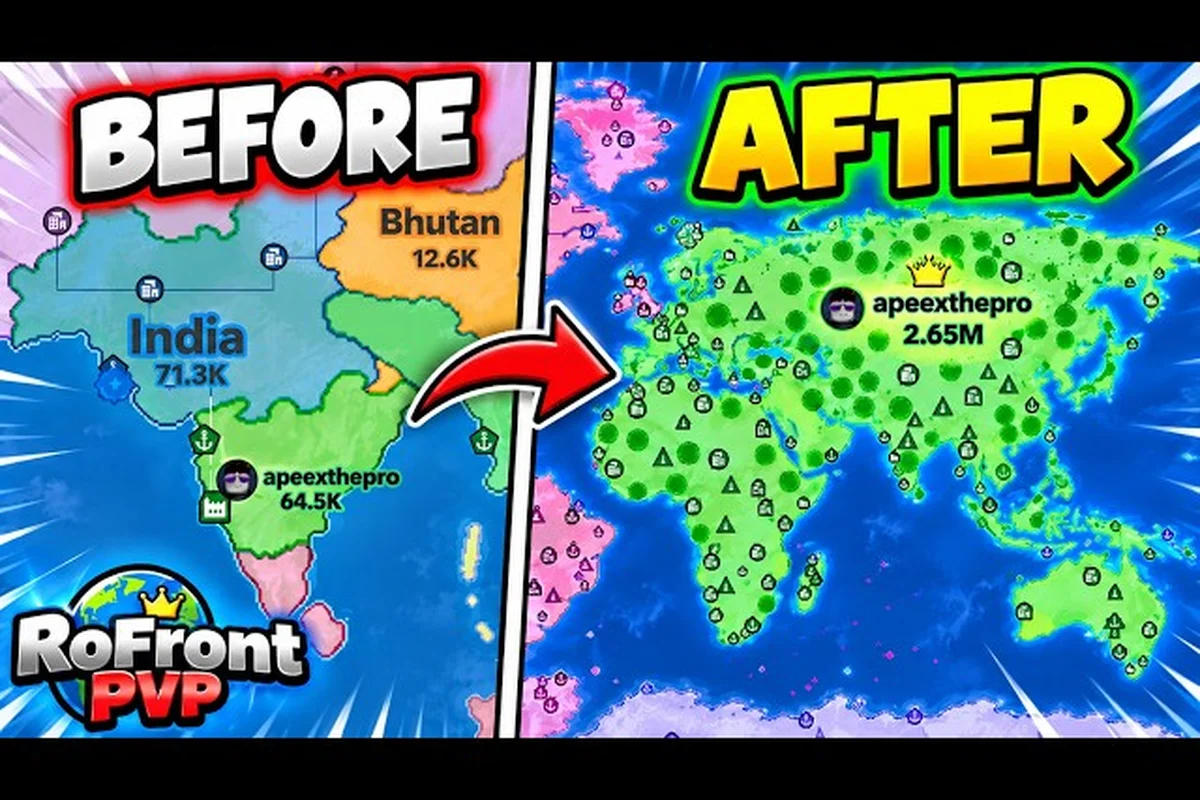
Community videos of RoWorld gameplay show players beginning with small positions, then using connected attacks to claim larger portions of the board. Those recordings are useful as player experience, not as guaranteed outcomes. A match that ends with half the world controlled does not establish a repeatable conquest rate, because opponents, alliances, troop allocation, and border conditions will differ.
Capital Mechanics and the First Frontier
The capital sets the direction of early expansion because the first claims radiate from the area you initially secure. A capital placed near valuable land, defensible terrain, or a coastal route can create several viable options, while a remote start may limit early access to useful infrastructure. RoWorld does not publish a terrain-value chart, so these observations should remain strategic principles rather than fixed bonuses.
Choosing a Capital Position
| Capital position | Early advantage | Early risk |
|---|---|---|
| Near neutral space | Several expansion paths | Multiple fronts can open quickly |
| Near a city network | Existing economic links | Exposure to contested borders |
| Near a port | Access to coastal expansion | Threats may arrive by sea |
| Near another major nation | Potential alliance value | Immediate political pressure |
| In a narrow region | Fewer broad fronts | Expansion space is restricted |
The best location is usually the one that preserves options. Choose a capital that lets you reach open land without making every neighboring claim equally urgent. If a position offers only one safe direction, opponents can block that route and force the entire nation into a defensive war.
RoWorld capital mechanics also affect planning around the entire empire. Later cities and ports may support a distant border, but they do not change the fundamental fact that territory must remain connected through captured tiles. A distant claim without a practical path is not useful expansion, regardless of how large the occupied area appears.
Capital Checklist
-
Pick a starting point with more than one viable expansion direction.
-
Identify neighboring powers before committing to a long expansion chain.
-
Check whether open land, a city route, or a coastal approach offers the safest growth.
-
Keep enough resources available to respond if a neighbor attacks the first claim.
-
Treat capital placement as the foundation of the capital-centered territory chain.
A guide to RoWorld building placement can help you evaluate the structures that support this first frontier, although border direction should be decided before individual buildings are placed. For example, a coastal capital can use a port to protect trade and delay an amphibious approach, while an inland capital may gain more border protection from a factory and nearby city links. Because these structures occupy or shape tiles, placing them before the border is settled can restrict expansion and force the capital-centered territory chain toward a less defensible route.
City, Port, and Factory Mechanics Along the Border
Cities, ports, and factories each support a different part of expansion. RoWorld city mechanics emphasize settled economic positions, while roWorld port mechanics add a coastal dimension to borders. RoWorld factory mechanics support production and strength, helping the nation sustain claims beyond its starting area. None should be treated as a published numerical multiplier.
Building Role by Border Position
| Building role | Best border relationship | Strategic purpose |
|---|---|---|
| City | Connected to a settled inland area | Supports economic development and a stable claim |
| Port | Coastal territory with useful access | Extends influence along a different axis |
| Factory | Near a defended economic center | Supports sustained competition and defense |
| Capital | Origin of the nation’s territorial chain | Provides the foundation for initial expansion |
| Supporting structure | A contested or valuable frontier | Strengthens a position that needs protection |
The key is not to scatter buildings randomly across the map. A city in a remote corner may look impressive, but it does not automatically improve every border it touches. A port is most useful when the coastal route is relevant to the direction you want to expand. A factory should support a region you can defend; otherwise, it may create a valuable target rather than stable growth.
City Borders
A city changes the character of nearby territory. Instead of claiming an empty tile with no purpose, you can build around a settlement that becomes part of your economic network. The exact income and maintenance figures are not published, so the practical test is whether the city supports nearby fronts without draining the resources required to protect them.
RoWorld city mechanics become especially valuable when a border approaches neutral space. A developed city behind the frontier can make the claim more defensible and gives the nation a reason to keep fighting for that direction. Players should still avoid treating population centers as automatic shields; the surrounding land and neighboring forces still matter.
Port Borders
Ports create a distinct border network because water routes can carry influence around or between land threats. This does not mean a port makes the shoreline immune to attack. Instead, it gives expansion another axis, which can be useful when inland movement is blocked or when your capital faces enemies on several land sides.
When comparing coastal and inland expansion, consider reachability, exposure, and the number of directions your nation must defend. A port can extend a nation’s influence across connected shoreline tiles, but each additional coastal frontage increases the number of port and city borders that may need protection. For example, linking a capital to a coastal city may open a second expansion axis while leaving the inland border exposed to direct pressure from a land neighbor, so border security should be measured across both land and sea approaches rather than by tile count alone.
| Expansion route | Reach | Main danger | Best use |
|---|---|---|---|
| Inland border | Nearby connected tiles | Direct pressure from land neighbors | Building a compact settlement network |
| Coastal border | Shoreline progression | Threats along several coastal edges | Linking ports and coastal cities |
| Mixed expansion | Land and sea influence | Coordination demands | Opening a second axis after securing the first |
The official game page confirms that ports and nuclear weapons exist, but it does not provide boat ranges or naval combat values. That uncertainty matters directly to roWorld border mechanics: a port may create a coastal frontier, yet without documented reach or combat values, you cannot assume that a port safely bypasses a land-based neighbor. Treat water access as a strategic option, not a guaranteed shortcut, and compare port mechanics, city mechanics, and the security of your capital mechanics before committing to a shoreline expansion route.
Factory Borders
Factories are best viewed as support for a sustained national effort. A factory near a contested region can make that region part of your long-term plan, but placing it too far ahead exposes your economy before the claim is secure. The most useful factory border is one whose surrounding territory can be supplied and defended.
Before placing one, ask whether the nearby border is stable, whether the route from your capital is secure, and whether the expected payoff justifies the commitment. For deeper production planning, see the RoWorld money guide.
Nation and Tribe Expansion Strategies
A successful nation needs a coherent expansion order rather than a collection of disconnected captures. RoWorld nation mechanics reward keeping a usable chain of land, economy, and defense between the capital and the frontier. RoWorld tribe mechanics become more important when smaller groups occupy the spaces a large nation needs or when alliances offer a temporary alternative to direct conflict.
Expansion Orders Compared
| Expansion order | Best situation | Advantage | Main weakness |
|---|---|---|---|
| Compact first | Crowded or heavily contested map | Easier to defend one frontier | Gives up distant opportunities |
| Economic first | Unclaimed space with useful cities | Builds support before larger claims | Can be slower under pressure |
| Coastal first | Open shoreline and limited land routes | Opens a separate axis | Exposes port territory |
| Opportunistic | Several neighbors with mixed strength | Exploits temporary openings | Risks inconsistent priorities |
| Alliance-led | Partner has complementary territory | Reduces direct frontier pressure | Depends on another player’s behavior |
Community reports suggest that players often choose a starting nation, place a capital, expand into unclaimed land, meet neighbors, build an economy, and then negotiate or fight. That sequence is a useful operational model, although it is an observation rather than an official rule. The most important result is a stable base from which the nation can react instead of being pulled in several directions at once.
Working With or Against Tribes
Smaller tribes can be useful neighbors, neutral buffers, trading partners, or immediate threats. Their position may matter more than their size. A tribe controlling a narrow land bridge can prevent a nation from reaching a larger area, while a coastal tribe can affect planned port routes.
Three broad approaches can shape a nation’s border policy: cooperation, negotiation, and competition. Their viability depends on how a tribe’s city, capital, and port placements affect movement, production, and expansion. A tribe holding a chokepoint can restrict access more efficiently than a larger, distant neighbor, while a coastal position may threaten planned port routes and disrupt the flow of resources between cities. Because border pressure changes as tribes grow, expand, or shift allegiance, each approach should be reassessed against current nation and city positions rather than treated as a permanent alliance.
-
Cooperate when both sides benefit from reduced immediate pressure.
-
Negotiate when border access matters more than full control.
-
Compete when territory is essential to your expansion route.
Do not assume an alliance removes border risk. Neighbors can change, shared borders can compress, and the location of a partner’s territory may still interfere with your preferred direction. The most stable plan assumes that every ally adds opportunities but also requires attention at shared edges.
Defensive Expansion
Sometimes expansion means securing the current frontier rather than taking more land. If several borders are exposed, reinforcing the capital-to-frontier chain is usually wiser than opening another front. A defensive pause does not waste progress because it can prevent an enemy from converting your scattered claims into a breakthrough.
Watch for these warning signs when evaluating a roWorld frontier: a new tile may expand your nation mechanics, but it can also dilute capital mechanics if the supply line becomes too long. For example, claiming a distant city while your capital-to-frontier route crosses empty territory increases vulnerability; a nearby port may be strategically valuable, yet poor defense around it can turn that gain into a breakthrough point. Compare the expected border benefit with the cost of reinforcing the chain before committing your nation’s next expansion.
-
Your newest tile touches multiple opponents.
-
The route back to the capital crosses weak or empty territory.
-
The economy is producing faster than your defenses can support.
-
Your capital lies close to a threatened city or port.
-
An ally’s position leaves an unintended gap in your perimeter.
These signs show why roWorld border mechanics are about timing as much as adjacency: a legal conquest is not automatically a wise conquest. If a new tile touches two opponents, claiming it may increase border pressure faster than it improves capital mechanics, especially when the city or port also strains factory mechanics. For example, taking a nearby port can shorten supply routes and strengthen port mechanics, but only if the capital-to-frontier chain can defend it; otherwise, the gain creates another breakthrough point. Evaluate the combined effect on nation mechanics, tribe mechanics, and supply security before committing to expansion.
A Practical Border Expansion Plan
A reliable plan begins with a capital that has multiple paths, then selects one frontier and develops it before branching. This sequence reduces the chance that a large nation becomes a collection of exposed claims. It also makes the supporting roles of cities, ports, and factories easier to understand.
Early, Mid, and Late Expansion
| Match phase | Border priority | Infrastructure focus | Strategic goal |
|---|---|---|---|
| Opening | Select a safe capital and first direction | Basic support near the capital | Secure the starting area |
| Early growth | Connect nearby claims | Add a useful city or route | Create one dependable frontier |
| Midgame | Strengthen the main front and scout rivals | Add ports or factories where relevant | Support controlled expansion |
| Late game | Close exposed gaps and contest key areas | Reinforce decisive regions | Reach the official victory threshold |
| Endgame | Defend the largest connected territory | Preserve critical capitals and cities | Control 80% of the world |
The official 80% world-control condition means the final phase is not merely about collecting isolated tiles. You need a territory large enough to meet that threshold, and losing the connections or centers supporting it can disrupt the entire plan. A strategically compact empire may therefore be more useful than a larger but disconnected one.
Seven-Step Expansion Routine
-
Survey the capital region. Identify nearby settlements, coastline, open land, and neighboring powers.
-
Choose one primary frontier. Favor a direction your economy can support before pursuing a second.
-
Claim connected tiles. Stay adjacent to controlled ground to preserve a usable territorial chain.
-
Add role-appropriate support. Use cities for settled development, ports for coastal routes, and factories for sustained production.
-
Review the new perimeter. Check whether the capture created additional fronts that need attention.
-
Consolidate before branching. Strengthen the capital-to-border path and protect vulnerable settlements.
-
Expand again with full context. Reassess neighbors, alliances, economy, and available routes before committing.
A Decision Test Before Each Attack
| Question | If the answer is no | If the answer is yes |
|---|---|---|
| Is the target adjacent to controlled land? | Do not make a disconnected claim | Keep the chain intact |
| Can the nation support another front? | Stabilize before expanding | Consider advancing |
| Does the capture create a valuable connection? | Verify the strategic value | Include it in the route |
| Can the position be defended afterward? | Reconsider the timing | Prepare support |
| Does it improve the route to 80% control? | Treat it as optional | Prioritize the claim |
The best expansion decision is not simply the nearest tile. It is the tile that improves your territorial structure without making the rest of the empire impossible to defend. If you need a closer look at the number of structures a nation can develop, the RoWorld buildings overview adds context on cities, ports, and factories.
Common Border Expansion Mistakes
The most common errors come from ignoring geography, overextending, and treating every neighboring group as the same threat. A large map can make these mistakes visible, but the official page does not provide numerical rules for troop limits or income, so players must judge each situation from objectives and board position.
Mistake 1: Expanding in Every Direction
Capturing in every direction looks productive, but it multiplies the borders that opponents can pressure. Use a primary and secondary direction rather than an unrestricted pattern. The main direction can grow steadily, while the secondary remains an option for later development.
Mistake 2: Ignoring the Land Between Tiles
Ownership of a distant tile does not guarantee a secure route if the ground connecting it to the capital is weak or contested. Maintain a continuous territorial chain and inspect every city, tribe, or port corridor between your capital and the frontier, since a single disconnected border segment can expose supply lines to enemy capture. For example, if a city is protected by a nearby tribe but the connecting city is weakly held, enemies can bypass that defense and sever the route. Border strength should therefore be evaluated as a whole chain, not as isolated tile ownership, because roWorld capital mechanics, roWorld nation mechanics, and roWorld city mechanics all depend on uninterrupted territorial access.
Mistake 3: Building Too Far Ahead
A city, port, or factory placed beyond a fragile frontier may expose valuable infrastructure. Place support where it strengthens an existing plan. If a building has no clear connection to the capital, nearby economy, or strategic objective, it may be an expensive decorative expansion.
Mistake 4: Treating Allies as Empty Space
An ally is another political actor, not neutral ground. Shared borders can reduce immediate pressure, but they still shape where you can build, expand, and compete. For example, a neighboring nation may tolerate settlement near your border while blocking expansion toward a valuable city or resource zone, so border access is not the same as unrestricted movement. Review the relationship whenever the border network changes.
Mistake 5: Chasing Territory Without a Victory Path
The 80% control condition requires an eventual route to that threshold. A chain of isolated holdings may look impressive on the map without offering a coherent path to enough connected territory. Review the shape of the whole nation, not only the latest capture.
Mistake 6: Assuming Community Numbers Are Rules
Player videos can reveal common strategies and plausible match situations, but they do not establish official values. A community-reported outcome is a single example, and no recorded video proves a fixed gold formula, troop multiplier, or win rate. Use those reports for ideas while relying on the official game page for confirmed features and conditions.
Frequently Asked Questions
How does territory expand in RoWorld?
RoWorld expands through connected border actions: attacking a tile next to controlled territory can add that area to your nation and move the frontier outward. The official page confirms the game’s territory-control structure but does not publish troop ratios, attack percentages, or a fixed formula. The new tile should therefore be evaluated for adjacency, defense needs, and the path back to your capital.
What is the best capital position for early expansion?
The strongest position usually offers multiple viable directions, access to useful settlements or coastline, and enough defensibility to survive a neighbor’s response. No official terrain-value formula is published, so “best” depends on the current server and other players. Compare nearby land, cities, ports, and potential rivals before committing to a route.
Do cities, ports, and factories affect border expansion?
They support different strategic roles rather than changing a published expansion formula. Cities anchor settled development, ports enable coastal routes, and factories support sustained production. Their value is greatest when they reinforce a connected and defensible region. Placing them too far beyond a weak border can instead make them easier targets.
Should a nation expand through neutral land or attack a neighbor?
Neutral expansion is generally safer when it offers a useful connected route and the opponent is already threatening another front. Attacking a neighbor may be necessary when the neutral route is closed or when their territory blocks a vital corridor. The best choice depends on your economy, current perimeter, allies, and the number of fronts you can support.
How can tribes and alliances affect a nation’s borders?
A tribe can act as a partner, neutral buffer, competitor, or owner of a corridor that blocks expansion. An alliance may reduce immediate pressure, yet it does not remove the need to manage shared land or changing relationships. Evaluate every neighboring actor by position and behavior rather than assuming that every group has the same strength or intent.