
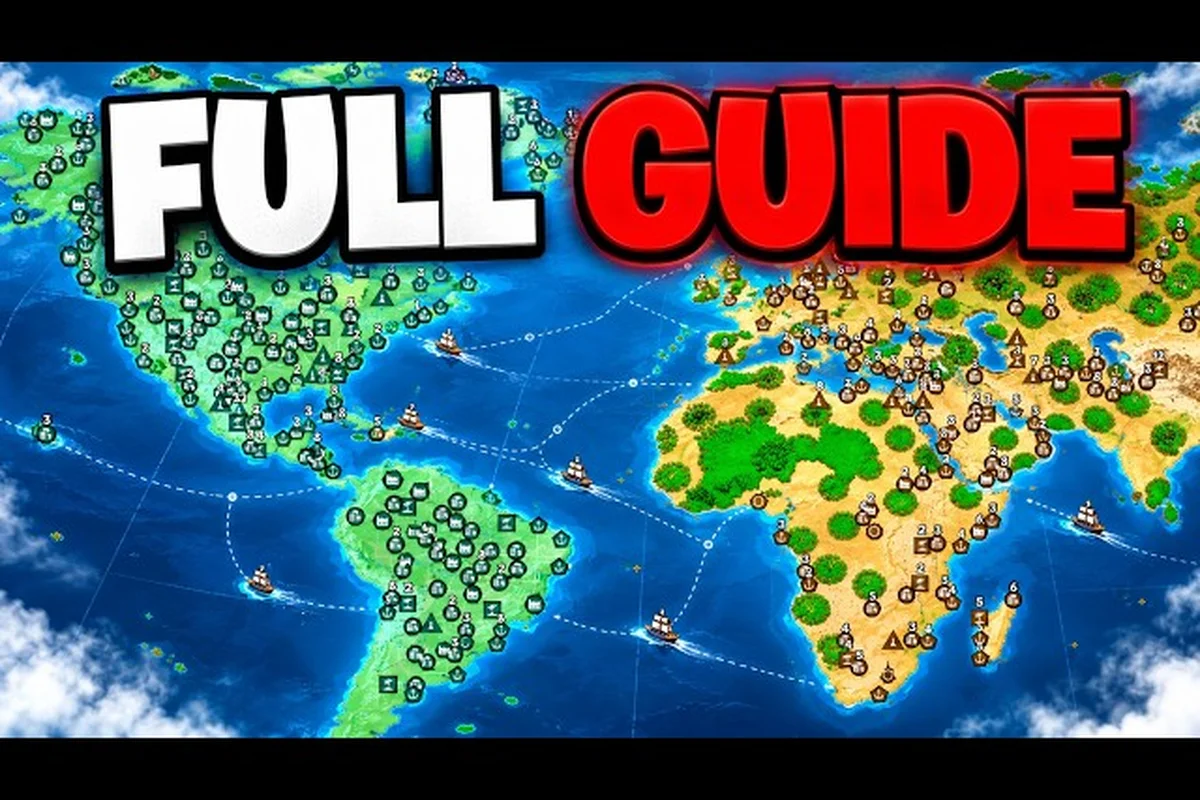
A strong city in RoWorld depends on placement, income, and border control, not just placing buildings. Position factories near resource and factory-automation coverage, while keeping ports within boat range of your trade routes so imported materials can reach production efficiently. Place defensive structures around exposed borders and strategic chokepoints, then balance city funds among factories, ports, and defenses. This guide explains how to build a city, manage factory and port income, and prepare defenses so your nation can expand safely.
The official RoWorld game page describes a world PvP strategy game with cities, ports, factories, alliances, and nuclear weapons. Each server can include up to 55 players, while 88 player nations and hundreds of tribes compete across the map. Controlling 80% of the world is the stated victory condition, so a successful city must support both steady growth and territorial expansion.
RoWorld city foundations: build for income and reach
Understanding the roWorld how to build a city process starts with the capital and nearby territory. Community footage consistently shows players claiming available land early, placing a capital, and then developing a small economic base before taking on a stronger neighbor. The exact placement rules and building prices are not published by the developer, so avoid relying on invented gold costs or income figures. Instead, judge each decision by what it enables.
A useful city has three connected jobs: generate resources, connect your territory, and protect valuable land. A capital anchors the settlement, economy-focused structures improve income, factories support military production, and ports enable naval movement. The best layout gives each structure a clear role without trapping your future expansion in a crowded formation.
Start with the capital and nearby open land
Your capital should be the center of early development, but it should not force every later decision. Claim enough surrounding territory to create room for economic structures and defensive positions. If a neighbor occupies one side, use that border for your strongest defenses while keeping your economic side open toward unclaimed land or safe water.
Community reports emphasize claiming empty land before relations become hostile. That approach creates a buffer, reduces the distance between your capital and production, and gives you options if an alliance offer arrives. It also prevents a common mistake: building an impressive city around the capital while leaving only narrow, exposed corridors to expand.
Match each structure to a city role
The available building count and exact cost formula depend on the current version and may change, according to the official game page. Since numeric values are not published, compare structures by function rather than by an assumed gold total. This table gives a practical planning model for the roWorld how to build a city process.
| City role | Structures to prioritize | Best location | Main benefit |
|---|---|---|---|
| Capital hub | Capital and essential economy buildings | Center of controlled territory | Anchors administration and nearby development |
| Income core | Structures that generate resources | Near the capital but not on the main combat border | Supports steady construction and troop recruitment |
| Production district | Factory and related military structures | Behind protected land or near a factory route | Improves access to military production |
| Trade and transport hub | Port | Coastal access with short, defensible routes | Supports boat movement and maritime expansion |
| Border control | Military structures and defensive positions | Contested edges and valuable approaches | Slows enemy entry and protects nearby income |
For a detailed breakdown of what different cities, ports, and factories contribute, see RoWorld building roles and structure limits. That reference can help you distinguish a production city from a transport hub before committing space to either one.
RoWorld city costs and income priorities
Building costs are the most important missing number for city planning, because RoWorld does not currently publish an official cost table. The interface may reveal a structure’s price when you select it, and those displayed values are the reliable source for the current session. Do not copy figures from OpenFront, the upstream game, because balance changes can make those values inaccurate for RoWorld.
Instead of minimizing every purchase, calculate the practical cost of each option. A port may require more resources than a basic city structure, but it can unlock better boat access. A factory adds military value, yet its location determines whether your troops can reach the front. The key is to spend resources on buildings that remove a current bottleneck.
Compare spending paths without guessing prices
| Spending path | Best when | Advantage | Main trade-off |
|---|---|---|---|
| Expand income first | You lack construction funds or troop support | Creates a stronger resource base | Takes time before the economy is fully developed |
| Build a factory first | Threats are approaching and production matters | Strengthens military capacity | Carries risk if the border is insecure |
| Build a port first | Water access or transport is the main constraint | Improves naval options and regional reach | Consumes space and investment near the coast |
| Build defenses first | A hostile neighbor controls one side | Protects the capital and income structures | May leave the economy underdeveloped |
| Expand territory first | Open land is available nearby | Creates room for future structures | Can expose you to more borders |
A factory is not automatically the best next purchase. The roWorld how to build a factory decision should depend on whether your current economy can recruit and sustain units. If income is unstable, protect the capital, improve resource production, and avoid committing every available reserve to military structures. Once production is dependable, factories can support a more deliberate expansion plan.
Prioritize economic continuity
A city should be able to continue operating after one battle. If all income depends on a border structure, enemies can damage the entire economy by attacking one point. Spread important functions across different land approaches, but do not scatter them so widely that troops take excessive time to respond.
The best early priority order is usually capital stability, then steady income, then a protected production route, followed by border defense and territorial expansion. This order changes when enemies arrive early. If an attack is likely, create a defensive buffer before adding optional buildings. If your capital is secure but the economy is weak, extra defenses may protect income that is too small to matter.
For a phase-by-phase method, compare the priorities in this planning table, using the Opening, Early economy, Midgame, and Late game columns to match each build to its current threat level. For example, establish the capital, income source, and one protected production route first; then add a factory or port only when the city can maintain a second response route. This prevents a single border breach from disabling the entire economy and makes later expansion along the weakest defended front safer.
| Game phase | Main objective | Building priority | Expansion approach |
|---|---|---|---|
| Opening | Establish a defensible base | Capital, income, one protected route | Claim nearby open land |
| Early economy | Create repeatable resources | Balanced city and production access | Secure one border, monitor the other |
| Midgame | Build independent military power | Factory, port if needed, layered defense | Attack one front or negotiate an alliance |
| Late game | Control more of the world | Redundant production and transport | Expand along the weakest defended front |
Factory and port placement for city expansion
A well-planned city separates economic buildings from high-risk military areas. Place factories where your troops can reach them without crossing the capital, and put ports near a coastline that offers movement rather than merely filling an empty tile. The surrounding terrain and nearby border matter more than decorative symmetry.
Plan the factory district
When deciding how to build a factory, begin with access rather than raw count. One factory in a protected production corridor can be more useful than several factories exposed to the same enemy approach. Look for land that has at least two viable routes to the capital or that can be guarded by a smaller defensive screen.
The roWorld how to build a factory layout should account for production-chain balance, reinforcement timing, and the enemy’s likely raid route. For example, pair a factory with its required production-chain facilities inside the protected corridor, but keep workshops and storage in separate clusters so one raid cannot disrupt the entire output. Because land routes and exact coverage values are not fully published, test the layout against multiple enemy approaches before committing to a large factory district.
-
Interior position: Keep the main factory beyond the first layer of contested land.
-
Short reinforcement route: Troops should be able to move to the factory without passing through the capital’s most vulnerable sector.
-
Separate entrances: Avoid placing every production building where one raid can capture them all.
-
Expansion room: Leave nearby land available for additional factories or a future defensive ring.
-
Terrain advantage: Elevated, narrow, or naturally divided approaches can improve defense, although exact coverage values are not published.
Factories should support a plan, not replace one. If your army cannot defend the factory district, adding more factories may simply create a larger target. Start with the smallest production chain that meets the current need, then expand after your capital and border remain stable.
Place ports as transport nodes
A port needs water access, a useful route, and a defensible land connection. Do not build it simply because the map includes water. A port that reaches directly into enemy territory may help them more than you, while one trapped behind your capital adds little strategic value.
A practical port sequence is: first test the water route with a small settlement or scout movement, then secure a coastal district before committing production to docks and ships. For example, placing a factory behind a protected harbor is stronger than placing it across a narrow strait that enemies can cut, because uninterrupted land access lets workers and factories support the port continuously. A good city layout therefore treats the port as a transport node, not an isolated waterfront building, and preserves a defensible road or rail link back to the capital.
-
Identify the body of water that supports your intended movement.
-
Choose a coastline with a short route to controlled land.
-
Protect the land approach between the port and your capital.
-
Confirm that the port can expand into a coastal district rather than becoming an isolated endpoint.
-
Add a second route when your territory reaches multiple coasts.
This is also where learning how to use boats becomes important. Boats are most valuable when they move between controlled ports, support a coastal operation, or threaten an exposed enemy shoreline. They are less valuable when they idle in a crowded harbor or depart without a clear objective.
The roWorld how to use boats strategy is to treat maritime movement as an extension of your land plan. A boat route should have a purpose, such as connecting settlements, flanking an enemy port, supporting an amphibious push, or protecting a coastal structure. Community videos describe the game as a real-time contest similar to Risk with real-time strategy elements, so an operation that lacks coordination can expose the entire coast.
Defending the city and managing borders
A city becomes a target when it controls land others want. The roWorld how to defend approach should therefore combine border control, protected production, and a credible response plan. A wall of structures around every side can be expensive or misleading if it leaves no room for maneuver and no reserve of troops.
The official game page confirms that nuclear weapons are part of RoWorld, but it does not publish launch requirements, damage values, or build costs. Treat the nuke as an extreme strategic option rather than the foundation of early city defense.
Use terrain to slow an advance
Use terrain to create layers. Place outer positions where they can delay an attacker, keep the capital and income core behind them, and maintain enough space for a defensive response. If a border is very long, concentrate strength around meaningful crossings instead of spreading every unit across the whole edge.
| Border condition | Preferred response | Structural priority |
|---|---|---|
| Open plains | Layered positions and clear reinforcement routes | Defensive posts near likely approaches |
| Narrow land corridor | Strong control at the entry point | Silos or military structures behind a buffer |
| Coastal front | Port support and overlapping sea lanes | Port, coastal defense, mobile boats |
| Border with a stronger neighbor | Avoid early expansion and keep reserves | Protected capital and interior production |
| Border with a nearby ally | Shared security without relying entirely on the ally | Independent defense along the core |
Players commonly report that fighting one front at a time is safer than opening a second conflict. That approach protects the economy and troop reserve, which are difficult to replace after losses. For the broader military relationships and alert structures, review border mechanics and capital protection in RoWorld.
Use nukes only as a last resort
Learning how to launch a nuke is useful for understanding the risk created by nuclear weapons, but preparation should focus on conventional defense first. The roWorld how to launch a nuke process depends on the current interface and may require a dedicated military structure, sufficient resources, and an available target. Because the developer has not published a confirmed requirement list, consult the in-game controls rather than relying on community formulas.
Before considering a launch, ask four questions: First, confirm that your city’s income, production, and supply lines can withstand the delay or damage; a blast that consumes resources needed for a factory or defensive boats can worsen the crisis it was meant to solve. Second, verify the target through the current in-game interface, including range, readiness, and required military structure. Third, compare the expected territorial gain with the cost of rebuilding exposed infrastructure. Finally, check whether conventional defense, such as boats, walls, and reserve forces, can achieve the same result without permanently destabilizing your roWorld how to build a city economy.
-
Is the target worth the resource and political cost?
-
Will the blast improve your territorial position, or only destroy a weaker border?
-
Can you protect your own exposed infrastructure afterward?
-
Would a conventional operation produce a more durable gain?
A nuke can punish a neglected border, but it cannot repair weak income, poor city placement, or a front with no reserves. Treat it as a strategic escalation option, not a substitute for a functioning city. For example, if a border raid has already stalled because your factory lacks resource income and your defensive boats cannot reach the target, launching a nuke may only remove the immediate threat while leaving the roWorld how to build a city system exposed. Reserve the blast for a confirmed military target, protect nearby infrastructure, and use boats plus walls to hold the gap while production recovers.
City layout examples for different strategies
There is no single ideal RoWorld city. A land power, coastal empire, and defensive nation need different layouts. The useful comparison is not which design looks largest, but which design matches the threats and expansion routes available to your nation.
Balanced growth layout
A balanced city keeps income near the capital, places a factory farther inland, and establishes defenses only on threatened sides. This arrangement is practical during early expansion, when players can still claim open land and build a dependable resource base without spreading defenses too thin. For example, a capital centered among initial claims can support nearby income structures, while a factory placed behind a defended corridor reduces its exposure to direct raids. This foundation also preserves room for a port, if a useful water route becomes strategically important, without spending resources on irrelevant access.
| Layout zone | Recommended position | Reason |
|---|---|---|
| Capital | Near the middle of initial claims | Keeps administration and defense balanced |
| Income structures | Close to the capital, away from one exposed edge | Protects the resource base |
| Factory | Interior or behind a defended corridor | Reduces the chance of a direct raid |
| Port | Only if a water route is strategically useful | Avoids wasting resources on irrelevant access |
| Defenses | On the likely enemy approach | Concentrates strength where it matters |
Coastal expansion layout
A coastal layout adds a port as a central transport node and uses boat routes to connect separate coastal sectors. It can create valuable options, but it also splits defensive responsibilities between land and water. A player should never build a port before identifying how boats will reach and protect it.
Fortress capital layout
A defensive layout places the capital behind multiple layers, keeps production inland, and uses narrow approaches as natural bottlenecks. This may slow expansion, but it can be correct against an aggressive neighbor. The layout is stronger when combined with alliances or a clear plan for one offensive operation, since passive defense alone does not contribute to the 80% world-control objective.
A practical city-building checklist
A successful build comes from a sequence of checks, not a preset blueprint. Use this checklist after each major purchase or border change. The RoWorld building placement tips can help you evaluate the timing of cities, ports, factories, defense posts, and silos.
Verify the foundation
-
Is the capital surrounded by enough owned land to support expansion?
-
Can you identify at least one safe approach for reinforcements?
-
Does each structure have a specific economic, military, or transport purpose?
-
Are important buildings spread across more than one enemy approach?
Verify the economy and production
-
Is your income stable enough to support the next construction phase?
-
Can you afford troops without draining every reserve?
-
Is the factory accessible without exposing the capital?
-
Does the port open a route that boats can actually use?
Verify defense and expansion
-
Is the strongest border covered by terrain and structures?
-
Do you have a response plan if the enemy attacks a second front?
-
Are you expanding only where you can protect the new territory?
-
Is a nuclear launch truly the best option for the target?
The final rule is simple: build a city that can earn, move, and survive. If each new structure improves one of those functions without creating an obvious weakness, the city is becoming a durable foundation. If it only looks larger, it may actually be easier to raid.
Frequently Asked Questions
What is the best way to build a city in RoWorld?
Start with a secure capital, claim nearby land, and prioritize dependable income before adding optional structures. Place factories along protected interior routes and build a port only when water access supports transport or coastal expansion. Keep a troop reserve for emergencies, and expand when your city can survive a loss on one border.
How much does it cost to build a city in RoWorld?
RoWorld does not publish an official cost table for cities, factories, or ports, and the current interface is the best source for exact prices. Compare structures by function rather than relying on numbers from older guides or the upstream OpenFront game. A practical budget should cover income, a protected production route, and immediate border protection before optional expansion.
Should factories be placed inside the city?
Factories are usually safer along interior routes where troops can reinforce them without passing through the capital’s most exposed sector. Avoid placing every factory beside one border, because a single attack could disable the entire production chain. Leave room for additional military buildings and confirm that the factory supports your current offensive plan.
When should a player build a port in RoWorld?
Build a port when reliable water travel, protected transport, or a coastal attack route becomes necessary. A useful port connects to a meaningful destination and has a defensible land approach to your capital. If the nearest coast leads only to enemy territory and you have no naval plan, save the space and resources for stronger land-based development.
Is launching a nuke the best way to defend a city?
Usually not. Nuclear weapons can punish a serious threat, but they do not replace a layered border, healthy income, or protected production. First improve conventional defenses and consider the consequences of a retaliatory attack. Use a nuke only when its tactical and strategic benefits outweigh the cost and the risk to your own exposed territory.