
Choosing a nation in RoWorld matters because your opening position shapes where you can expand, how safely you can build, and which neighbors you must eventually manage. This roWorld nation list uses confirmed map facts and community observations to compare starting picks without inventing unsupported bonuses.
What the roWorld Nation List Actually Contains
RoWorld does not publish a fixed spreadsheet of country modifiers, win rates, or ranked national statistics. The official RoWorld game page on Roblox confirms the important structure: 88 player nations, hundreds of tribes, and a victory condition based on controlling 80% of the world. Because individual country bonuses are not documented, the roWorld all nations concept is best understood as the available starting countries on each match’s selection screen.
That distinction prevents a common mistake. A list that assigns “S-tier” bonuses to specific countries without an official source would be misleading. Instead, useful nation evaluation depends on starting geography: coastal access, nearby land, capital placement, expansion routes, and the military pressure surrounding the initial tile.
| What players can verify | Confirmed information | What it means for selection |
|---|---|---|
| Player nations | 88 per match | There is room for numerous political factions |
| Tribes | Hundreds are also listed | Some activity may come from smaller groups |
| Server capacity | Up to 55 players | A match may not place every nation at once |
| Victory goal | 80% world control | Early expansion can matter more than one isolated capital |
| Country modifiers | No official per-nation values published | Compare geography, not invented bonuses |
Confirmed facts versus community observations
The official page establishes the scale and objective, while community footage shows the typical opening sequence: choose a country, place a capital, secure nearby land, establish an economy, and then negotiate or fight neighboring factions. Those observed routines are useful for learning the game loop, but they do not establish that every country performs in the same way on every map.
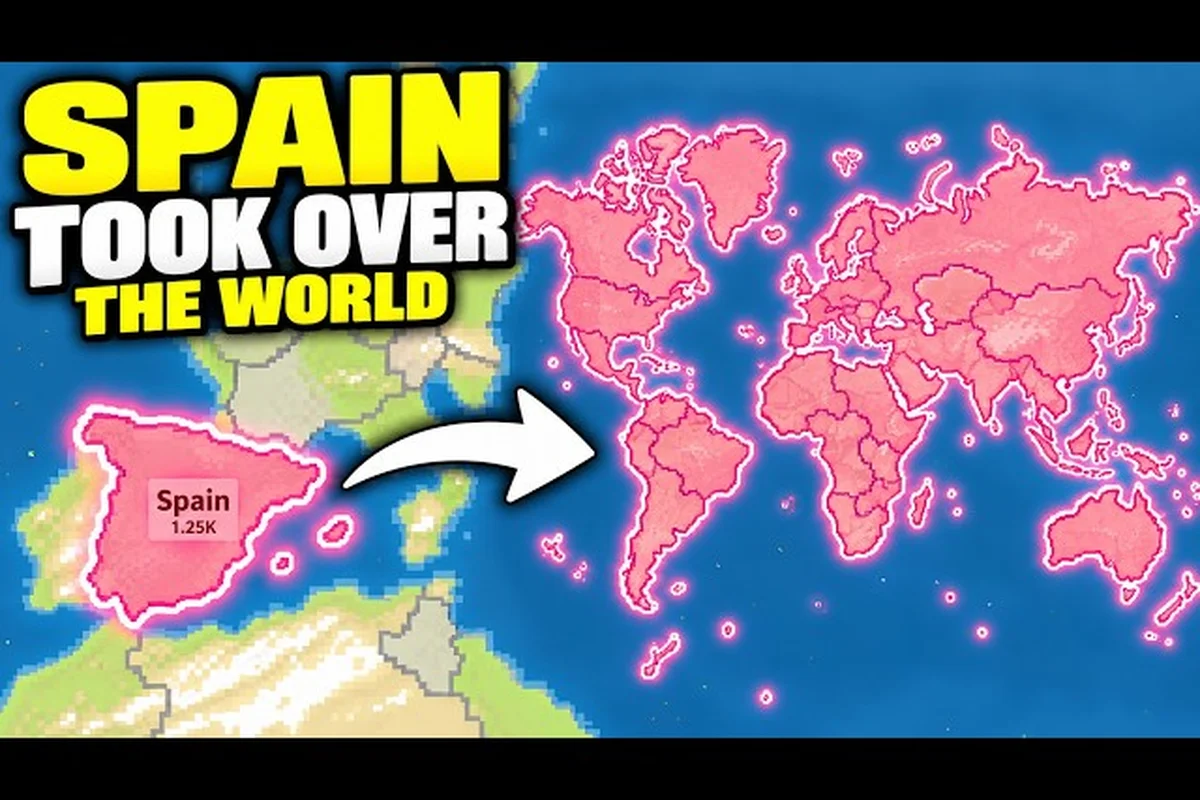
Players have also reported runs beginning in Spain, yet that example is not enough to call Spain the strongest option. A single run cannot account for the surrounding nations, the chosen capital, alliances, or map conditions. The same caution applies to community reports about coastlines, interior starts, and early attacks: they are strategic observations, not official modifiers.
Why map position outweighs a simple ranking
A nation with a large coast may gain access to ports and broader movement options, but it can also face pressure from several directions if neighboring powers are close. A landlocked nation may have fewer approach routes, yet those same borders can slow opponents who lack a nearby starting base. The best choice is therefore the country that fits your preferred style of expansion on the map in front of you.
The RoWorld map guide can help you understand the world layout and recognize where safe expansion space appears. Combine that knowledge with the geographic criteria in this roWorld nation guide rather than searching for a guaranteed “correct” country.
Comparing RoWorld Starting Nations by Geography
There is no published numerical ranking of countries in RoWorld, so the roWorld nation list must compare strategic roles instead of raw power. Coastline, borders, and available space reveal whether a starting nation supports trade, quick expansion, defensive consolidation, or an aggressive opening.
| Starting position | Main advantage | Main risk | Best strategic profile |
|---|---|---|---|
| Coastal nation | Access to sea routes and ports | Exposed to attacks from several directions | Expansion and trade-oriented player |
| Inland nation | Fewer natural approach routes | Can be boxed in by nearby powers | Defensive builder and careful planner |
| Border nation | Immediate access to neighboring territory | Early pressure and limited recovery time | Aggressive early conqueror |
| Central nation | Expansion room in several directions | Many rivals can approach from different angles | Balanced all-rounder |
| Edge nation | Time to build before contact | Fewer routes for later expansion | Economy-first or turtle strategy |
Coastal starting nations
Coastal positions appear attractive because ports are part of RoWorld’s advertised feature set, and water can create another way to move or trade. The advantage is strongest when the selected capital connects to useful open water and nearby islands. A coast that merely faces a crowded landmass may not offer much protection, because enemy cities and factories can still advance over land.
The roWorld how to choose a nation process should therefore ask whether the coastline is open, congested, or effectively a dead end. A player who values expansion can accept more early contact if there are several viable inland routes. A less aggressive player should seek a coastal side with enough room to develop cities and ports without sitting beside the busiest land frontier.
Inland and defensively placed nations
Inland starts are often discussed as safer because enemies cannot arrive directly from the sea. However, safety depends on the number and strength of land neighbors. A central inland position with several adjacent nations can become a pressure cooker, while a less exposed inland region may provide time to establish a dependable economy before contesting nearby land.
Your opening plan matters more than a nation’s label. If the local route to growth passes through crowded territory, the inland position becomes less attractive. If open land lies beyond one manageable border, it can support a controlled expansion. Read the surrounding tiles and capitals as carefully as the country name displayed beside the preview.
Border and central nations
A border position gives you immediate access to another faction, which can be useful when your style involves capturing territory early. The risk is that the neighbor may act before your economy stabilizes. Success depends on selecting a capital with defensible access, understanding the likely approach, and preparing enough support to defend the first expansion without overextending.
Central positions are more flexible because they can support several expansion routes, but flexibility only matters if you can choose which direction to use. A center surrounded by powerful opponents is often more dangerous than an edge position with a clear defensive line. For broader information about expansion priorities, use the RoWorld game mechanics guide to connect territory, economy, and survival decisions.
How to Choose a Nation for Your Preferred Strategy
Your preferred play style should determine what you inspect on the selection screen. A good roWorld nation selection process evaluates the same available facts differently for an economic player, a border raider, and a defensive builder. The nation name itself may carry no published stat bonus, so location must do most of the analytical work.
| Player objective | Nation-selection priority | First expansion target | Risk to manage |
|---|---|---|---|
| Build economy | Uncrowded starting region | Nearby empty land and production sites | Early contact with a large neighbor |
| Expand quickly | Multiple open borders | A manageable neighboring territory | Overextending before stabilization |
| Play defensively | Few exposed approaches | Controlled buffer near the capital | Being surrounded as the map closes |
| Trade or use ports | Reliable coastal access | A defensible port and coastal route | Naval or land pressure at the shore |
| Join a strong alliance | Useful central position | A shared frontier or protected corridor | Becoming a frontline proxy |
For economy-first players
Economy-first players should look for empty nearby land, safe building space, and a capital that does not force an immediate confrontation. A country positioned near several active factions may offer resources and trading partners, but it also risks becoming a battleground. A quieter edge can provide a stronger foundation, provided the player does not wait so long that stronger nations surround the region.
Because exact income rates and building costs are not published, the sound approach is to compare visible opportunities rather than assume a hidden national multiplier. Build the economy that matches your available space, keep routes to your capital secure, and avoid treating an unverified country bonus as part of your plan. For a wider set of opening buildings and priorities, see the RoWorld tier list.
For aggressive expansion players
Aggressive players can benefit from a border nation with a reachable neighbor and several open inland paths. The best target is not simply the closest country; it is a neighbor whose position offers useful land without placing you in a prolonged two-front war. A successful opening creates space, resources, and strategic options instead of producing one scattered cluster of border tiles.
A roWorld best starting nation approach for aggression should still account for defense. If your capital is exposed while the conquered territory lies on the far side of the map, the capture may weaken your position rather than strengthen it. Aim to expand in a direction that keeps your capital connected to the new territory through controlled routes.
For defensive and cooperative players
Defensive players should favor positions with few natural approaches, while cooperative players may prefer central locations that can support an alliance. The official game page lists alliances among the available features, so shared borders and coordinated defense can be legitimate strategic resources. The RoWorld alliance tier list can help frame the value of communication and dependable partners.
A defensive strategy still needs an active economy. Waiting behind borders without producing sufficient resources can leave your capital isolated when stronger neighbors eventually arrive. Build a secure core first, secure nearby land, and use diplomacy when cooperation offers a safer route to the 80% control objective.
What Makes the Best Starting Nation?
The best starting nation is the one that gives you enough room to execute your plan against the specific opponents on the server. There is no official evidence for a universal country tier, and community videos do not establish statistically reliable national win rates. Any claim that one nation always wins should therefore be treated as opinion rather than fact.
| Evaluation question | Strong starting signal | Warning sign |
|---|---|---|
| Can I settle nearby space? | Open land with more than one approach | The capital is surrounded by active nations |
| Can I defend the capital? | Limited approaches or useful natural barriers | Several immediate attack directions |
| Can I support growth? | Room for cities, ports, factories, or trade | Expansion routes lead through crowded territory |
| Can I recover from mistakes? | Access to alternative borders | One mistake exposes the entire economy |
| Does it fit my skill? | Geography supports a practiced style | The player must master a completely different battle rhythm |
A practical selection checklist
Before locking in, inspect the map for at least one stable economic area, one defensible approach, and one expansion route. A good position should not depend on a single lucky fight. If your only viable land lies through the strongest visible neighbor, the starting nation carries too much risk even if it looks attractive in isolation.
This roWorld starting nation checklist also helps distinguish an aggressive pick from a dependable one. If your capital can expand in several directions, you retain more options later. If it has only one route, every lost tile can threaten the entire strategy. A balanced position is often more forgiving because you can choose when and where to engage.
When a famous or familiar country is the wrong choice
Choosing a recognizable country can feel safer, but name recognition has no confirmed mechanical value in RoWorld. Spain may appear in community runs, yet that does not make it the optimal pick on every board. The same logic applies to any country someone labels “strong,” “easy,” or “OP”: those labels usually come from personal preference or a single match.
Instead, compare the territory around the selected country. If a familiar country occupies a better location, choose it. If another country offers safer borders, more space, and a stronger economy route, take that option. The goal is not to display a particular flag; it is to survive long enough to convert your initial position into a large, connected nation.
Strategic Picks for Different Match Conditions
Map conditions can reverse a nation’s apparent value. A crowded center may be excellent when alliances contain the strongest neighbors, yet dangerous when several independent powers surround it. A coastal edge can dominate if ports are plentiful, but a large land power nearby may make that shore dangerous. The roWorld nation list is therefore a set of matchup-dependent profiles, not a universal ranking.
When the map is crowded
On a crowded map, prioritize a legal, manageable neighboring territory over the most exposed one. A nation with a narrow border and limited open land may need to expand quickly, while a nation tucked behind other powers can build safely. Diplomacy can buy time, but a strong alliance should not be treated as a permanent shield because every faction has its own goals.
Crowded conditions reward a clear decision order: establish the core economy, identify the weakest viable border, secure an adjacent buffer, and avoid simultaneous expansion. A player with several strong neighbors should avoid relying on a single alliance partner, because coordinated defense becomes harder when each ally is defending another front.
When the map is open
Open maps create more expansion options, which can make a central or border position attractive. The danger is that distant territory can become strategically disconnected. A large arc of controlled tiles is not automatically stronger than a compact block because your armies and economy may need to move through a long supply path.
When space is abundant, choose a starting nation with a broad expansion front but a capital that can be defended. Expand in layers, keeping the first new territory close enough to support the original core. This prevents an early conquest from turning into a distant outpost that cannot help when the home capital is threatened.
When ports dominate the match
A coastal nation becomes especially valuable when sea routes connect separate parts of the world. Ports can accelerate trade, movement, or strategic projection, although the exact benefits depend on the live match and RoWorld does not publish fixed numerical values for them. A coastal start with a deep harbor and open water is therefore more useful than a narrow shoreline.
Balance maritime access with land security. A strong port is valuable only if your capital and industrial base remain secure while you use it. Players who rely heavily on coastal access should also understand the available abstract map and how its broader layout can affect movement and territorial pressure.
Applying Nation Choice to the Full Match Plan
A starting nation is the opening move in a longer campaign toward 80% world control. The right choice creates options; it does not win the match by itself. Successful players treat nation selection as the first part of a sequence covering territory, economy, diplomacy, and war.
From capital placement to regional control
Place the capital where it supports a practical regional plan. It should be close enough to useful growth areas to develop, but not so exposed that every expansion is instantly contestable. After placement, secure the surrounding territory, establish production, and identify the next border that can be reached without passing through multiple hostile nations.
This sequence reflects what community videos commonly show: the opening is not only a flag selection, because capital placement and early expansion determine whether the nation can become a regional power. The roWorld all nations available on the selection screen become strategically distinct only after you account for the land, sea, and opponents around them.
Build a plan beyond the first border
Once one region is secure, decide whether the next objective is coastal access, a shared border with an ally, a strategically useful city, or control of an interior corridor. The best route is one that strengthens the whole nation rather than creating another disconnected front. This prevents a nation from becoming large on paper but weak in practice.
| Match phase | Primary objective | Nation-level priority |
|---|---|---|
| Opening | Establish a safe core | Secure nearby land and basic production |
| Early growth | Gain useful territory | Choose a border with manageable pressure |
| Mid-match | Build regional strength | Connect expansion and reinforce key routes |
| Late match | Contest major powers | Protect the core while taking strategic land |
| Victory push | Reach 80% control | Prioritize coherent, connected territory |
Adjust when the match changes
Your initial nation may be the right choice, but the match is dynamic. A weak neighbor can collapse, an ally can become distracted, and a peaceful border can turn hostile. Review your situation after securing the basics, then update the plan without abandoning the core unnecessarily. Adaptation includes switching from defense to aggression when the surrounding pressure eases, or consolidating when too many fronts open at once.
The most important distinction is between a starting mistake and a temporary setback. If the capital position limits growth, changing plans early may be sensible. If a strong opponent simply attacked a well-positioned nation, abandoning the core could waste the advantage of your original selection. Judge the position rather than reacting to one event.
Common Mistakes in RoWorld Nation Selection
Most nation-selection errors come from focusing on labels, distant targets, or combat power instead of immediate geography. A player may choose a country because another player called it the strongest, ignore nearby threats, or expand too far before establishing a stable base. These mistakes are avoidable once selection is treated as a systems decision.
Ranking countries without verified modifiers
The roWorld nation list contains no official country ranking, damage bonus, income multiplier, or troop advantage table. A guide that assigns precise values without a source should not be trusted. Even qualitative labels such as “S-tier” can mislead when a nation’s value changes with the capital tile and nearby factions.
Use official information for fixed facts, such as the number of player nations and the victory condition. Use community reports only for observed tactics, clearly acknowledging that they may vary. This distinction keeps tactical advice useful without presenting opinion as a developer-confirmed rule.
Ignoring the first opponent
The closest active nation deserves attention before any distant power. It may be weak, but its attacks can disrupt your capital and economy before you are ready. Choose a target based on pressure, path difficulty, and strategic benefit rather than the nationality shown on the map.
Expanding too thin
Capturing a scattered series of distant territories can create an impressive map but a fragile network. A connected block is easier to defend, support, and use. A border grab far from the capital may also pull attention away from the route that connects your original territory to the front.
Forgetting economy before combat
A successful conquest does not help if your cities lack the support needed to sustain expansion. Establish production and secure resources before committing to large offensives. The best starting nation is not the one that wins the first battle; it is the one that can recover, reinforce, and continue fighting after the initial clash.
Frequently Asked Questions
Does RoWorld have an official tier list for every nation?
No official per-nation tier list has been published. The game page confirms 88 player nations and the 80% control objective, but it does not provide country-specific bonuses, win rates, or ranked statistics. Players should compare each starting position through its coastline, borders, available land, capital location, and neighboring factions.
Which country is the strongest starting nation in RoWorld?
There is no verified country that is always strongest. The best choice depends on the live map, the capital position, and nearby powers. An experienced player may prefer a coastal start in one match and a protected inland start in another, so territorial flexibility and early safety are more reliable indicators than the country name.
Should beginners choose a coastal or inland nation?
Beginners generally benefit from a position with manageable neighbors and room to build. A coastline can provide ports and movement options, while an inland region may offer more protection from maritime approaches. Neither is automatically easier, so check whether the capital has open land, defensible approaches, and a safe economic area nearby.
Can the starting nation change during a match?
The official materials reviewed for this guide do not establish a confirmed mechanic for changing the selected starting nation. Players begin with the country they choose, then make decisions through capital placement, expansion, diplomacy, and war. Treat any claim about a specific reassignment feature as unverified unless it appears on the official game page.
Is Spain the best starting nation in RoWorld?
Community footage includes runs beginning in Spain, but one or several recorded runs do not prove a universal advantage. Spain is best when its position on the current map offers safe borders, useful expansion space, and favorable access. The same geographic checks should be applied to every country rather than treating recorded footage as a statistical ranking.
Choosing well in the roWorld nation list means finding geographic conditions that support your strategy: room to grow, defensible approaches, and a capital connected to useful territory. Confirm official facts on the game page, treat community tactics as observations, and select the country that makes your next few decisions more flexible than those of nearby rivals.