
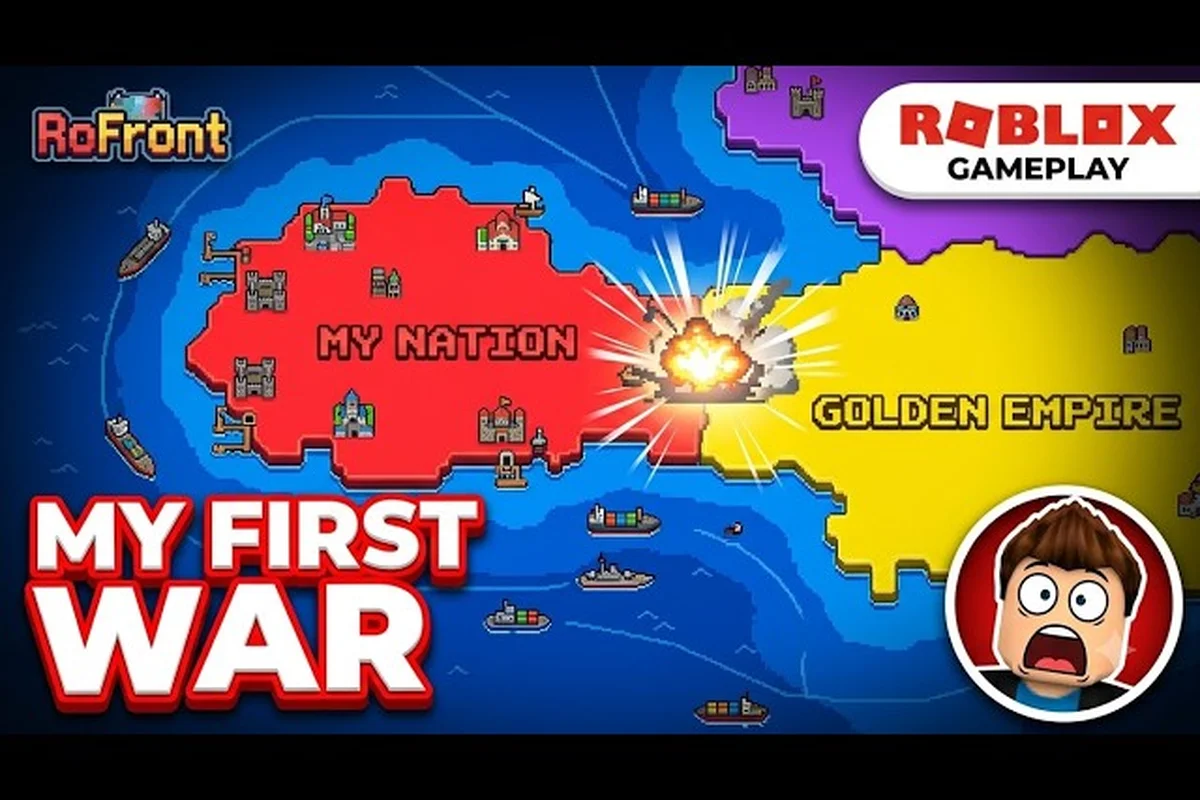
The roWorld worst nation picks can punish a slow opening, but the real issue is choosing without considering borders, coastlines, and expansion. Compare stronger alternatives to start safely, whether you play alone, lead a team, or want the roWorld best nation for beginners.
RoWorld Worst Nation: What Makes a Weak Opening?
Calling one nation the roWorld worst nation is misleading because RoWorld uses many player nations, tribes, and names, and their practical performance changes with the map position. A nation that feels weak in one server may be safer than a supposedly elite pick when its capital is boxed in by stronger neighbors. The useful question is not which country always loses, but which opening creates the fewest viable plans.
The official RoWorld page on Roblox lists 88 player nations plus hundreds of tribes, with servers supporting as many as 55 players. It also identifies cities, ports, factories, alliances, and nuclear weapons as core features, while the match objective is control of 80% of the world. Those facts make opening position more important than a permanent nation ranking because crowded servers can leave very little safe land.
| Weak-opening sign | Why it hurts | Better response |
|---|---|---|
| Capital has no practical expansion route | Neighbors can contain the first stages of growth | Select a nation with several viable inland paths |
| Coastline is exposed from several directions | Ports may invite pressure from multiple nearby nations | Favor protected coast or an inland position |
| The nation looks strong but starts isolated | It may be unable to support nearby allies | Favor a position connected to active regions |
| Early strategy requires one exact opening | A blocked plan leaves no backup | Choose a nation with several building priorities |
| Nearby land is all high-risk | Expansion creates repeated conflicts | Compare borders before committing |
This framework identifies strategic archetypes rather than measured statistics. RoWorld does not publish official win rates, attack multipliers, income values, or building costs, so no responsible tier list can invent a universal power score for every nation. Player experience and community reports can still reveal recurring patterns, but those observations should guide questions rather than function as hard balance facts.
The Real Weakness: Few Recovery Paths
A weak opening is not necessarily one that starts with fewer buildings or a visually small territory. Its deeper problem is a lack of flexibility. If all realistic development requires claiming one narrow direction, nearby players can block that route before the economy becomes stable. A stronger opening creates several possible paths: inland expansion, coastal ports, secure borders, nearby allies, or a defensive pause while infrastructure develops.
The RoWorld nation selection guide is useful for reviewing the available roster, but selection should happen after considering your server conditions. Compare the capital’s open borders, the number of reachable unclaimed areas, and whether the surrounding region has a mix of peaceful, active, and distant players. Those structural checks are more dependable than a labeled tier.
Weakest Nation Picks: Border, Coast, and Context
The roWorld weakest nation conclusion depends on the type of problem you want to avoid. A cramped inland position can be more dangerous than a large coastal country, while an exposed coastal capital may be easier to pressure than a compact position with secure neighboring alliances. Instead of ranking decorative countries, consider three failure types: border confinement, coastal exposure, and single-path dependence.
| Nation profile | Main weakness | Suitable player | Better option to seek |
|---|---|---|---|
| Boxed-in inland nation | Expansion is limited by nearby borders | None for a first match | Nation with multiple land routes |
| Open inland nation | Fewer port and naval options | Solo player focused on land | Flexible coast with protected access |
| Exposed coastal nation | Ports and coast can attract pressure | Experienced coordinator | Shorter or protected coast |
| Wide coastal nation | Split attention across many directions | Large coordinated team | Compact coastal position |
| Isolated power spot | Hard to support and difficult to reinforce | Patient builder | Central position near trade routes |
| Central connector | Can be pressured from several sides | Skilled diplomat | Semi-peripheral position with choices |
Community gameplay reports generally describe a common loop: select a nation, place a capital, expand into unclaimed land, encounter neighbors, build the economy, and then negotiate or fight. That sequence supports a simple conclusion: a nation with more reasonable borders usually offers more ways to continue. It does not prove that any one named country is always the worst.
Why the Same Nation Can Flip Tiers
A nation that feels weak in a crowded lobby may be strong in a quieter server because the player can expand before aggressive neighbors arrive. Conversely, a popular coastal pick may seem excellent in an empty match but become a liability when several large nations surround the same ports. Server population, neighboring activity, and the path of the match can all reverse a preliminary assessment.
The RoWorld map tactics overview adds the missing context. Border count, coastline exposure, chokepoints, and distances between capitals should be checked before a nation is treated as high tier. A land position with several exits is usually more resilient than one whose only expansion route passes through a heavily occupied region. This is a structural advantage, not an official balance statistic.
Stronger Alternatives for Beginners and Solo Play
Finding the roWorld best nation for beginners means prioritizing a forgiving opening rather than an elaborate strategy. The strongest option for a new player usually offers room to make early mistakes, access to useful infrastructure, and several paths for growth. A visually impressive country can still be poor for a beginner when its capital is surrounded or its identity requires a long setup.
Beginner-friendly profiles generally share three qualities: multiple land exits, at least one defensible border, and enough space to establish a functioning economy. These qualities do not guarantee victory. They do, however, reduce the number of immediate decisions that can end the run before you learn the core loop.
| Player situation | Prioritize | Avoid | Practical reason |
|---|---|---|---|
| New player | Several open borders | Tight capital encirclement | More time to learn expansion and defense |
| Solo player | Manageable territory | A position demanding constant diplomacy | Easier to monitor many fronts |
| Builder | Stable inland routes | A coast that requires constant defense | Lets attention stay on economy |
| Aggressive player | Expansion flexibility | A single obvious attack lane | Creates more tactical options |
| Team captain | Connected central location | An isolated start | Easier to support clustered allies |
The roWorld best nation for solo play is therefore less about raw size and more about attention load. A sprawling country can be harder for one player to defend because every border becomes another obligation. A compact but stable position can be more effective when the solo player must gather resources, build infrastructure, and monitor diplomacy without another commander handling half the map.
Choosing by Your Earliest Objective
State your first major objective before selecting a nation. If it is rapid expansion, prioritize open land and a capital with multiple routes. If it is economic development, look for stable borders and room for factories. If it is coastal influence, choose a coast that is useful without being exposed from every direction. If it is endurance, center your evaluation on defense and safe construction rather than quick territorial gains.
The RoWorld best nation for defense analysis explains why protected borders, secure capitals, and accessible building locations should outweigh decorative labels. Those principles also help beginners: a defensive opening buys time, and time is the resource new players need to learn how troops, alliances, ports, and factories work together.
Best Nation Picks for Team Coordination
The roWorld best nation for teams depends on coordination style, not only territory. Large teams can benefit from a central position, a long coastline for multiple naval roles, or a land bridge between allies. However, a team that spreads its members across distant regions can turn a good location into a coordination problem. The best pick is the one that fits the group’s communication and reinforcement patterns.
| Team pattern | Preferred opening | Main benefit | Main risk |
|---|---|---|---|
| Highly coordinated group | Central land position | Shorter reinforcement routes | Can be surrounded from several sides |
| Separate regional cells | Connector position | Links allied groups | Overextension between cells |
| Naval-focused team | Protected coastal base | Access to ports and sea routes | Exposed supply lines |
| Land-pressure team | Broad inland borders | Multiple attack directions | Defense may become thin |
| Builder-led group | Stable interior base | Time to develop infrastructure | Less access to early ports |
For an experienced team, reinforcement distance may be the decisive factor. A central capital can shorten travel between members, but only if the group can hold several nearby approaches. A coastal team should also consider whether its port location supports its members or creates a predictable target. These decisions are more actionable than assuming the roWorld strongest nation will fit every coordinated group.
A Practical Team Selection Test
Before committing, draw an imaginary connection between the capital and each likely teammate area. Ask whether your group can reach the first expansion zone, defend a shared border, or support a port without abandoning another front. If every plan requires crossing unrelated nations, the position may produce more friction than opportunity. A central opening works best when the team is truly centralized; otherwise, a compact, protected base can be more useful.
Team evaluation should also separate production from combat. Ports, factories, cities, and land space support different plans, but the official page does not publish their costs or output values. Do not assume that a large coastal nation automatically has a stronger economy. Instead, compare buildable locations, defensibility, and the number of fronts your members can manage. That keeps the analysis grounded in the mechanics players can actually observe.
How to Avoid the roWorld Worst Nation Trap
Avoiding the roWorld worst nation trap requires a repeatable pre-match routine. Spend the opening moments comparing nations rather than committing to the first option that looks impressive. Check the neighboring land, identify likely neighbors, locate the nearest usable coast, and picture where your capital would be after several expansion waves. The best choice preserves options when plans change.
| Order | Check | What to look for | Decision impact |
|---|---|---|---|
| First | Capital neighborhood | Open directions and nearby pressure | Reveals immediate containment risk |
| Second | Expansion routes | Several unclaimed paths | Creates a backup if one closes |
| Third | Coast access | Useful position versus exposed position | Supports port and naval planning |
| Fourth | Team spacing | Reachable allied territory | Improves coordination and reinforcement |
| Fifth | Buildable space | Room around critical structures | Supports economic development |
| Sixth | Negotiation value | Avoiding a completely isolated position | Preserves diplomatic flexibility |
A map scan should be quick but specific. The official listing says that cities, ports, factories, alliances, and nuclear weapons are all present, and that 80% world control determines victory. That means a map corner may offer space while providing little relevance, while a central position may expose a developing team but shorten its path toward broader control. Neither extreme is automatically correct.
The RoWorld tier list framework should be read as an archetype ranking rather than a measured table. It is useful for comparing border safety, expansion room, and water access together. Avoid ranking nations by one isolated feature, such as coast size or starting territory, because another opening can compensate for that weakness.
Final Ranking by Player Need
The best conclusion is a conditional one. For beginners, the roWorld worst nation is any choice that offers too few borders, an exposed coast, or a single expansion path. For solo players, a compact position with manageable fronts is safer than a huge nation requiring constant defense. For teams, the best pick depends on how closely members are organized and whether their capital can connect their operating zones.
| Player need | Best search target | Avoid | Result |
|---|---|---|---|
| Beginner | Wide border access and simple expansion | Encircled capitals | More forgiving learning curve |
| Solo player | Compact territory with stable borders | Several distant fronts | Easier resource and defense management |
| Team leader | Connected or central position | Isolated capital | Better reinforcement and coordination |
| Builder | Stable interior and buildable land | Constant coastal threats | More time for infrastructure |
| Naval strategist | Protected and useful coast | Coast exposed on every side | Safer port planning |
| Aggressive player | Multiple attack routes | One predictable expansion lane | Greater tactical flexibility |
The roWorld strongest nation is not a fixed nation name in this framework. It is the opening with the strongest combination of safe border access, expansion options, water usefulness, and coordination fit. If two choices look similar, favor the one whose capital has more ways to support the next phase of the match.
Community reports are useful for spotting recurring nation-selection habits, but they do not create an official balance list. Always confirm the current experience on the official RoWorld game page and the official creator group on Roblox, because balance details and map conditions can change without notice.
Frequently Asked Questions
What is the roWorld worst nation?
The roWorld worst nation depends on map position, neighboring players, and team coordination. A capital with one expansion route, several exposed borders, or no safe coastline is a weaker opening than a flexible one, but RoWorld does not publish official win rates that support a permanent country ranking.
Which nation is the roWorld weakest nation for beginners?
Beginners should avoid nations whose territory is boxed in or whose useful development depends on a narrow attack lane. The better choice offers several expansion paths, stable borders, and enough time to learn the economy. A complete roster overview appears in the RoWorld nation list.
What makes the roWorld best nation for solo play useful?
A strong solo opening limits the number of fronts that need constant supervision. Compact territory, multiple expansion routes, and a capital that can be protected are more valuable than sheer size. The roWorld best nation for solo play ultimately reduces attention spent on distant borders and unpredictable neighbors.
Is the roWorld strongest nation always best for a team?
No. The strongest opening for one player may create too many responsibilities for a group. Teams need short reinforcement routes, compatible operating zones, and enough territory for their members. A connected central position can outperform a larger isolated nation when the group can coordinate several fronts.
Should beginners avoid coastal nations entirely?
No, but they should favor a coast with useful access and manageable exposure rather than assuming every shoreline is valuable. Ports support strategic plans, yet a coastline surrounded by active nations can create pressure. Compare the position, neighboring activity, and available land routes before choosing.