
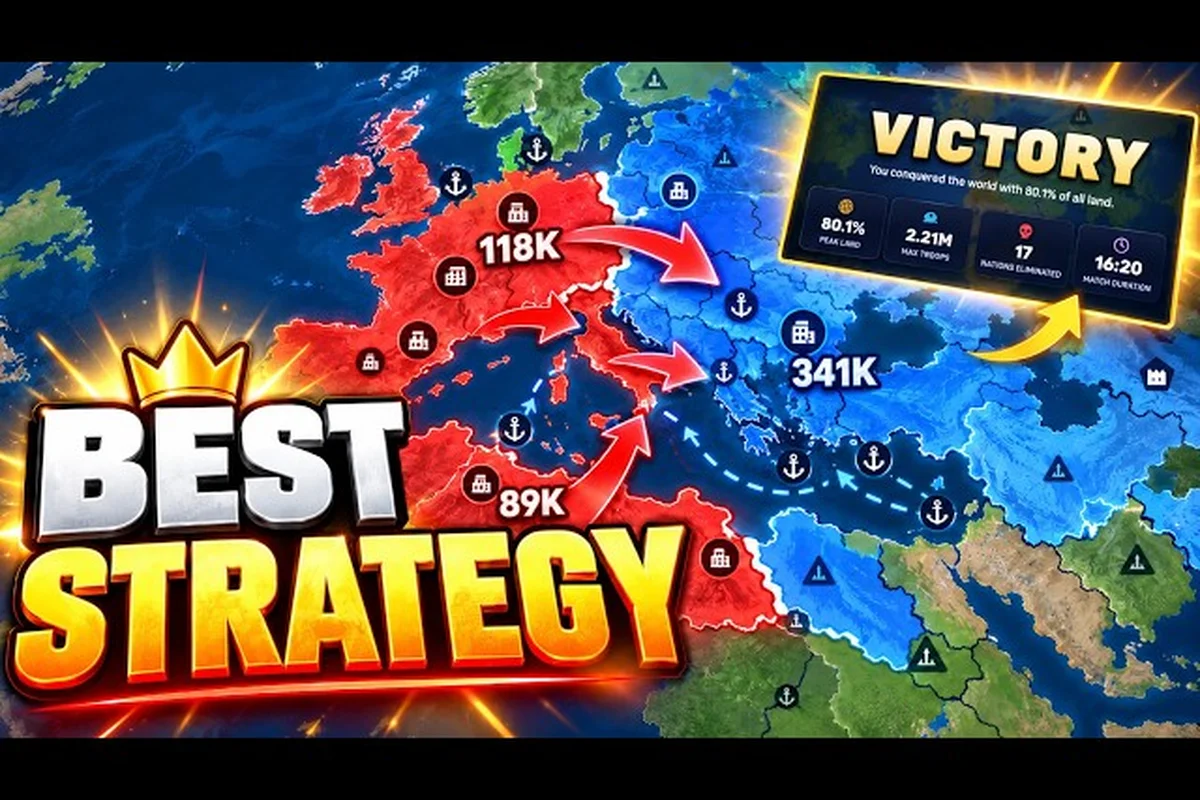
The roWorld best strategy tier list matters because a strong opening depends on territory, economy, diplomacy, and timing—not one overpowered unit. Use these seven picks to build a flexible route to the official 80% world-control objective.
roWorld Best Strategy Tier List: Seven Winning Picks
This ranking is a strategic archetype framework, not a measured win-rate chart. RoWorld’s official listing says 88 player nations and hundreds of tribes share the world, while servers support as many as 55 players. That creates many possible openings, so a strong strategy must work against nearby rivals without demanding a single perfect border.
The best approach begins with safe expansion, then adds economic support, controlled conflict, and a flexible nuclear response. Each pick below is judged by border safety, access to resources, operational usefulness, and the number of situations in which it remains valuable.
| Strategy pick | Primary strength | Best use | Main limitation |
|---|---|---|---|
| Inland buffer opening | Secure borders | Stabilizing early expansion | Fewer immediate water options |
| Coastal capital | Ports and projects | Building trade and naval power | More exposed to shoreline rivals |
| Compact starter | Fast consolidation | Aggressive early unification | Weak if surrounded |
| Economic focus | Long-term growth | Preparing factories and alliances | Vulnerable before income develops |
| Balanced military build | Flexible response | Handling several threats | Less specialized than one-unit builds |
| Defensive deterrence | Border control | Protecting conquered land | Can delay rather than solve pressure |
| Flexible escalation | Timely force | Breaking a stalemate | Requires careful diplomacy and timing |
Why one universal strategy cannot dominate
A capital beside a coast may begin with more project options than a remote inland start, but it can also place two aggressive neighbors on one flank. A compact starter can win early space before the map becomes crowded, although that advantage disappears when a larger power arrives nearby. The official RoWorld game page lists cities, ports, factories, alliances, and nuclear weapons among the core systems, making opening priorities more important than choosing a decorative favorite nation.
The right choice also changes during the match. An economic strategy is excellent before contact becomes inevitable, while a deterrence strategy becomes more valuable once several borders are exposed. Because no official troop, damage, income, or upkeep figures are published, this tier list avoids invented statistics and instead ranks the reliability of each strategic role.
Troop doctrine ranked by terrain and objective
The roWorld best troops tier list should be read as a doctrine list rather than a ranking of identical soldiers. Troops are most valuable when their behavior matches the terrain, the size of the enemy force, and the objective you need them to accomplish. A balanced force that can cross several kinds of land generally gives a new player more room to learn than a narrow specialization.
| Troop role | Strategic tier | Why it ranks here | Best situation |
|---|---|---|---|
| General-purpose field force | S | Offers the broadest usable battlefield coverage | Uncertain opponents and mixed terrain |
| Fast flank force | S | Helps exploit exposed borders and chase isolated targets | Wide front lines and weak enemy cohesion |
| Siege-oriented force | A | Strong when a defender has prepared a fixed position | Breaking a fortified or protected capital |
| Defensive formation | A | Makes direct attacks expensive and discourages expansion | Holding a wide, unstable border |
| Specialty unit | B | Strong in a clear scenario but less adaptable | A target-rich area with one dominant threat |
| Low-priority mass unit | C | Fits only when supported by a stronger system | Late reinforcement or area saturation |
S-tier troop doctrines: general-purpose and fast flanks
A general-purpose core earns an S-tier designation because it can remain useful when the front changes. It is not presented as having the highest damage, since the official game page does not publish comparative unit values. Its advantage is versatility: it can defend a capital, support a neighboring ally, escort an expansion, or respond to an attack without requiring a completely separate force.
A fast flank doctrine is the other S-tier choice, but only when the battlefield provides space. Flanking is most effective when the enemy commits in one area and leaves another border exposed. It is less dependable in a crowded capital with many adjacent territories, where the same maneuver may run into another nation rather than an open flank.
Players comparing branches can also consult the broader RoWorld war guide for how troops, warships, missiles, and nuclear options fit into broader wartime decisions. The key question is not which troop concept “does the most damage”; it is which concept can remain useful when the opponent refuses to cooperate with your preferred formation.
A-tier troop doctrines: siege and border control
A siege-first strategy earns A-tier status because it creates a clear purpose: reduce the defender’s advantage before committing a general assault. However, it is vulnerable if the target keeps moving, reinforces another border, or leaves the attacking force exposed. Siege planning should therefore follow the target rather than lead it.
A defensive anchor can also reach A tier. Wide territories need a dependable center because every exposed border pulls attention away from the other front. Defensive troops serve that role by making attacks costly, buying time for allies, and allowing factories or city improvements to develop. Their ranking remains below flexible S-tier doctrines because a static defense does not automatically solve a strategic encirclement.
B- and C-tier troop doctrines: narrow power
A specialty unit belongs in the B tier when its tactical advantage is obvious but its operational limits are equally obvious. An elite formation may shine against one kind of opponent but waste strength against another. Community videos of RoWorld, including the community strategy recording formerly associated with the name RoFront, show players changing priorities as several nations appear on the same front, which supports treating flexibility as a strategic advantage.
A mass unit that lacks a clear special role falls into C tier. It can still fill territory, protect a logistics route, or support a stronger attack, but it should not be the foundation of the whole plan. The best results come from combining a dependable core with one situational specialty rather than filling the army with narrow tools and hoping the opponent cooperates with the chosen matchup.
roWorld Best Nuke Tier List: Timing Over Raw Power
The roWorld best nuke tier list is primarily about deployment timing. RoWorld’s official listing confirms nuclear weapons as a feature, but it does not publish nuclear damage, radius, cooldown, cost, or deterrence values. For that reason, every placement below describes a strategic purpose instead of inventing a power score.
| Nuclear approach | Strategic tier | Practical advantage | Strategic risk |
|---|---|---|---|
| Last-window retaliation | S | Can reverse a threatening collapse when used at the right moment | Waiting too long may leave no useful target |
| Border deterrence | A | Signals serious consequences without immediate use | Rivals may adjust rather than surrender |
| Breakthrough strike | A | Creates a strong opening in a decisive campaign | Misjudging the front can waste the advantage |
| Early pressure | B | May discourage an early expansion attempt | Reveals intent without securing terrain |
| Revenge strike | C | Satisfies retaliation but rarely solves the structural problem | Wastes the resource on a defeated opponent |
| Random deployment | C | Offers little repeatable strategic value | Can harm the user’s own position |
S-tier use: preserve the last decisive window
The strongest nuclear approach is last-window retaliation. Its value comes from being held until a major border test, a capital loss, or a sudden coalition advance creates a meaningful target. At that point, the weapon becomes a response to a specific problem rather than a dramatic but disconnected display.
The timing must still be strategic. If a neighboring player is about to connect two enemy fronts against you, a threat at the correct central area may be more valuable than a strike on the weakest visible unit. If an ally calls for help against a larger attacker, immediate support may preserve the relationship that matters for the broader match. This is why nuclear planning belongs beside diplomacy, not after every other weapon has been considered.
A-tier use: deterrence and breakthrough
A credible deterrent ranks in the A tier because it can discourage an opponent from committing to a dangerous attack. Its credibility depends on visible preparation, believable intent, and a target that matters. A nuclear threat attached to a vague plan is less effective than one linked to the actual route an enemy appears likely to use.
A breakthrough strike can also sit in the A tier. If a battle has stalled, a surprise nuclear use might reopen movement, damage an exposed formation, or cause the opponent to redirect resources. The downside is volatility: a failed opening merely changes the conflict, while a successful one may let the attacker turn temporary confusion into lasting territorial control.
Why early or revenge uses fall lower
Early pressure is usually a B-tier choice because opponents are not yet committed and may simply avoid the threatened border. The pressure can protect a quieter opening, but it also spends a limited strategic resource before the user understands the server’s political landscape.
Revenge use falls to C tier when the enemy is already broken. A strike may punish aggression, yet it does not recover land, stabilize allies, or address the reason the position collapsed. The 80% world-control condition makes resource efficiency central: a nuclear weapon is strongest when it changes the path to that threshold, not when it merely records a grievance.
roWorld Best Warship Tier List: Control the Coast
The roWorld best warship tier list depends on whether a player controls a coastline and whether the naval route is contested. Warships are not automatically superior to land forces. Their value comes from protecting ports, moving along connected water routes, supporting shore operations, and creating pressure that a land army cannot safely ignore.
| Warship role | Strategic tier | Best contribution | Key weakness |
|---|---|---|---|
| Fleet-route protector | S | Controls valuable water access and screens exposed coastlines | Tied to naval geography |
| Port raider | A | Threatens valuable coastal infrastructure | Requires a viable launch route |
| Amphibious escort | A | Supports landings and protects transport space | Vulnerable if land support is absent |
| Fleet-response reserve | B | Adds flexibility when the threat location is unclear | Can arrive too late |
| Decorative fleet | C | Creates a large visible naval presence without a defined mission | Consumes attention and may stretch resources |
| Isolated fleet | C | Operates without a clear strategic connection | Cannot affect the main land contest |
S-tier warship role: protect the route that matters
The coastal-route protector earns the top tier because it turns coastline access into a dependable strategic asset. The official game page identifies ports as a feature, and the broader RoWorld map guide is useful for comparing how coastline, inland expansion, and neighboring borders can shape an opening. A warship assigned to protect a productive route creates leverage that cannot be reproduced by another land force on the other side of the map.
This role is not about building the largest possible fleet. It is about identifying the water path that connects valuable territory, then using the fleet to make that path safe. If the port and capital are connected by a short, protected corridor, even a small naval presence can influence the entire coast.
A-tier warship roles: raid and escort
The port raider is dangerous because coastal infrastructure represents a major part of the strategic map. A fleet that can reach an enemy port creates pressure across several fronts, although it must have a reliable path to that target. If the target sits behind a narrow, blocked, or heavily controlled route, the same fleet may be unable to convert its presence into meaningful damage.
An amphibious escort provides a different kind of value. It can protect landings and support a coordinated push from sea to land, but it needs coordination with the army. Warships operating without a land objective often feel busy while contributing little. The better plan assigns each ship group a task, such as covering a crossing, distracting a defender, or threatening a port while the army moves elsewhere.
Fleet reserve versus decorative fleet
A fleet-response reserve belongs in the B tier because it gives a player options when the next threat is unclear. It becomes stronger once the player can protect it from early attacks and move it toward the likely theater of operations. If the reserve is scattered across unrelated duties, however, it may be unable to concentrate when a real emergency develops.
A decorative fleet ranks in C tier because visible quantity is not the same as useful force. Ships without a route, target, or support plan can divide attention and expose the coast they were supposed to protect. The same principle applies to a fleet that operates far from the main action: it may look impressive in isolation, yet it changes neither the land battle nor the player’s path toward world control.
roWorld Best Map Tier List: Choose Strategic Conditions
The roWorld best map tier list is not a ranking of official map names. The available sources do not provide a verified list of named maps, so this framework compares opening conditions that players can recognize: border count, coastline, room to expand, nearby threat, and access to ports. The official page supports the world-scale context, but not numerical map ratings.
| Map condition | Strategic tier | Opening advantage | Main test |
|---|---|---|---|
| Open inland space | S | Allows broad, staged expansion | Whether nearby rivals can close the gap |
| Coast with multiple routes | S | Combines port access with naval flexibility | Whether routes remain secure |
| Balanced mixed map | A | Supports both land and naval development | Whether the player can manage two economies |
| Compact crowded map | B | Creates immediate interaction and fast unification | Whether the player can survive multiple threats |
| Narrow coastal corridor | B | Creates a clear defensive front and strong choke points | Whether land pressure can bypass it |
| Isolated island start | C | Offers natural protection and time to organize | Whether expansion and resources remain sufficient |
| Enclosed land pocket | C | Reduces immediate attack directions | Whether nearby powers leave a viable exit |
S-tier conditions: room plus resources
A map with open inland space ranks highly because it supports the first principle of a strong strategy: expand without immediately creating several fragile borders. The player can choose which direction to reinforce, delay contact with one rival, and use space to establish economic and military priorities. The danger is that open land may be valuable to several nearby powers, so the player must keep moving before neighbors converge.
A coast with multiple routes is the other S-tier condition. Multiple waterways give a player options to rotate ships, protect ports, or avoid a single chokepoint. The advantage only remains real if the player can use those routes; ships parked in one exposed area effectively reduce the coast to one front. Good map play converts geographic options into active plans.
A-tier conditions: balanced but manageable
A balanced mixed map ranks in the A tier because it supports multiple strategic tools without making any one of them automatically dominant. Land expansion can meet naval pressure, and ports can supplement the inland economy. The challenge is prioritization. A player who spreads effort evenly across every objective may be weaker than one who deliberately turns the map’s mixed geometry into a focused plan.
A defensible coastal corridor can also reach A tier when its chokepoints are clear and the player’s land forces support the fleet. The route may reduce the number of attack angles, but it can also let a nearby enemy identify the only path and concentrate against it. A good player varies construction and guards the approaches that matter rather than relying on one obstacle.
C-tier conditions and escape planning
An isolated island start offers natural protection, yet that same separation can delay growth and limit interaction with the wider board. It is not a weak position by itself; it becomes a weak opening when the player cannot find a sustainable route outward or develops faster than the map allows.
An enclosed land pocket creates a similar problem in reverse. Few borders can mean safety, but it can also mean that a larger neighboring power surrounds the pocket and squeezes it. Escape planning is therefore the deciding skill. Players should identify where expansion can resume, which border can be defended during consolidation, and which neighbor is most likely to become the main rival before the pocket becomes a trap.
roWorld S Tier Nations and A Tier Nations
The roWorld s tier nations and roWorld a tier nations should be understood as starting-position archetypes, not official balance rankings. RoWorld lists 88 player nations and hundreds of tribes, yet it does not publish a complete nation-by-nation power table. A nation’s practical tier therefore depends on capital placement, neighbors, coastline, and the strategy the player intends to execute.
| Nation-opening archetype | Tier | Strategic advantage | Best player approach |
|---|---|---|---|
| Wide-coast starter | S | Supports ports, fleet routes, and economic projects | Protect two coastal anchors |
| Open-plain starter | S | Gives room for rapid, flexible expansion | Build a secure interior first |
| Balanced central starter | A | Offers several viable development paths | Select one primary advantage early |
| Coastal-border starter | A | Creates strong pressure opportunities | Coordinate fleet and land goals |
| Compact-border starter | B | Allows quick consolidation when threats are weak | Secure nearby territory before expansion |
| Peripheral starter | B | May avoid the busiest early contest | Connect to safer inland routes |
| Extreme-risk starter | C | Could reward a bold, successful attack | Accept greater inconsistency for tempo |
Why nation tiers depend on the opening
A nation placed on open terrain can be S-tier for an expansionist because it supports safe border development. The same nation may become less consistent if every direction contains a hostile capital, since the visual advantages of its terrain disappear when hostile neighbors compress the available space. This is why the list does not attach a permanent letter to a specific country name without official, comparable placement data.
Coastal starts belong near the top when they offer more than one water route. A single exposed shoreline can become a liability because neighboring powers can threaten the port and the capital at once. The strongest coastal opening gives the player room to choose which route to defend, which shore to develop, and when a fleet should move beyond local defense.
A-tier nations: broad options with one clear commitment
An A-tier nation offers enough flexibility to support several strategies, but it does not guarantee that every strategy will work. A balanced central position, for example, can become excellent when the player develops economy first, strong when the player expands early, and poor when the player waits for the map to resolve itself. The opening provides options; the player still has to choose a commitment.
That commitment should appear early. Choosing land growth means accepting less immediate naval theater. Choosing naval pressure means coordinating ships with a coastal objective. Choosing deterrence means protecting a border while preparing a credible response. For broader comparisons of how nations and alliances function together, see the RoWorld alliance tier list.
Why the lowest tier is not simply the weakest nation
An extreme-risk start is placed in C tier not because it is automatically defeated, but because its result depends heavily on execution and neighboring behavior. A bold opening may capture valuable land before the server stabilizes, yet the same route can fail if several powers converge or if the player lacks enough infrastructure to hold what was taken.
Tier lists are most useful when they explain conditions, not when they disguise uncertainty. RoWorld’s 55-player server limit, numerous nations, and large world create a dynamic environment in which neighboring relationships can change faster than a static label. The practical question is always: does this opening fit the strategy the player can execute consistently?
Seven-Pick Strategy for Consistent Victory
A complete roWorld best strategy tier list should connect the seven choices into one sequence rather than leaving them as disconnected rankings. The order below turns geography, economy, force, and deterrence into a practical opening that can adapt when a rival changes the situation.
| Match phase | Priority | Supporting action | Strategic question |
|---|---|---|---|
| Opening | Choose a safe, useful capital | Place a capital with expansion room and defensible borders | Can I develop without inviting several wars? |
| Consolidation | Strengthen economy and one border | Improve cities, secure projects, and connect territories | Which advantage compounds over time? |
| Contact | Read the nearest rival | Compare military posture, borders, and likely reaction | Is the threat local, or part of a larger coalition? |
| Expansion | Add a controlled front | Expand where support can arrive without exposing another flank | Does this gain land or create two new threats? |
| Escalation | Commit the appropriate force | Use troops, ships, alliances, or nuclear deterrence as needed | Which tool matches the actual problem? |
| Consolidation under pressure | Repair and reinforce | Stabilize the front, redistribute forces, and protect key assets | Which loss would cause the largest collapse? |
| Final push | Target the decisive region | Concentrate on a route that contributes to world control | Is this gain more valuable than the exposed border? |
Step-by-step decision order
Begin with capital safety, not a military wish list. Examine every neighboring nation, identify the likely first contact, and preserve enough space to establish economy. The official game page lists cities, ports, factories, alliances, and nuclear weapons, so even a peaceful opening involves choices about production and cooperation rather than a simple race to build troops.
Next, select one primary advantage. It might be safe inland growth, port access, a strong defensive geography, or a position suited to rapid unification. This is the point where the troop, warship, and nation rankings become useful: they tell you which tools fit the position you already have, not which tool is generally fashionable.
Then build a contingency plan for the most likely rival response. If a neighboring power expands toward you, which unit or structure arrives first? If a coastal threat forms, where does the fleet go? If a coalition begins to coordinate, which commitments can be withdrawn without losing your core position? A strong strategy has a clear default action and a clear trigger for changing it.
Match-specific adaptations
A crowded server requires stronger border discipline because more nearby nations create more simultaneous pressure. A quieter server may reward earlier expansion, but the player still needs to account for unused space and rivals crossing the map later. The RoWorld current meta page is a natural place to monitor how community priorities shift as the game develops.
The final adaptation concerns objectives. With 80% world control as the stated victory condition, holding scattered territory is not automatically enough. A successful player evaluates connected regions, defensible borders, and the ability to project force. A large empire can be harder to defend than a compact one, so the strongest endgame plan often sacrifices exposed land to preserve the territory that links everything together.
Frequently Asked Questions
What is the best strategy in RoWorld for a new player?
The strongest beginner strategy is to choose a capital with safe borders, build economy, secure one nearby advantage, and avoid fighting on two fronts at once. RoWorld includes up to 55 players per server, so early aggression can attract several opponents. A general-purpose troop core and a clear escalation plan are more adaptable than a highly specialized opening.
Which troops should a RoWorld player prioritize first?
Prioritize a dependable general-purpose force, then add a specialization that matches the opponent or terrain. Fast units help on open flanks, while siege and defensive formations fit prepared positions. Because official comparative troop statistics are not published, the roWorld best troops tier list is based on battlefield role, adaptability, and the number of situations each doctrine can handle.
When is a nuclear weapon worth using in RoWorld?
A nuclear weapon is most valuable when it can change a decisive border, capital, or breakthrough situation. Holding it until a clear target appears preserves flexibility, while using it after the enemy is already defeated may not affect your path toward world control. Since exact nuclear values are not published, timing and target relevance matter more than assuming a universal best moment.
Should coastal or inland capitals be preferred in RoWorld?
Coastal capitals are strong when they provide multiple routes, safe ports, and room for naval operations. Inland capitals are often better for staged expansion and border development. The right choice depends on nearby players, available exits, and the resources you can protect; a blocked coastline can be dangerous just as an enclosed inland pocket can limit growth.
Are S-tier and A-tier nations always stronger in RoWorld?
No. The roWorld s tier nations and roWorld a tier nations represent opening archetypes, not guaranteed winners. A nation performs differently depending on capital placement, nearby rivals, coastline access, and player decisions. The most reliable approach is to understand what your opening allows, build a strong economic core, and change the plan when the map becomes more crowded.