
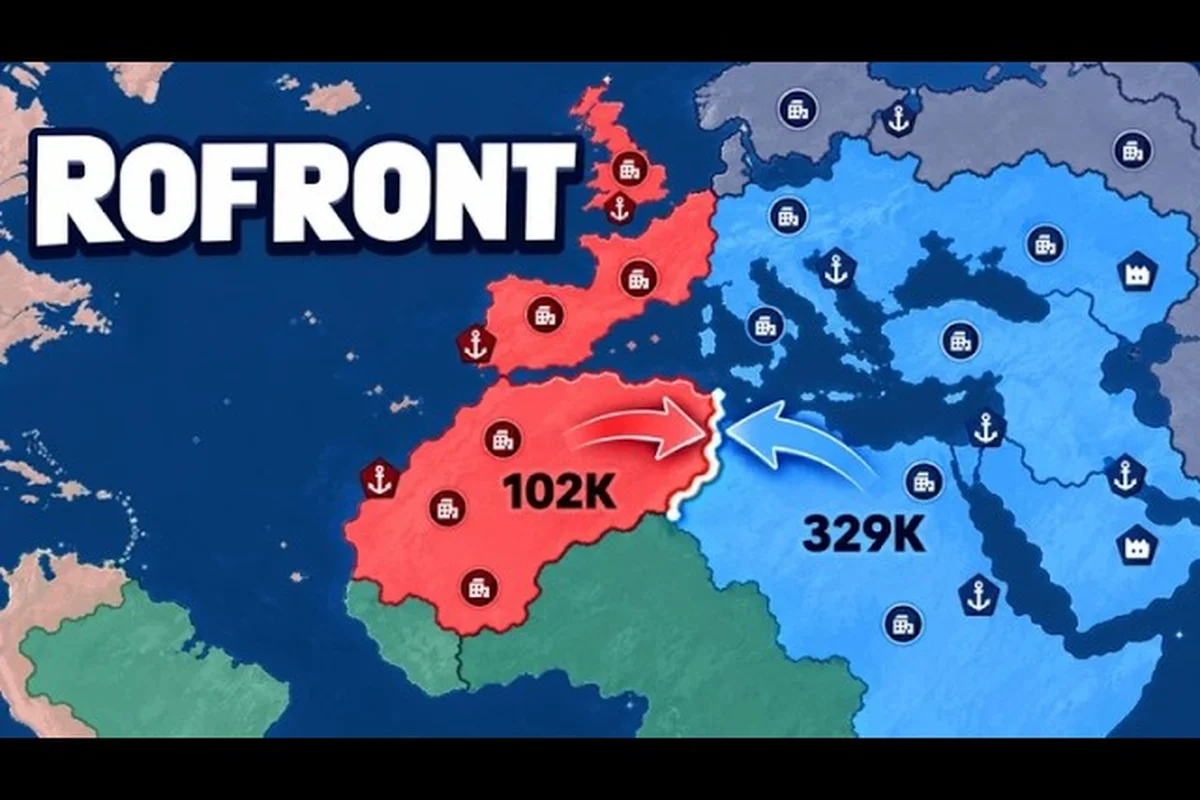
The roWorld current meta matters because your opening spawn determines income, expansion options, and how quickly neighboring players can pressure you. Use the ranked starts and practical adjustments below to build a stronger first phase without relying on invented win rates.
As the roWorld YouTube video demonstrates, current roWorld meta revolves around the available gameplay mechanics and data that shape effective play. A strong opening is judged by more than raw income: spawn placement also affects claim timing, expansion distance, troop availability, and how soon a neighboring nation can contest your territory. That makes the meta nations and spawn tier list useful planning tools, but neither should replace a real-time reading of production, army composition, and nearby pressure during the first phase.
roWorld Current Meta: What Actually Defines a Strong Opening
RoWorld’s official Roblox page confirms the central structure of the match: 88 player nations and hundreds of tribes share the map, servers hold up to 55 players, and a side wins by controlling 80% of the world. Cities, ports, factories, alliances, and nuclear weapons are part of the broader experience, so the strongest openings are not simply the most aggressive ones. They combine safe border access, useful economy, and room to respond when a neighbor expands.
That makes the roWorld current meta a positioning problem. A good capital may sit beside unclaimed land, a port, or a route toward a valuable objective, but a spectacular position can still fail if it isolates the economy. The rankings below are strategic archetypes rather than measured statistics, because the developer has not published per-nation power values, income rates, troop multipliers, or win rates.
| Opening archetype | Border pressure | Expansion potential | Economy value | Main strength |
|---|---|---|---|---|
| Balanced inland | Medium | High | High | Flexible development |
| Coastal port | Medium | Medium | High | Access to waterways |
| Open frontier | High | Very high | Medium | Fast territorial growth |
| Coastal corner | Low | Low | High | Defendable economy |
| Enclosed position | Low | Very low | Medium | Short-term security |
The current update should therefore be read as a decision framework, not a promise that one nation always wins. Community video reports consistently show the same opening loop: select a nation, place a capital, claim open land, establish economy, then negotiate or fight as neighbors make contact.
The Factors Behind Every Rank
Border safety determines how much attention the opening demands. Expansion room indicates whether the player can grow without crossing a powerful neighbor immediately. Water access is valuable when the capital or nearby territory can support port-based development, while inland positions trade coastal advantages for a larger set of land routes.
| Factor | What to inspect | Strategic question |
|---|---|---|
| Border safety | Open land around the capital | Can economy develop before contact? |
| Expansion room | Nearby unclaimed territory | Is there room without crossing a major rival? |
| Water access | Ports and coastal claims | Can the position support useful trade or movement? |
| Resource layout | Cities, factories, and claimed tiles | Does the capital create a balanced foundation? |
| Neighbor pressure | Direction of likely expansion | Where will the first hostile contact occur? |
A practical roWorld meta strategy is to score the spawn mentally before choosing. Give the highest priority to immediate safety and expansion room, then consider water access and resource layout. A faction with impressive visuals but a boxed-in capital can be less valuable than a quieter nation with several viable expansion directions.
roWorld Meta Nations: Ranked Spawn Picks by Opening Quality
The best spawn depends more on the immediate board than the faction’s reputation. A nation with an exposed position may be excellent when surrounded by empty land, while a normally strong coastal nation becomes awkward when its useful shoreline is blocked. This is why the roWorld best spawn tier list focuses on board conditions rather than a fabricated universal power ranking.
| Tier | Spawn profile | Recommended opening | Why it ranks here |
|---|---|---|---|
| S | Safe coastal space with multiple land routes | Develop economy, then claim one strong inland arc | Strong safety, income potential, and expansion flexibility |
| S | Inland space with wide unclaimed borders | Build a compact core before pushing outward | Lowest early disruption and excellent land access |
| A | Coastal port with one vulnerable route | Secure the port, then reinforce the narrow approach | Good water value with manageable pressure |
| A | Interior position beside several open tiles | Claim defensible borders and create local balance | Reliable but not exceptional land access |
| B | Coastal position with limited shoreline | Prioritize one strong port district | Useful economy, but constrained growth |
| B | Frontier spawn with multiple threats nearby | Establish allies or fortifications before expanding | Fast growth potential comes with high pressure |
| C | Corner or enclosed capital | Fortify, specialize, and avoid early aggression | Security is high, but opportunities are limited |
This roWorld tier list update is intended as a live strategic lens. It favors safe coastal space, wide inland borders, and mixed openings that combine a protected core with room to expand. The broader RoWorld best strategy tier list can help translate that opening position into stronger troop, nuclear, and warship decisions later in the match.
Best Picks by Situation
There is no single faction that remains ideal after every neighboring claim changes. For an early match, an inland or balanced opening is easier to manage. When open space dominates the server, a frontier spawn becomes much stronger because the player can convert surrounding land into a buffer. A coastal opening shines when the water route matters and the land approach remains controllable.
| Situation | Strongest archetype | Main caution |
|---|---|---|
| Mostly open server | Wide inland border | Do not expand equally in every direction |
| Island or water-heavy board | Coastal port with defensible land route | Avoid a long, exposed coastline |
| Dense cluster of players | Safe corner or compact core | Specialist resources cannot replace land |
| Balanced mixed board | Dual-route coastal-inland position | Preserve enough troops for both threats |
| Sudden neighbor expansion | Position with multiple fallback borders | Avoid one-dimensional defense planning |
For a complete catalog of selectable countries and their likely role, the RoWorld nation list can help players compare archetypes before committing. The key distinction is between a strong nation and a strong placement: a nation that offers a favorable capital location remains relevant even if another faction has a more recognizable name.
Why Some Popular Picks Become Weak
A popular faction can lose value when the server develops around its capital. If the nearest attractive resources are already claimed, the player may need to cross hostile territory before building a balanced economy. The same applies when a coastal faction starts with access to water but lacks safe land connections.
| Draft concern | Effect on opening | Adjustment |
|---|---|---|
| Narrow land corridor | Easy to blockade | Build early and avoid scattered claims |
| Attractive nearby resources | Encourages immediate conflict | Develop a local economy first |
| Exposed capital | Consumes attention early | Prioritize safety over distant expansion |
| Limited shoreline | Weakens water advantage | Specialize around one strong port area |
| No nearby unclaimed land | Removes natural growth space | Seek access through diplomacy or a compact core |
A strong roWorld best faction pick is therefore situational. Favor the faction whose capital makes your next decisions easy, not the one associated with a memorable community clip. Territory pressure, expansion room, and defense depth provide better signals than popularity.
roWorld Meta Strategy: The First 15 Minutes of a Match
The opening phase should produce a stable economic core, not a sudden attempt to occupy half the map. A sound roWorld meta strategy prioritizes a defensible set of claims, connects nearby resources, and creates enough flexibility to answer pressure from more than one direction. Because published build costs and income values are unavailable, this approach focuses on decision order rather than fabricated resource thresholds.
| Priority | Opening action | Reason | Avoid |
|---|---|---|---|
| 1 | Place the capital on safe, useful land | Prevents immediate economic interruption | Spawning for appearance alone |
| 2 | Claim nearby territory before distant goals | Builds a coherent local base | Scattered, fragile claims |
| 3 | Secure essential city, port, or factory access | Supports long-term income | Ignoring all transport infrastructure |
| 4 | Identify likely pressure directions | Prepares defenses and choices | Assuming every border is equally dangerous |
| 5 | Expand along the safest useful arc | Grows without overextending | Equal pressure on every front |
| 6 | Reassess after each neighbor move | Keeps the strategy responsive | Following a fixed path regardless of events |
Phase One: Build a Defensible Economic Core
The first claims should be close enough to support one another and far enough from hostile territory to allow development. Inland starts generally benefit from a compact cluster around useful land, while coastal starts should connect the port district to a protected land route. A city without a safe approach may look strong on the map but remain difficult to use.
Resource planning deserves special attention because expansion consumes attention before it creates stability. The RoWorld gold strategy guide explains how to connect income, construction, and expansion without assuming unpublished cost or income values. In the current roWorld current meta, the best opening is the one that funds its next decision instead of creating a distant objective the economy cannot yet support.
Phase Two: Read the First Neighbor Move
Watch not only the enemy’s expansion, but also which claims they leave open. A player building away from your border may be avoiding confrontation, focusing on a resource route, or preparing to circle around a third party. Treating every approach as an immediate attack wastes attention and can cause a slow player to lose uncontested land.
| Neighbor signal | Likely interpretation | Response |
|---|---|---|
| Expansion directly toward your capital | Immediate territorial pressure | Reinforce the exposed arc |
| Claims form around your sides | Encirclement risk | Secure an escape route |
| Expansion heads away from you | Another target takes priority | Claim useful space while available |
| Fortification after contact | Defensive posture | Hold current ground and monitor |
| Sudden diplomacy request | Strategic uncertainty | Seek value before committing |
A reactive strategy is not passive. It reserves the ability to redirect claims, reinforce an important route, or recognize an opening elsewhere on the map. The roWorld current meta rewards that flexibility because the world changes as dozens of nations and tribes compete for the same space.
Phase Three: Expand in Arcs, Not Dots
Dotted claims look ambitious but create weak pockets, long travel routes, and difficult defense. Arc expansion gives the player a coherent frontier: each new section connects to the existing territory and creates a clear next decision. The best arc is normally the one with the greatest economic utility and the lowest immediate threat, not simply the nearest open tile.
| Expansion pattern | Strength | Risk |
|---|---|---|
| Contiguous arc | Clear borders and easier defense | May lead into a major rival |
| Thin corridor | Quick access to distant value | Vulnerable if both sides are threatened |
| Widely spaced claims | Multiple resources and forward presence | Difficult to support |
| Compact pocket | Low maintenance | Can restrict later growth |
| Balanced two-front shape | Flexibility across the map | Requires stronger coordination |
Spawn quality in the current roWorld meta should be judged by usable adjacency, not raw distance to resources. A strong spawn links a balanced two-front shape to several economic options, letting a meta nation secure a frontier without exposing a thin corridor. By contrast, a compact pocket or widely spaced claims can force a predictable opening: opponents can pressure the narrow route, contest vision, and slow expansion before the economy stabilizes.
roWorld Tier List Update: Adapting to Board Pressure
A tier list becomes outdated when it assumes the same server state. The roWorld tier list update should instead rate how consistently an opening supports good decisions under pressure. Spawns with several viable expansion paths remain high tier; positions that work only when no one contests them should be treated as conditional. This approach is transparent and avoids inventing official balance data.
| Board state | Spawn value shift | Strategy shift |
|---|---|---|
| Open early game | Frontier and inland picks rise | Claim connected land quickly |
| Crowded center | Safe coastal picks rise | Strengthen one border and preserve space |
| Strong port presence | Water access rises in value | Secure port routes without stretching inland |
| Wide open spaces | Border-heavy starts rise | Build a buffer before economy slows |
| Established coalition | Solo expansion risk rises | Secure compact territory and consider cooperation |
| Empty outer map | Central starts fall | Migrate toward activity and objectives |
Defensive, Balanced, and Aggressive Adjustments
A defensive opening protects a compact core while choosing which surrounding area to contest. It is not merely a turtle strategy, because a static defense gives away the initiative. A balanced opening develops both land and optional water access. An aggressive opening expands earlier, but only when the surrounding territory is quiet enough to support that risk.
| Style | Best conditions | Main danger | Winning behavior |
|---|---|---|---|
| Defensive | Dense server or strong nearby coalition | Being slowly boxed in | Counter-expanding on the least pressured side |
| Balanced | Mixed threats and mixed resources | Overextending every front | Maintaining one clear land core |
| Aggressive | Open server and weak neighbors | Early retaliation | Securing a border buffer first |
| Economic | Valuable cities, ports, or factories | Being attacked before income develops | Linking resources and protecting access |
| Diplomatic | Several reliable neighbors | Exploited by an ally | Keep useful alternatives and claim value |
This is also where the roWorld meta nations evaluation becomes more useful. Rank nations by the decisions they permit, not by a label attached to the faction. A flexible opening can be developed defensively, while a pressured opening may require diplomacy or a compact economy. The RoWorld alliance tier list offers a separate framework for judging cooperation rather than individual placement.
When to Change Your Opening Plan
The plan should change when a player reveals a different priority, not every time a border shifts. Early noise may come from an alliance settling positions, while sustained construction near your territory carries more significance. Compare the direction, continuity, and defensive preparation of the move before committing troops or abandoning a valuable opening.
A practical review process is simple: compare each nation’s build order, capital pressure, and territorial reach against the current roWorld meta instead of reacting to isolated border activity. For example, if a neighboring player has maintained repeated construction on one front while upgrading capital-range units, treat that direction as a strategic threat even before an attack lands. This helps separate a temporary opening adjustment from a genuine change in the opening plan, preserving troop concentration and resources for the most dangerous axis.
-
Mark which neighbor can reach your capital most directly.
-
Identify claims that connect two separate player territories.
-
Note where cities, ports, and factories are being developed.
-
Check whether a player is expanding toward another target or toward you.
-
Preserve one expansion route that remains open if the main front closes.
-
Revisit the capital and resource plan after major territorial shifts.
The current roWorld current meta is therefore dynamic but not random. A spawn remains strong when it offers options, and it becomes weak when opponents remove those options one by one. The best player is not necessarily the one with the largest army; it is the one whose position continues to make sense after the board changes.
roWorld Best Spawn Tier List: Quick Decision Checklist
Use the roWorld best spawn tier list as a short decision checklist before committing. First, ask whether the capital has breathing room. Then verify that useful claims can connect to it without crossing several likely rivals. Finally, confirm that the opening has at least two roles: a defensible economic base and a plausible direction for expansion.
| Question | Strong answer | Weak answer |
|---|---|---|
| Can the economy grow before contact? | Several safe nearby claims | Immediate hostile border |
| Is expansion connected? | One or two clear arcs | Scattered distant tiles |
| Is water useful but controllable? | Protected port access | Exposed shoreline with no fallback |
| Does the capital support resources? | Balanced local foundation | Narrow position dependent on one route |
| Can pressure be escaped? | Multiple viable directions | Fully enclosed or corner-locked |
Fast Evaluation by Spawn Type
A broad inland opening receives a high score when it offers several connected land routes. A coastal spawn scores well when its port access is meaningful and its land approach can be defended. A corner position can be practical for a specialist economy, yet it should not be mistaken for a high-growth tier merely because it is peaceful.
| Spawn type | Opening grade | Best use | Main condition |
|---|---|---|---|
| Wide inland | Excellent | Balanced growth and local economy | Claims remain unclaimed |
| Coastal with safe inland route | Excellent | Mixed land-water development | Port access matters |
| Coastal with exposed shore | Fair | Defensive port focus | Enough nearby resources |
| Compact interior | Fair | Secure economic core | Pressure is not closing in |
| Wide-open frontier | Conditional | Fast buffer-building | Neighbors are distant |
| Enclosed corner | Conditional | Specialist development | No immediate route outward |
No checklist can replace reading the server. The roWorld best faction is the one that fits the current board, the available neighbors, and the player’s willingness to contest or avoid them. The map’s broader geography is covered in the RoWorld map guide, which can help interpret coastline, central pressure, and available expansion corridors.
Final Recommendation
For a general opening, prioritize a balanced inland or protected coastal position with several adjacent unclaimed tiles. From there, establish a coherent economy, secure one high-value route, and expand along the side with the least immediate pressure. This recommendation reflects the roWorld current meta because it preserves more decisions than a highly specialized or exposed spawn.
In summary, the strongest roWorld current meta is defined by optionality: safe borders, connected expansion, useful infrastructure, and room to adapt. Choose the nation that places you in a workable position, build a compact economic core, and let neighboring moves determine where the next advantage lies.
Frequently Asked Questions
What is the strongest opening in the roWorld current meta?
The strongest opening is a balanced or protected coastal position with several connected unclaimed tiles. It combines safer development with multiple expansion routes. No faction has an official universal power rating, so the board matters more than reputation. A good capital should let the player build income, protect access to useful infrastructure, and respond to pressure without fighting every direction at once.
How do I choose the best faction in roWorld?
Choose the faction whose capital offers safe nearby land, a viable economic foundation, and room to expand. Compare surrounding players, coastline access, and likely expansion paths before choosing. A famous nation can become awkward when its surroundings are occupied, while a quieter pick may be excellent in an open server. Position quality usually creates more value than the faction label itself.
Does the roWorld tier list update include official win rates?
No. The official game materials do not publish per-nation win rates, income rates, troop multipliers, or build costs. The tiers in this guide are strategic archetypes based on border safety, expansion room, water access, and opening flexibility. They should be used to compare board situations, not presented as measured statistics. Community reports can reveal recurring patterns, but they do not create official balance data.
Should an early-game player expand or defend?
Expand only along a connected, low-risk arc, then keep enough attention on the threatened border to prevent a costly surprise. Constant defense can surrender all uncontested land, while uncontrolled expansion leaves the economy stretched. If nearby players show sustained intent, reinforce first. If threats remain elsewhere, take compact adjacent territory that strengthens the core instead of scattering claims across the map.
Is a coastal spawn always better than an inland spawn?
No. A coastal spawn is strongest when water access supports a useful port and the land approach is secure. It can be weak when the shoreline is exposed, surrounded, or disconnected from a defensible interior. A wide inland opening may be better when neighboring territory is open and resources can be claimed without water access. Evaluate local safety and expansion routes rather than treating coastline access as an automatic advantage.