
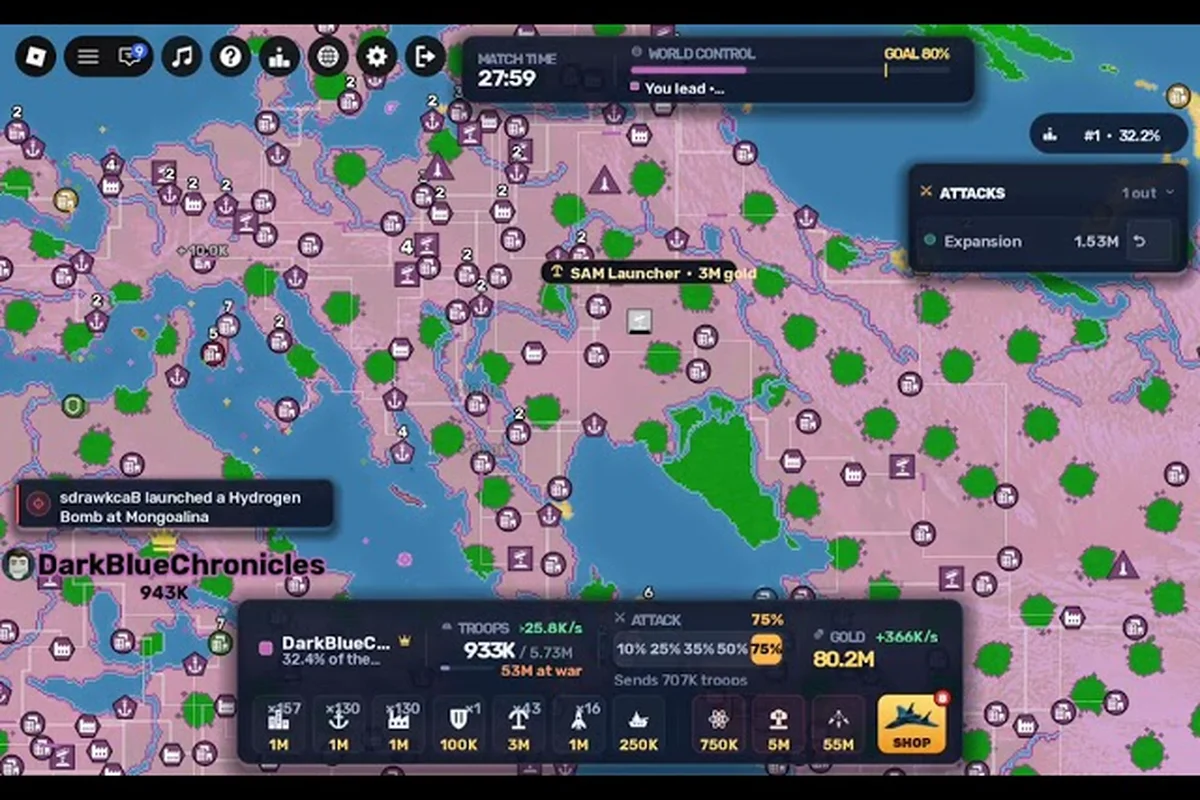
A strong roWorld best gold strategy matters because income decides when you can expand, defend, and outlast rivals. Rather than chasing every visible gold deposit, prioritize the income sources that compound: balanced resource planning, production buildings, and controlled territorial growth. For example, securing a new region should raise both gold output and resource access, while the gold reserve remains available for defense or a higher-value expansion. This approach turns early economy decisions into a sustainable conquest economy and reduces the risk of overextending before your roWorld economy tier list position is secure.
RoWorld Best Gold Strategy Fundamentals
The official RoWorld game page describes a world-PvP strategy game with cities, ports, factories, alliances, and a victory condition based on controlling 80% of the world. That makes gold a strategic resource rather than merely a score: it supports expansion, infrastructure, and the forces needed to protect what you own.
Community observations emphasize a common pattern: establish a starting position, secure nearby territory, build economic capacity, and then fight. A player who attacks continuously before income stabilizes may look powerful briefly, but often becomes unable to repair losses, replace troops, or respond to a second front.
| Economic role | Primary value | Common mistake | Better decision rule |
|---|---|---|---|
| Income source | Produces recurring resources | Building before securing the area | Establish control first |
| Gold reserve | Pays for future actions | Spending the entire balance | Keep a protected reserve |
| Territory | Creates access to more resources | Expanding in isolated directions | Grow connected land |
| Military force | Protects income and territory | Fighting with no reserve | Attack only when sustainable |
| Infrastructure | Improves long-term capacity | Spreading construction too thin | Upgrade key economic hubs |
The Core Economic Loop
The best roWorld gold strategy is a repeating economy loop rather than a single farming trick: balance current income against long-term expansion, because maximizing gold while ignoring upkeep can leave your conquest economy weaker than it appears. For example, a Resource Point that generates steady income may be more valuable than a distant territory with high production but expensive defenses and supply-chain costs. Track income, upkeep, and reserve capacity together, then reinvest only the portion you can afford without exposing your capital to collapse.
-
Secure a defensible capital and nearby land.
-
Identify income opportunities that remain useful as your territory grows.
-
Collect revenue while spending only a controlled portion of it.
-
Expand into connected territory when reserves and production can support the change.
-
Use military force to protect profitable regions, not merely to chase land.
-
Repeat the cycle with higher priorities as the match develops.
This loop makes roWorld maximize income more effective because every expansion should improve both your current income and your future access to resources. If a new region creates more upkeep than dependable production, it may strengthen conquest on paper while weakening your actual capacity to continue.
What the Official Information Confirms
The official page confirms the game's large competitive structure, including 88 player nations and hundreds of tribes, with servers supporting as many as 55 players. It also confirms the presence of cities, ports, and factories. However, it does not publish specific building costs, income rates, troop multipliers, attack percentages, or upkeep figures.
That limitation matters. Any guide claiming exact gold returns would be presenting unsupported information. The best roWorld resource planning is therefore based on observable priorities: protect active income, avoid simultaneous overextension, improve valuable hubs, and maintain enough liquidity to respond when a rival attacks.
The broader RoWorld gold guide can help players distinguish recurring income from short-term gains, while this article focuses on deciding when those gains should be saved, spent, or reinvested. A practical rule is to reserve gold generated by a stable city or factory operation for upkeep and emergencies, then reinvest only the surplus into another income-producing hub. For example, if two connected cities generate enough gold to cover troop maintenance but leave little liquidity, a player should delay a third expansion until the existing cities maintain a visible buffer; otherwise, one rival attack can force resource planning to shift from growth to defense. This approach treats cities, ports, and factories as separate gold engines, helping maximize income without stretching the treasury thin during a conquest economy.
RoWorld Economy Tier List for Gold Production
There are no official income statistics, so a meaningful roWorld economy tier list must rank economic reliability and strategic usefulness rather than invent gold values. A high-tier source remains useful when it is secure, connected, and not continuously exposed. A lower-tier source may still be worthwhile if it supports an important expansion route.
| Tier | Income archetype | Reliability | Strategic strength | Main limitation |
|---|---|---|---|---|
| S | Protected core economy | High | Supports sustained growth and defense | Takes time to establish |
| A | Connected urban economy | High | Provides multiple nearby assets | Can overextend if poorly managed |
| B | Coastal trade economy | Medium-high | Supports ports and broad movement | More exposed to disruption |
| C | Remote production economy | Medium | Reaches valuable isolated territory | Costly to defend and supply |
| D | Opportunistic income | Low-medium | Useful during a temporary opening | Vulnerable to disruption or competition |
This ranking is a strategic framework, not a statement that one named building always outranks another. The same economy can fall several tiers in practice if it is surrounded by hostile territory, cut off from your capital, or forced to support too many distant fronts.
Tier S: Protected Core Economy
A protected core is the foundation of any strong conquest economy. It should be close enough to your capital to support consistent defense, while still containing enough assets to grow. Its value comes from reliability: when neighbors pressure your borders, stable core income gives you room to choose whether to reinforce, negotiate, or counterattack.
The strongest core economies also offer interior continuity. Your territory should not resemble a chain of isolated outposts. When cities, factories, ports, or other economic assets can support one another, disruption in one area is less likely to disable the entire network.
Tier A: Connected Urban Economy
A connected urban economy expands the productive base around a defended nucleus. It can be stronger than a small isolated operation because nearby assets reinforce one another, but it demands careful spacing. Expanding in every direction may create more borders to defend and leave too few resources for emergencies.
The key test is whether the expansion adds more economic value than border pressure. If an adjacent area improves production but forces you to maintain several new fronts, it may not be a net gain. Compare land connections, exposure, and likely upkeep pressure without assigning unsupported gold amounts.
Tier B: Coastal Trade Economy
Coastal territory can offer strong economic potential because ports are part of the official game feature set. It may also support broader movement and trade opportunities. Yet coastline does not automatically mean a better economy. A coastal region becomes valuable only when you can protect its connections and prevent rivals from interrupting trade.
A sound coastal setup includes an inland fallback, a defensible port corridor, and enough gold to respond to a blockade. For example, if ports provide the main gold income, keep a reserve that can fund rebuilding or securing an alternate route when sea trade is interrupted; relying on coastline alone turns one rival disruption into a direct hit to the entire economy.
Tier C and D: Expansion and Temporary Income
Remote production and opportunistic sources can fill a strategic gap. They may reach a factory cluster, an unused port, or territory that becomes valuable later. The trade-off is distance: every remote asset adds travel time, coordination demands, and another place where an enemy can create trouble.
Treat these opportunities as experiments with limits. Fund one extension, observe whether it supports your core, and avoid opening several remote fronts simultaneously. This is where roWorld expansion economy becomes a matter of controlled sequencing rather than unlimited land capture.
RoWorld Maximize Income Through Resource Planning
Maximizing income is not the same as collecting every visible resource. Your effective total depends on what remains after losses, upkeep, repairs, and abandoned projects. A productive asset that cannot be protected contributes less than a slightly smaller asset with a secure route to your capital.
Start with a planning model that separates resources into four roles, then assign each visible stockpile to a specific purpose before spending it. A practical roWorld economy tier list can be built from this split: a working balance keeps construction active, an expansion reserve funds a connected acquisition, a defense reserve protects infrastructure, and a long-term reserve captures major opportunities. If border pressure repeatedly reduces income, prioritize the defense reserve over a distant expansion project; if production is stable and the corridor is secure, redirect the excess toward expansion.
-
Working balance for immediate construction and routine needs.
-
Expansion reserve for the next connected acquisition.
-
Defense reserve for emergencies and damaged infrastructure.
-
Long-term reserve for major opportunities that require sustained investment.
Because the official listing gives no numeric income or upkeep values, use observation rather than invented formulas. Track where your gold comes from, whether production continues when a border is attacked, and which projects fail to contribute. These patterns are more dependable than a generic build order copied from another match.
| Planning priority | Positive signal | Warning sign | Corrective action |
|---|---|---|---|
| Core production | Income remains steady under pressure | Revenue stops after local damage | Reinforce the core before expanding |
| Expansion | New land connects to existing assets | New region is isolated | Pause until the corridor is secure |
| Spending | Projects support a clear plan | Costs rise without a source of income | Cancel or delay lower-value work |
| Reserves | Enough remains for an emergency | Every available gold is committed | Stop nonessential spending |
| Defense | Fronts are covered by a coherent plan | Too many active threats at once | Consolidate and abandon exposed ground |
A Practical Review Cycle
Review your economy after each major change—whether a conquest, defensive victory, or building project—because every action can alter your roWorld economy tier list placement, usable resource flow, and upkeep pressure. For example, compare the gold income generated by a new building with the resources consumed by defending a conquered region, then ask four focused questions to identify whether your roWorld expansion economy is actually stronger or merely larger on the map.
-
Which income source produced the most usable resources?
-
Which asset contributed least after accounting for its risk?
-
Did spending improve income, defense, or only visible size?
-
What would happen if the most exposed region were attacked?
This review supports roWorld resource planning without requiring inaccessible statistics. It also gives you an early-warning system for upkeep pressure. If revenue remains healthy only while you avoid every fight, the economy is fragile even if your territory looks impressive.
Spending Order
Use a deliberate spending order before upgrading a visual centerpiece or starting another distant project. First protect essential income and connections. Next improve the most useful infrastructure in the defended core. Then fund a connected expansion. Only after those priorities are secure should you pursue broader military projects.
This order keeps gold tied to a clear purpose. A building that raises production has a direct economic connection, while a distant project may be attractive yet create a long maintenance burden. Use the RoWorld map guide to evaluate whether a target is connected, coastal, exposed, or unnecessarily far from your capital.
RoWorld Expansion Economy and Territorial Growth
Expansion increases your economy only when it adds productive capacity without making defense impossible. More land can provide additional cities, port access, factory coverage, and strategic depth. It can also multiply borders, stretch command, and force a larger share of income toward upkeep. The distinction is productive access versus simple land count.
A good expansion plan begins with a clear economic purpose. Identify what the new region supplies, how it connects to the core, and which existing assets it protects. An expansion that produces nothing but a larger defensive perimeter may be strategically sound in the short term, but it should be treated as a deliberate cost rather than free growth.
| Expansion pattern | Economic benefit | Defensive burden | Best use |
|---|---|---|---|
| Connected inland growth | Strengthens nearby production network | Manageable when developed in stages | Primary expansion |
| Coastal bridge | Links inland production to maritime assets | Exposure at ports and corridors | High-value strategic link |
| Resource-rich outpost | Reaches a distinct production source | High travel and defense demands | Limited, mature expansion |
| Wide border grab | Adds territory quickly | Multiple fronts and divided reserves | Emergency or opportunistic move |
| Enclave consolidation | Joins isolated holdings to the core | Short-term disruption risk | Repairing inefficient expansion |
Expand Connected Land First
Connected growth usually offers the best balance because your capital, infrastructure, and forces can support one another. Move from a secure core to a neighboring region, then evaluate the next move. This sequence reduces the chance that you will pay for several distant operations while your main economy is still immature.
The principle also protects against a common misconception: a large map is not automatically a strong economy. A nation can occupy much of the map yet lose its cities, factories, or trade routes faster than it can rebuild them. Sustainable expansion is measured by control that continues producing value, not by land visible at one moment.
Improve Hubs Before Multiplying Outposts
Before establishing another outpost, improve the hubs already inside your territory. A connected, functioning city or port generally contributes more strategic value than another remote holding with no secure route. This is especially important when rivals begin coordinating against your expansion.
A practical order is to stabilize one hub first, then measure its gold output before committing resources to the next expansion. If a city lacks a safe resource route, prioritize that link; if a port is exposed, improve its protection before using it to fund distant outposts. This sequencing keeps income flowing through the conquest economy, reduces the risk of overextending across the roWorld economy tier list, and creates a stronger base for expansion.
-
Repair or protect the most productive core asset.
-
Strengthen its connection to nearby economic infrastructure.
-
Secure access routes to secondary regions.
-
Add a new outpost only when the core can absorb pressure.
-
Reassess after each stage.
A useful way to improve the results of that process is to compare your starting position with the options in the best-nation guide. Starting advantages shape early priorities, but they do not replace careful income management once the match develops.
RoWorld Conquest Economy Without Financial Collapse
Conquest economy balances three demands: enough force to take territory, enough income to sustain that force, and enough reserve to survive a counterattack. A successful attack that leaves the treasury empty may create more land than the nation can manage. The strongest conquest decisions keep the economy functional after the fighting ends.
Before committing to a major offensive, compare the target’s likely gold income with the upkeep required to hold its territory and defend its borders. A high-value resource district can still be a poor conquest if every captured node increases frontier readiness costs faster than income. For example, an early opportunistic capture with weak income readiness and weak frontier readiness should usually be postponed, whereas a connected neighboring expansion with moderate income and moderate frontier readiness is a stronger candidate. Consider four factors:
-
Connectivity: Can your core support the captured area?
-
Economic value: Does it add useful production or strategic access?
-
Enemy pressure: Will more owners be able to threaten the new front?
-
Reserve depth: Can you respond if the attack stalls or triggers retaliation?
| Conquest decision | Income readiness | Frontier readiness | Strategic conclusion |
|---|---|---|---|
| Early opportunistic capture | Weak | Weak | Usually postpone unless strategically unavoidable |
| Connected neighboring expansion | Moderate | Moderate | Strong candidate when reserves are protected |
| Coastal resource route | Moderate-high | Moderate | Worth pursuing if ports and fallbacks are secure |
| Broad multi-front campaign | Low | Low | High financial risk |
| Defensive consolidation | Any | Improving | Often the most economical way to stabilize income |
The Reserve Before the Attack Principle
Keep a reserve before attacking whenever possible. The exact amount cannot be expressed credibly because official upkeep and unit values are not published. Use a qualitative threshold instead: you should still be able to respond to an unexpected attack, repair important infrastructure, and continue operating after the offensive concludes.
If that sounds overly cautious, remember that the conquest economy is a sequence. Capturing one region may reduce your liquidity, create another border, and then require more spending. A reserve protects your ability to make the next decision rather than committing every resource to the current one.
Defensive Spending Is Also Economic Spending
A successful defense protects future income. Spending on defense is not automatically wasteful if it prevents the loss of cities, factories, ports, or the capital. The key is to avoid scattered defenses that respond to every threat without protecting the economic core.
Prioritize protection in this order: first, prevent the enemy from reaching the capital and its production, because every city or factory lost permanently reduces your resource income; second, secure the connected corridor linking those assets, since isolated defenses can be bypassed; third, cover secondary cities, ports, and mines; and fourth, use diplomacy, timing, or a limited counterattack for distant threats. This ordering supports the roWorld best gold strategy by keeping the conquest economy functional before expanding its borders.
-
Preserve the capital and its immediate production.
-
Shield the most important connected economic corridor.
-
Cover exposed secondary assets.
-
Respond to distant threats with diplomacy, timing, or a limited counterattack when possible.
This approach improves the roWorld conquest economy by treating every border as part of the financial system. A border that is expensive to hold should earn more strategic value than it consumes, otherwise the land may be better released or consolidated.
Defense, Economy, and Current Meta
Some nations and strategies naturally encourage faster expansion, while others favor stronger borders. If you want to understand how that changes timing, compare the current options in the RoWorld current meta guide. Use the tier information as context, not as permission to ignore your own economy. A strong aggressive opening can still fail when upkeep outpaces income, and a defensive build can win if it consistently preserves more valuable territory.
A Repeatable RoWorld Gold Strategy
The most effective approach is a disciplined cycle of assessment, protection, reinvestment, and controlled expansion. Start by establishing reliable income in a secure core. Save enough to handle emergencies, improve connected infrastructure, and take territory only when the new area supports the broader economy.
A concise operating checklist for maximizing income while reducing overextension risk: use the Opening, Consolidation, Expansion, Attrition, and Endgame phases to match gold allocation to the map state, and track cities, ports, factories, and territory as a connected financial system. For example, a remote gold mine matters less than a port-linked resource route that remains productive after battles, so assess the core economy, infrastructure, and route connectivity before each expansion.
-
Confirm that the core economy remains active before committing gold elsewhere.
-
Spend on projects with a clear role in production, connectivity, or defense.
-
Keep a reserve separate from funds already committed to expansion.
-
Expand along connected routes whenever possible.
-
Review exposed regions after every major battle.
-
Avoid several remote projects at once.
-
Treat conquered land as valuable only when it continues generating resources.
| Phase | Primary focus | Gold allocation tendency | Main strategic goal |
|---|---|---|---|
| Opening | Secure starting region | Conservative | Establish a viable core |
| Consolidation | Improve income and borders | Moderate reinvestment | Remove early vulnerabilities |
| Expansion | Connect valuable territory | Controlled | Grow without overextension |
| Attrition | Maintain infrastructure and reserves | Defensive | Protect economic continuity |
| Endgame | Consolidate high-value control | Selective | Outlast rivals efficiently |
The strongest players treat the map as a financial system. Cities, ports, factories, territory, and armies all affect the ability to earn and retain resources. When every expansion supports the next stage, the roWorld best gold strategy becomes a repeatable operating system rather than a collection of short-term farming tips.
Frequently Asked Questions
Should gold be spent immediately in RoWorld?
No. Keep enough uncommitted gold to respond to damage, secure a profitable expansion, or handle an unexpected attack. Spending is strongest when it improves income, connectivity, or defense, and weakest when it commits resources to distant objectives without a clear return.
Is controlling more land always better for gold income?
No. Additional land can increase production, but every new border also creates upkeep, coordination demands, and defensive exposure. For a roWorld expansion economy, compare the added gold income with the cost of securing that territory; a connected district is generally easier to defend and support than a scattered holding, so evaluate economic value and defensive burden together.
Which economy is strongest: inland, coastal, or remote?
There is no official tier ranking or universal winner. A protected inland core is highly reliable, coastal economy can be strong when ports are secure, and remote production can reach valuable assets but often carries greater defense risk. Stability and access matter more than the label alone.
How can I recover after spending too much gold?
Stop nonessential projects, protect the capital and core income, and delay distant expansion. Rebuild your reserve while choosing improvements that generate useful income or strengthen key connections. Once the core is stable, resume growth from a smaller and more controlled position.
Should a new player attack early to expand?
Usually not unless a low-risk opening opportunity is available. Early income, safe borders, and a protected reserve provide more options later. If you attack before the economy is stable, your future choices may be dictated by repairs and emergency construction rather than strategy.