
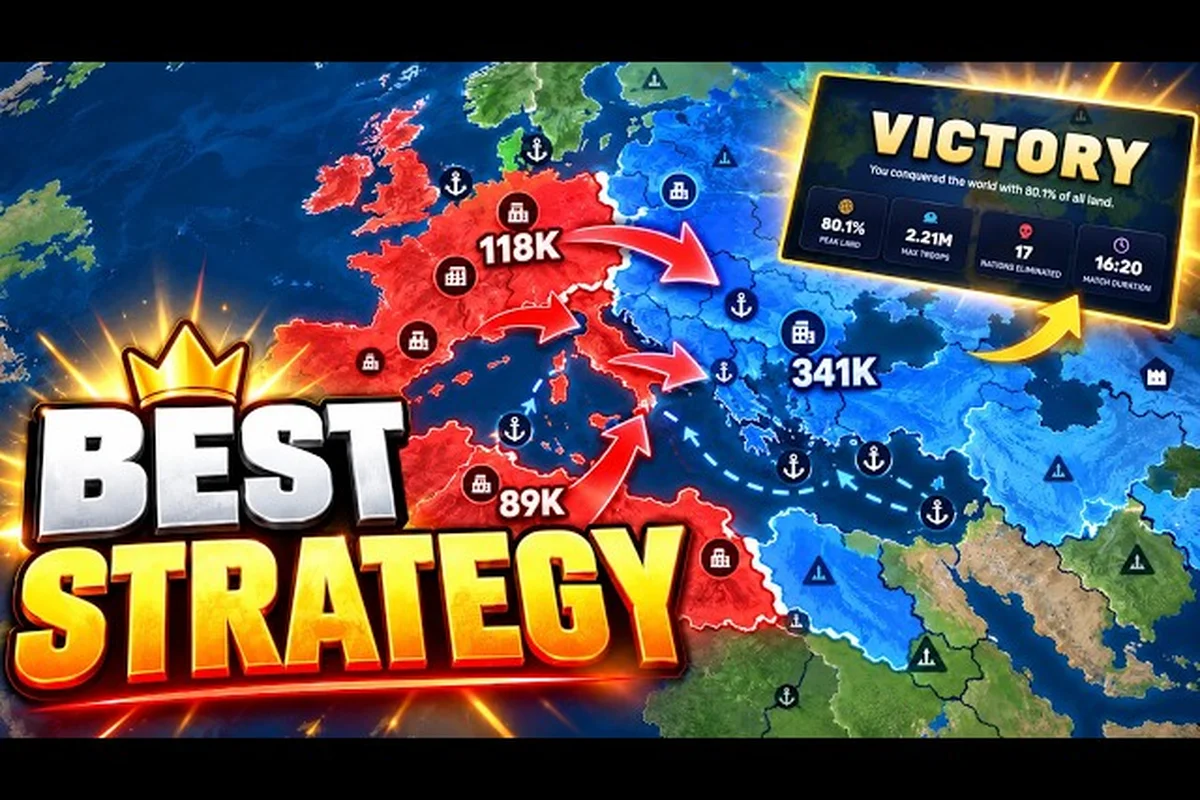
RoWorld diplomatic strategy matters because control depends on both expansion and diplomacy. The official Roblox listing describes a world with 88 player nations, hundreds of tribes, alliances, cities, ports, factories, and a goal of controlling 80% of the world. Learn how to reduce active fronts, build reliable partnerships, and negotiate from a position of strength.
Why roWorld Diplomacy Starts With Map Control
RoWorld diplomacy is not merely a menu of promises. It is the practical work of deciding which borders can be defended, which relationships are useful, and when cooperation gives you more security than another territorial fight. The official RoWorld game page lists alliances among the core features and identifies world control as the victory objective, so every negotiation should connect to a clear strategic purpose.
The world shown on the official page contains 88 player nations and hundreds of tribes, with servers supporting up to 55 players. That scale creates constant pressure: even a strong nation can become surrounded if it expands without considering the map around it. Your best roWorld diplomatic strategy is therefore built around front management—knowing which neighbors are immediate threats, which are distant competitors, and which could become useful partners.
Start by classifying every nearby nation rather than treating all relationships alike. A nation sharing a long border may deserve a truce, while a distant nation with complementary territory may be a better coalition candidate. This is not a permanent judgment, because one player’s reputation and territorial position can change after a major battle.
| Relationship type | Main strategic value | Primary risk | Best diplomatic action |
|---|---|---|---|
| Border neighbor | Security and predictable borders | Pressure or surprise attack | Offer a limited truce |
| Nearby competitor | Exclusive control over key land | Reputation damage after defeat | Negotiate boundaries carefully |
| Distant power | Coalition leverage and shared targets | Competing claims far away | Build conditional cooperation |
| Small neighbor | Easy ally against larger threats | Absorption or sudden betrayal | Support without overcommitting |
| Broken partner | Reputation and retaliatory access | Renewed conflict | Offer terms, then rebuild trust |
Front count is the most useful diplomatic metric you can track without relying on unpublished numbers. Every active hostile relationship adds attention, travel time, and defensive responsibility. A successful agreement may therefore be more valuable than one additional border, especially if it frees forces to protect factories, ports, and cities.
The official listing also confirms that ports, factories, and cities are meaningful parts of the world. Use those features to understand each neighbor’s priorities. A player seeking coast access may value a different agreement than a landlocked power seeking security. More specific offers are easier to accept and less likely to create hidden resentment.
Building roWorld Alliances With Clear Purpose
Strong roWorld alliances begin with a shared interest that is concrete enough to guide behavior. “We are friends” creates no useful decision rule, while a mutual defense against a nearby aggressor, respect for a border, or coordinated pressure on a third power gives both parties something concrete to preserve.
Before proposing an agreement, identify what you can offer and what you need in return. Possible contributions include avoiding a border attack, supporting a partner’s territorial claim, opening cooperation against a shared enemy, or keeping another nation from joining a rival coalition. Avoid offering more than you can monitor, because an unmanageable promise can turn a useful partnership into another crisis.
Match the Agreement to the Threat
Different situations call for different forms of cooperation. A temporary arrangement can stabilize a dangerous border, while a broader arrangement may help a coalition divide targets. The roWorld alliance guide provides more detail on forming relationships and assessing their risks.
| Situation | Suitable arrangement | Main advantage | Main limitation |
|---|---|---|---|
| Immediate border tension | Short truce | Buys time to assess intentions | May expire without warning |
| Common nearby enemy | Defensive alliance | Shares defensive pressure | Can create chain conflicts |
| Contested distant region | Coalition cooperation | Concentrates influence | Requires coordination |
| Unequal power relationship | Limited partnership | Gives smaller nation protection | May create dependency |
| Recovering from betrayal | Conditional rebuild | Restores some cooperation | Requires demonstrated follow-through |
Write a Simple Relationship Contract
Even without assuming undocumented menu settings, you can keep a personal agreement record. Note the participants, purpose, territory mentioned, start condition, and behavior that would end the arrangement. This is especially valuable when the official listing describes many alliances operating across a busy multiplayer world.
A simple record prevents three common mistakes: confusing old cooperation with current permission, assuming silence means consent, and forgetting what another nation already accepted. Keep promises observable. If the agreement concerns a border, avoid actions that make the other player feel immediately threatened even if the letter of the agreement allows them.
Credibility compounds because diplomacy depends on expected future behavior. Deliver the first promise completely, avoid opportunistic attacks, and acknowledge mistakes. A smaller, respected partner can sometimes be more useful than a larger ally whose intentions remain unclear.
Managing roWorld Truces Without Creating Weakness
A roWorld truce is most valuable when it removes uncertainty, not when it replaces all strategy. The official page confirms alliances, but community reports also describe truce behavior; the exact menus and enforcement details are not published, so treat them as observed experience rather than guaranteed rules. A wise player uses a truce to protect a border while gathering better information about a potential partner or enemy.
Before accepting a truce, compare the arrangement with your current map position. A deal is attractive when it removes a dangerous front without surrendering access to territory you still need. It is weak when it freezes you in a poor position while a rival expands freely nearby. The map matters more than the label attached to the relationship.
Test Intentions Through Limited Cooperation
Rather than demanding total commitment, begin with a small action that reveals priorities. A player may honor a non-attack understanding while still seeking cities elsewhere, or it may cooperate honestly but lack the strength to help in a larger war. Limited tests help distinguish capacity from willingness without forcing a premature coalition.
Avoid using a truce to justify reckless expansion beside the other player. If you repeatedly pressure a supposedly peaceful border, your actions may outweigh the agreement, and other nations may view you as a threat. The best truce leaves both sides with a credible boundary and a reason not to reopen the dispute.
| Question before agreeing | Why it matters | Caution sign |
|---|---|---|
| Does this remove a current front? | Improves defensive stability | It only delays an expected attack |
| Can both sides explain the terms? | Reduces misunderstanding | Different players describe different deals |
| Does the agreement fit current map needs? | Supports sensible expansion | It locks you into a poor position |
| Can you monitor compliance? | Protects against opportunistic moves | Information is scarce and contradictory |
| Is the end condition clear? | Makes cooperation manageable | Every issue remains open-ended |
Reputation under pressure matters more than reputation when idle. A player who respects a truce while losing ground is making a visible signal. A player who attacks after asking for trust makes future partners more cautious, even if the attack is strategically effective.
Expanding roWorld Teaming Into a roWorld Coalition
RoWorld teaming should begin with a limited objective and a clear division of roles. Two players may share a target, defend different sectors, or provide economic and territorial support. A larger roWorld coalition adds complexity because more members can pursue conflicting goals, so agreement on the main target must come before detailed coordination.
Define the Coalition’s Center
A coalition needs a center of gravity: the border that is most dangerous, the region everyone wants, or the opponent that threatens all members. Without a shared center, separate plans may pull the group in different directions. Members can still have secondary interests, but those interests should not distract from the immediate objective.
The roWorld world war guide explains how alliance pressure and late-game diplomacy can change as the match advances. That broader view is important because a useful team during the opening phase may become a liability when control becomes concentrated around a few powerful nations.
| Coalition role | Contribution | Coordination need |
|---|---|---|
| Main attacker | Engages the central target | Agree on target and timing |
| Flanking force | Distracts from another direction | Avoid conflicting orders |
| Defensive anchor | Holds shared border | Maintain early warning and supply |
| Economic supporter | Protects cities, ports, or factories | Share threats and priorities |
| Flexible member | Reacts to unexpected moves | Agree on acceptable losses |
Prevent Coalition Dilution
Coalitions decay when membership grows faster than trust. Set a reasonable cap for operational decisions, use smaller groups for tactical choices, and avoid promising every member equal influence. A rotating spokesperson can reduce disputes, but participants still need enough information to make sound decisions.
Treat threats to one member as relevant data for the whole coalition. If one nation suddenly faces several enemies, the others should decide whether intervention improves the shared position or merely pulls them into an unwanted war. This is where roWorld diplomacy becomes a coordination system rather than a collection of private promises.
Coalition discipline means stating what happens when a member leaves, loses land, or changes direction. Exact penalties are not confirmed in official materials, so do not invent them. Instead, preserve the coalition by keeping plans modular, sharing information early, and avoiding a structure that collapses when one player withdraws.
Using Reputation to Support Diplomatic Goals
Reputation is the result of visible behavior, not a status bar you can assume exists. Players observe whether you keep a truce, honor a joint operation, avoid opportunistic attacks, and respond reasonably after a disagreement. The official game page identifies alliances as a feature, but it does not publish numerical reputation values, so all relationship guidance should remain strategic rather than mechanical.
Track reputation in three practical categories: reliability, restraint, and competence. Reliability means keeping stated commitments. Restraint means not demanding resources or attacking when the situation no longer supports the original agreement. Competence means making partners stronger rather than exhausting them before the joint objective is complete.
Repair a Damaged Relationship
A broken agreement does not always require permanent hostility. Begin with a clear acknowledgment, return to the smallest useful cooperation, and make each subsequent promise easy to verify. If the other party refuses, contain the damage by securing borders and avoiding a spreading cycle of revenge.
Community players have reported a traitor mark after certain alliance breakdowns, although the duration and effects are not confirmed in official materials. Treat that behavior as a reason to evaluate trust, not as a known punishment with a published value. The traitor-mark guide can help separate observed mechanics from unsupported assumptions.
| Reputation signal | Likely interpretation | Response |
|---|---|---|
| Truce respected under pressure | Strong reliability signal | Offer a slightly deeper agreement |
| Delayed communication | Possible misunderstanding | Clarify terms before committing |
| Repeated border pressure | Weak restraint | Prepare defenses and reduce exposure |
| Opportunistic attack | Major trust breach | End cooperation and secure borders |
| Honest retreat from a target | Practical reliability | Keep the relationship open |
Credible restraint can preserve influence after a failed alliance. A player who accepts that a joint plan no longer makes sense is not necessarily weak; a player who keeps attacking for prestige may be harder to work with. The best roWorld diplomatic strategy treats reputation as a long-term asset that reduces the number of people you must watch.
A Practical Decision Framework for Every Offer
Before agreeing to an alliance, truce, or coalition plan, run the decision through four filters: necessity, proportionality, observability, and reversibility. This framework does not depend on hidden stats and can be used with any player, including one whose preferred build is focused on expansion. For broader nation-level priorities, including island and landlocked positions, see the large-nation strategy guide.
Necessity
Ask whether the proposed agreement solves a real problem. If the relationship does not protect a border, unlock cooperation, or prevent a dangerous front, it may add communication overhead without strategic value. Sometimes the best answer is no alliance at all.
Proportionality
Match the commitment to the need. A border anxiety may justify a limited truce, while a shared existential threat may justify a coalition. Avoid promising broad support for a narrow problem, because unmet expectations can damage trust more than an honest refusal.
Observability
Prefer behaviors that can be seen. A border agreement should correspond to observable border activity. A joint operation should have an agreed enemy and general area of action. If you cannot tell whether the other side has complied, reduce the scope or gather more information.
Reversibility
Leave room for the map to change. Conditions can expire because a nation grows stronger, a third power intervenes, or a shared target disappears. A reversible agreement is easier to revise honestly than one that creates an embarrassing choice between breaking a promise and accepting a dangerous outcome.
| Decision filter | Key question | Warning sign |
|---|---|---|
| Necessity | Does it solve a current problem? | Cooperation exists only as a vague idea |
| Proportionality | Is the commitment proportionate? | The promise is much broader than the need |
| Observability | Can compliance be assessed? | No shared reference point |
| Reversibility | Can it be revised safely? | Every change requires total abandonment |
After applying the filters, compare the expected benefit with the number of new obligations. roWorld alliances are strongest when they solve a larger problem than they create. If the relationship adds two potential enemies, removes no threat, and consumes constant attention, it is not a partnership worth pursuing.
Applying Diplomatic Strategy Across the Match
Early, middle, and late phases demand different forms of roWorld diplomacy. Early relationships are easy to establish but their value may be unclear. Middle-game agreements become more important as borders harden. Late-game cooperation often depends on whether the world has narrowed into a few major powers and shared threats have changed.
Early Match: Gather Information
Focus on neighbors, identify immediate threats, and offer narrow cooperation where useful. Protect developing cities, ports, and factories while learning whether players keep basic commitments. Avoid joining a large coalition merely because its leader appears influential; early membership can drag you into distant conflicts.
Middle Match: Formalize Useful Cooperation
Convert successful local understandings into clearer arrangements. Define the target, create communication routines, and make responsibilities explicit. This is a good period to establish a truce with a competitive neighbor if a third power is pushing you both toward an unwanted war.
Late Match: Protect the Coalition Center
As major powers absorb smaller territories, survival may depend on a shared regional goal. Review commitments, eliminate weak links, and prevent the coalition from expanding beyond its ability to coordinate. If an ally becomes a direct competitor, separate defense of the shared center from disputes over secondary territory.
| Match phase | Main diplomatic goal | Best relationship focus | Common mistake |
|---|---|---|---|
| Early match | Identify trustworthy neighbors | Limited truces and tests | Joining large teams too early |
| Middle match | Stabilize useful relationships | Clear alliances and borders | Vague promises between busy players |
| Late match | Survive among major powers | Focused coalition objectives | Fighting every available opponent |
| Final contest | Preserve coalition viability | Shared target and clear roles | Letting individual goals fracture the group |
This phased approach also prevents negotiation from becoming detached from the map. A relationship that looked essential earlier may now consume resources that would be better spent defending a vulnerable city. A partnership that was unnecessary before may become valuable when a common enemy emerges.
Common roWorld Diplomatic Mistakes to Avoid
The largest errors come from treating diplomacy as a one-time click rather than an ongoing management process. Players can make a promise while focused on expansion, forget which region it covered, and later interpret another nation’s move as hostile without checking the original context. A simple relationship log reduces this confusion.
Another mistake is confusing a large coalition with strong coordination. Adding members can increase pressure on a target, but it can also create competing objectives, delayed decisions, and arguments over credit. Keep the coalition’s immediate target narrow and use smaller task groups for regional decisions.
Avoid opportunistic attacks against partners when the strategic benefit appears large. Such a move may produce land immediately while making every future player less willing to cooperate. If a relationship must end, end it openly and avoid expanding into the former partner before the other side can reorganize.
Conduct a Pre-Commitment Review
Before accepting a significant agreement, verify the following:
-
The current map supports the promised arrangement.
-
The relevant nation has authority over the people acting for it.
-
The scope is specific enough to evaluate.
-
Both sides understand which actions would violate it.
-
The agreement has a clear end or review condition.
-
The relationship improves your security rather than merely enlarging a roster.
-
You can monitor important commitments without constant distraction.
-
A fallback plan exists if the shared target changes.
This review is particularly useful when reputation is already uneven. A cautious agreement with a proven partner can be worth more than a tempting offer from an unknown player. The roWorld strategy guide can help connect diplomatic choices with economy, expansion, and overall map priorities.
Building a Reputation That Supports Long-Term Cooperation
Long-term cooperation requires a stable approach to promises. The most useful standard is whether another nation can predict your behavior when you stand to gain from breaking a deal. Consistency under pressure creates trust, while opportunistic inconsistency may be rational in the short term but expensive across the rest of the match.
Communicate early when circumstances change. A player that cannot complete an obligation should provide enough context for partners to adjust. Silence forces everyone to prepare for the worst and may turn a manageable disagreement into a front. This is especially important in a world where alliances and territorial control operate on the same map.
Use Small Commitments to Build Trust
A series of modest, completed obligations is usually more persuasive than one dramatic promise. Test cooperation through narrow matters, document the result, and expand only after both sides demonstrate reliability. This method reduces the damage caused by misunderstandings and makes reputation easier to evaluate.
| Trust-building habit | Practical result | Long-term advantage |
|---|---|---|
| Keep written notes | Fewer scope disputes | Clearer accountability |
| Honor narrow terms | Proves basic reliability | Opens deeper cooperation |
| Communicate changes early | Gives partners time to adapt | Reduces surprise conflict |
| Avoid opportunistic attacks | Protects future trust | Encourages stable coalitions |
| Give partners room to recover | Prevents unnecessary humiliation | Makes peace easier later |
Reliable follow-through is the common thread across successful partnerships. It matters in small border agreements and major coalitions alike. If you must break an agreement, minimize surprise, avoid immediate exploitation, and give the other side a chance to disengage. That behavior cannot erase every betrayal, but it can keep a single broken promise from poisoning every future relationship.
Putting the Full roWorld Diplomatic Strategy Into Practice
A durable roWorld diplomatic strategy combines map awareness, limited commitments, visible reliability, and coalition discipline. The official RoWorld listing identifies the Torrey Pines creator group as the official community, but the game does not publish every truce rule, reputation value, or penalty. Use confirmed features and community experience while avoiding claims about undocumented numbers.
Your next match can begin with a simple plan: map every nearby relationship, choose one border worth stabilizing, offer a limited proposal with a clear purpose, and record the terms. As cooperation works, expand from that small foundation into a roWorld coalition aimed at a shared threat. If trust breaks, protect the essential border, contain the retaliation, and decide whether rebuilding the relationship is genuinely safer than abandoning it.
Frequently Asked Questions
What is the best roWorld diplomatic strategy for a new player?
The best roWorld diplomatic strategy is to protect nearby borders before pursuing distant partnerships. Start with a narrow truce, observe whether the other player follows through, and avoid joining a large coalition until you understand its target and expected commitments. Small, completed agreements create useful evidence without tying your early expansion to a complicated political structure.
How do roWorld alliances help control more of the world?
RoWorld alliances can divide attention and pressure across multiple fronts, allowing members to focus on different regions while opposing a shared threat. They are most effective when they have one clear center of gravity, compatible roles, and simple communication. A poorly coordinated coalition may still capture land, but it can also stretch members into several conflicts and weaken their overall defense.
Should I make a roWorld truce with every neighbor?
No. Make a roWorld truce when a border is dangerous, cooperation offers a strategic benefit, and the terms are clear enough to follow. A truce can be valuable even without a broader alliance, but it should not freeze you into a poor position while rivals expand. Evaluate each neighbor according to immediate threat, map position, reliability, and the possibility of future cooperation.
How can I recover after breaking a roWorld alliance?
Stop expanding into the former partner’s territory, acknowledge the broken commitment, and restore basic security before attempting to rebuild trust. A small, observable action is more useful than a large promise made under pressure. If the other player refuses reconciliation, contain the conflict, reinforce your borders, and prevent retaliation from spreading into unrelated relationships.
When should a roWorld coalition split apart?
A roWorld coalition should reconsider its structure when members pursue conflicting targets, decisions become too slow, or the shared threat disappears. Avoid a dramatic split when only one secondary objective is disputed; divide responsibilities and protect the main coalition center instead. If the coalition no longer improves survival or territorial leverage, ending it cleanly is better than maintaining a fragile alliance that weakens every member.