
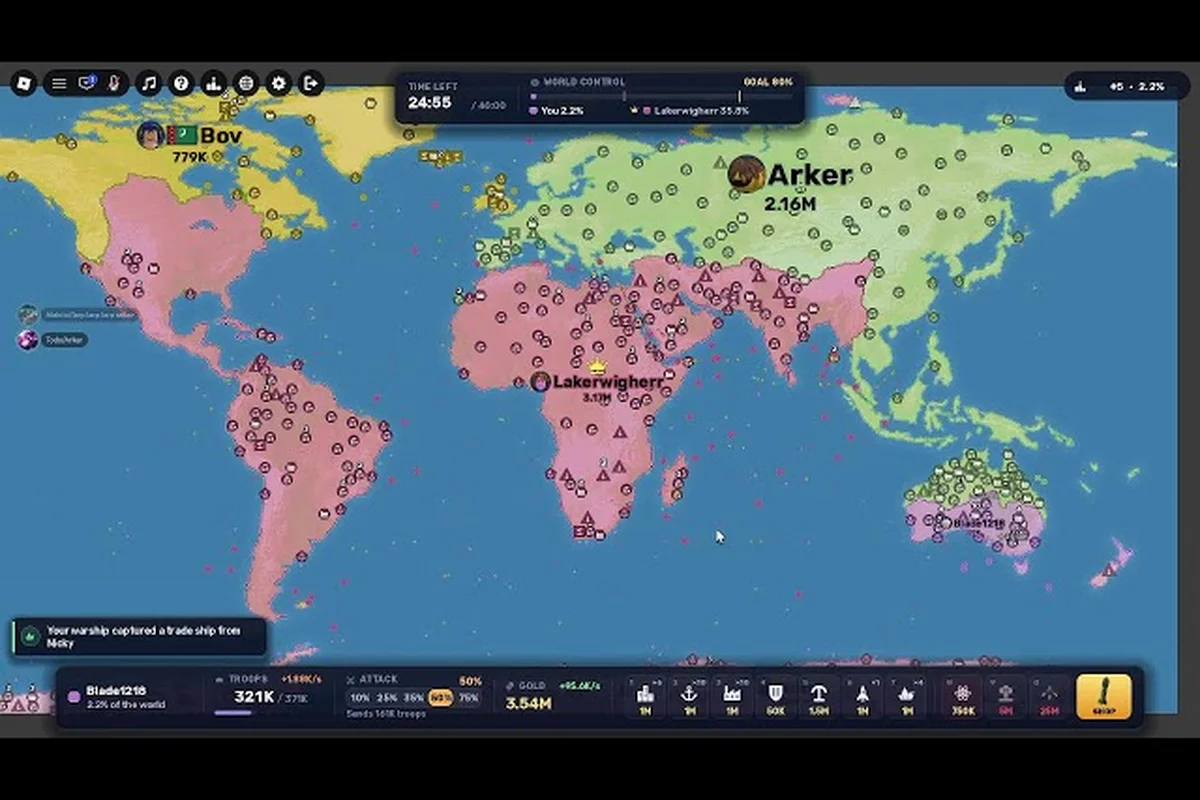
A roWorld world war turns every scattered border into a potential target, so priorities shift from broad expansion to securing supply lines and reducing simultaneous threats. Winning late-game conflicts depends on consolidating active fronts, using alliance chat to coordinate attacks, and building a defensive buffer around key territory. A solo player may need fewer commitments to avoid overextending, while a team can divide responsibilities for sieges, resource collection, and border defense. This balance matters because creating too many enemies leaves fewer alliances available to help counter a major offensive.
How roWorld World War Late Stages Change the Game
In the official Roblox listing, RoWorld supports up to 55 players per server, with nations and tribes sharing a large map. The same listing identifies 88 player nations, hundreds of tribes, cities, ports, factories, alliances, and nuclear weapons as core features. It also states that controlling 80% of the world wins the match. These details make global control more than a slogan: it is the stated victory condition.
The late game is not simply a larger version of the opening. Early expansion usually emphasizes secure nearby land and a functioning economy. During a roWorld world war, a player may simultaneously need to protect a coastal port, support an ally, contain a hostile border, and decide which distant territory is worth attacking. Every action can alter who regards you as a friend, neutral party, or immediate threat.
That is why roWorld late game diplomacy becomes a strategic skill rather than a social side activity. The official Torrey Pines creator group on Roblox is the only verified official community channel found during research, so players should treat balance details and unconfirmed mechanics cautiously unless they appear on the official game page.
| Late-game condition | Main strategic risk | Best response |
|---|---|---|
| Borders touch several rivals | Attacking one front exposes another | Prioritize the least dangerous neighbor |
| Territory is scattered | Resources and defenses become harder to manage | Consolidate before expanding again |
| Allies hold strategic land | War plans depend on another player | Record roles and contingency plans |
| A powerful rival emerges | A regional contest becomes global | Form a defensive coalition |
| Internal expansion slows | The match may settle into stagnation | Seek valuable coast, ports, or choke points |
Separate Strategic Goals from Immediate Threats
A dangerous neighbor is not automatically your most urgent enemy. A border rival may occupy valuable land beside you, while a distant power may be more capable of defeating you if left unchecked. Before committing troops, separate the player who can hurt you immediately from the one whose growth would change the entire balance.
Use three questions during a roWorld world war to separate immediate danger from long-term strategic risk. If a border rival controls developed land near your exposed territory, calculate whether it can reinforce that front before your own infrastructure is secure. If a distant player has the capacity to build a larger war machine, estimate how that growth could shift late-game power and decide whether an early strike prevents a future threat better than defending now.
-
Proximity: How quickly can this rival reach my exposed territory?
-
Capacity: Does this player have enough developed land and infrastructure to sustain a serious campaign?
-
Intent: Has the player shown aggression, accepted cooperation, or remained deliberately neutral?
Community reports describe truces, non-aggression arrangements, alliance chat, and a traitor mark following betrayal. However, the official page confirms alliances as a feature without publishing detailed rules for those behaviors. Treat them as reported systems that may vary by server or update, not guaranteed fixed rules.
Use a Simple Threat Matrix
| Assessment | Low immediate threat | High immediate threat |
|---|---|---|
| Low long-term risk | Preserve access and avoid wasting resources | Monitor closely and prepare defenses |
| High long-term risk | Seek talks or a limited agreement | Reduce the threat before another front opens |
This matrix prevents reactive warfare. It also helps answer the practical question of roWorld how alliances work in strategic terms: an alliance is most valuable when it covers a risk that would otherwise force you to divide attention. It is less useful when it duplicates an alliance you already have or creates obligations that pull you into unrelated wars.
Before entering the final phase, review the roWorld early, mid, and late-game guide to identify which land is strategically essential and which is merely attractive. A world war rewards concentration, not an endless sequence of border additions. Treat that as a planning rule rather than a fixed statistic.
roWorld Solo vs Team Play for Global Conquests
The roWorld solo vs team decision is not simply a preference between playing alone and playing with allies. It determines how quickly you can gather information, move forces, coordinate invasions, and recover from a failed attack. RoWorld supports alliances, and its late-game world can contain dozens of nations, so the practical difference between isolated and coordinated play grows as the map becomes crowded.
A solo player has complete freedom of decision. No ally can delay a campaign, dispute a target, or accidentally open another border. That control is valuable when your identity depends on maintaining a specific territorial shape or when you distrust nearby players. The cost is that every scouting, negotiation, defense, and attack depends on your own attention.
A coordinated player gains additional eyes and a broader set of targets, but coordination becomes a form of overhead. Even when an alliance is friendly, members may value different land, face different enemies, or interpret a joint promise differently. The strongest team strategy therefore assigns roles before declaring a common target.
| Decision factor | Solo approach | Team approach |
|---|---|---|
| Control of decisions | Immediate and complete | Shared through negotiation |
| Information gathering | Limited by personal attention | Distributed among members |
| Attack planning | Easier to conceal | Stronger with clear roles |
| Relationship risk | Low coordination risk | Betrayal and misunderstanding risk |
| Best strength | Flexible reaction | Combined capacity |
| Main weakness | Overextension | Misaligned priorities |
When Solo Control Is the Better Choice
Solo play is strongest when your territory is compact, your economy is stable, and nearby rivals cannot easily exploit a prolonged expedition. It also works well when you do not yet know whether a potential partner sees the conflict as a mutual defense or merely an opportunity to take your land.
Do not remain solo merely because you once preferred independence. Compare the cost of isolation with the benefit of partnership. If one hostile player controls several useful border regions, a temporary coalition may be more valuable than winning several disconnected skirmishes. A coalition can divide attention across separate targets, but every participant still needs a reason to continue cooperating.
Compact solo expansion is usually safer than scattered solo expansion. A player with contiguous land can protect the same borders with fewer defensive responsibilities, while disconnected holdings create more approaches for enemies to test. If expansion has created several isolated pockets, consolidation may be worth more than another conquest.
When a Team Changes the Strategic Equation
A capable team can divide responsibilities into scouting, production, border defense, and direct assault. That structure gives each member a defined purpose and reduces the number of decisions the leader must handle alone. It can also create a clearer message to opponents because coordinated threats often deter an invasion before the first attack.
The risk is a coalition agreement gap. One member may want to conquer a city, another may want secure ports, and a third may simply want to survive. Those goals can overlap, but they are not identical. Before committing, define the common minimum: which target, how long the effort will last, who handles defense, and what happens if another alliance joins the conflict.
For broader cooperation mechanics, the roWorld alliance strategy guide explains how to frame an alliance around shared interests instead of vague promises. Keep the conversation focused on observable decisions, because reputation becomes more valuable when players can predict how you will behave under pressure.
roWorld Teaming Rules, Alliance Chat, and Trust
The roWorld teaming rules are not published as a comprehensive rulebook, so reliable strategy comes from using visible agreements, consistent behavior, and conservative assumptions. Alliances are officially confirmed, while truces, non-aggression pacts, alliance chat, and the reported traitor mark remain community observations. This distinction matters because a strategy built around an undocumented penalty may fail if that behavior changes.
A practical agreement should answer four questions without requiring a long negotiation: define the shared target, identify actions that breach trust, establish how plan changes are communicated, and explain what happens when an ally is attacked elsewhere. For example, a roWorld coalition might agree to focus on one adjacent district, require alliance-chat notice before targeting a new settlement, and treat an unannounced solo attack as a breach. Because documented roWorld teaming rules are limited, the agreement should rely on observable commitments rather than assumed penalties or presumed loyalty.
-
What territory or outcome is the team pursuing?
-
Which actions count as a breach of trust?
-
How will members communicate a change of plan?
-
What happens to shared commitments if a member is attacked elsewhere?
Keep the agreement short enough to remember under pressure. A long list of promises sounds serious but creates more opportunities for accidental violations. Visible commitments are more useful than implied loyalty because they give partners a standard against which to judge future actions.
| Agreement point | Clear version | Risky version |
|---|---|---|
| Shared target | Conquer the adjacent district together | Help whenever convenient |
| Territory | Divide based on agreed landmarks | Take whatever each member wants |
| New enemies | Consult before expanding the coalition | Invite anyone without discussion |
| Communications | Keep alliance chat focused on shared plans | Use the channel for unrelated arguments |
| Withdrawal | Give notice and settle responsibilities | Leave when the situation becomes difficult |
Use Alliance Chat as an Operations Channel
RoWorld alliance chat is most effective when messages produce decisions. A channel filled with reactions, accusations, and repeated warnings becomes harder to use during a live campaign. Organize communication around current conditions, agreed targets, and requests that need a response.
A useful message pattern is situation, intent, request. For example: “A hostile group is building beside our eastern border. We intend to hold the city and counterattack if they advance. We need our partner to watch the northern approach.” This communicates enough for the partner to act without exposing every detail of your plan.
Short operational messages are particularly valuable during a world war because plans can change between moments. If negotiations concern a formal agreement rather than an immediate military decision, use the game’s visible alliance request or agreement system where available, then preserve the essential terms in alliance chat for coordination. The broader mechanics of gold, requests, cities, ports, and factories are covered in how RoWorld resources and structures work.
Verify What Counts as a Betrayal
According to community reports, breaking an alliance can leave a traitor mark that signals the breach to relevant players. The exact visibility and consequences were not published in the official materials reviewed, so do not build a strategy around an assumed duration or mechanical penalty. The safer principle is that a breach can affect trust even when the visible punishment is small.
Before attacking an ally, distinguish between several situations: a planned operation against a shared enemy, a change caused by immediate self-defense, a disagreement over territory, and deliberate seizure of allied land. Only the last two may resemble betrayal in the community understanding. Clear communication before entering a disputed border can preserve the relationship.
If a betrayal has already occurred, the roWorld traitor mark and alliance-betrayal guide provides a framework for separating visible consequences from reputation damage. The more important question is whether you can still work with that player without rewarding deliberate aggression.
A Practical Plan for roWorld World War Invasions
A roWorld world war invasion should proceed as a sequence of decisions rather than a single button press. Define the target, protect the home front, use allied support deliberately, and leave an exit plan before committing. Since official production, troop, damage, and attack values are not published, this plan relies on decisions and priorities rather than invented percentages.
Start with target value. A distant city is not automatically better than a nearby port or strategically useful inland area. Consider the value of the land, the effort required to hold it, the number of defenders, and whether your current economy can support another front. The best target is one that improves your position without exposing an even larger vulnerability.
| Invasion phase | Primary question | Preferred action |
|---|---|---|
| Target selection | Does the prize improve your strategic position? | Choose a defensible, useful objective |
| Preparation | Which home borders become exposed? | Secure them before moving |
| Coordination | Who attacks, supports, and protects? | Assign distinct roles |
| Execution | What is the fallback if the plan stalls? | Choose a limited objective |
| Consolidation | Can the new land be defended? | Secure it before expanding again |
Build the Campaign Around a Limited Objective
Overambitious invasions fail when they require several successful steps in a row. A limited objective might be taking one valuable district, disrupting a nearby rival, or demonstrating strength without occupying the entire region. It should produce a meaningful advantage even if a broader campaign does not proceed.
Prepare successor objectives instead of assuming one path. If the initial target is heavily defended, redirect toward a secondary area, protect the line of advance, or disengage. Flexible plans reduce the chance that a temporary setback becomes a complete collapse.
Protect the Home Front Before Departing
An attack creates an opening because attention and forces move away from another border. Before invasion, identify the exposed side of your territory and place enough defense there to discourage opportunistic players. This is especially important when alliances exist nearby, because another faction may interpret one conflict as permission to test a third.
The one-front principle is valuable here: avoid simultaneous major offensives against unrelated enemies unless your coordination can handle them. A carefully supported campaign against one target often produces a better result than two half-supported attacks that allow each opponent to respond separately.
Choose Allies by Complementarity
A strong ally should cover a capability or risk that you cannot cover alone. Geography is one of the clearest examples: one player may be positioned to block reinforcements while another handles the direct approach. Shared border access can reduce risk, but it also requires precise boundaries around objectives.
Do not recruit allies solely because they are powerful. Verify where their interests lie, whether they already face another threat, and whether a successful campaign would create a rival stronger than the target you removed. This is where roWorld late game diplomacy becomes a balance of immediate gain and future threat.
The guide to avoiding unnecessary wars in RoWorld can help refine ally selection, especially when a neutral player could become a valuable buffer. A useful neighbor can be more valuable than an extra combatant. Use it to choose the next move, then confirm details in the live match.
Managing Reputation, Betrayals, and Sudden Coalitions
Late-game diplomacy is reactive because every victory changes the map’s balance. Defeating one player may unite their threatened neighbors, while revealing a strong alliance may encourage other groups to coordinate against both members. Reputation therefore includes not only whether you keep promises, but also whether your overall growth appears likely to threaten everyone around you.
A reliable player can still face a hostile coalition. That does not make reputation irrelevant. It changes the quality of your options: trusted partners are more likely to supply warning, offer a truce, or accept a limited negotiation, while opportunistic players may wait for your next expansion before acting.
| Reputation signal | Likely interpretation | Strategic response |
|---|---|---|
| Keeping a limited agreement | Predictable and useful | Offer a bounded cooperation |
| Abruptly taking allied land | High relationship risk | Require clearer boundaries |
| Defending a shared enemy | Capable coalition partner | Discuss a broader defense |
| Expanding toward every neighbor | Threat to the whole region | Seek a common balancing front |
| Exposing a rival’s attack | Stabilizing influence | Build trust before proposing expansion |
Rebuilding trust through a smaller arrangement
After a disagreement, decide whether the relationship still serves a strategic purpose. A public apology may clarify intent, but it does not erase a betrayal. A repaired alliance should begin with a smaller arrangement that can be verified through behavior. For example, both sides might agree not to attack a defined border for a period, while concentrating on a shared external threat.
Avoid asking for unconditional trust after a breach. In late-game roWorld world war diplomacy, trust is better treated as a sequence of testable commitments, with each promise tied to a specific action, a deadline, and an observable result. Small verifiable promises can include sharing a resource transfer, honoring a temporary border pact, or withholding an attack for a fixed number of rounds. This gives solo and team players evidence in alliance chat before either side relies on lasting cooperation. If one commitment fails, the response can be limited to reversing that concession rather than abandoning the entire roWorld alliance, preserving leverage without pretending that history no longer matters.
Preparing for a Betrayal
Prepare for betrayal without treating every partner as an enemy. Keep important forces mobile, avoid making one ally responsible for your entire defense, and do not place your capital or core economy in an exposed corner. These principles improve resilience whether or not anyone breaks the agreement.
The best response to a traitor depends on the situation. If the betrayal is limited, contain it and preserve your remaining alliances. If it creates a larger strategic threat, demonstrate that unilateral aggression carries a cost. Avoid overreaction, though, because a dramatic response can unite the betrayer’s other neighbors against you.
Knowing When to End a War
Continuing an expensive conflict can weaken the victor more than the target. End negotiations when a specific goal has been reached, the cost of further fighting exceeds the land’s value, or the opponent can no longer threaten your core interests. A negotiated border may be more valuable than a temporarily captured district that creates a permanent front.
The roWorld alliance benefits and risk guide offers a useful framework for deciding whether cooperation still produces a net benefit. In the final phase, the best diplomatic outcome is often stable borders, not maximum hostility. That keeps expectations realistic whenever the board or patch changes.
Frequently Asked Questions
Is roWorld solo vs team play better for winning a world war?
Solo play gives you complete control and can be effective with compact territory, but team play adds scouting capacity, coordinated attacks, and shared defense. The better choice depends on communication and trust more than player count. A small, reliable alliance can outperform a large group whose goals conflict, while solo expansion is vulnerable once several rivals begin probing borders.
What are the most important roWorld teaming rules for late-game play?
Treat visible agreements as the foundation of roWorld teaming rules because a complete official rulebook is not published. Define the shared target, territory boundaries, defense responsibilities, and response to new threats. Keep alliance chat focused on decisions, record changed plans promptly, and avoid assuming that a reported traitor mark captures every consequence of betrayal.
How does roWorld alliance chat affect a major invasion?
Alliance chat is the practical coordination layer for a major invasion. Use it to identify the target, assign scouting, attack, and defense roles, and communicate changes before they create confusion. Because messages may be missed during combat, agree on simple signals and fallback conditions. The chat should reinforce a plan, not become the only place where the plan exists.
Should a player accept an alliance during a roWorld world war?
Accept an alliance when it covers a real strategic need, such as blocking a dangerous neighbor or sharing a difficult invasion. First verify the potential partner’s position, reputation, existing obligations, and likely goals. A powerful ally with incompatible priorities may be less useful than a smaller player whose borders and interests align with yours.
Can roWorld how alliances work change after a betrayal?
Yes, even if the mechanical penalty is uncertain. A betrayal can alter trust, attract new enemies, and make former partners coordinate against you. Because the exact traitor-marker effects are community-reported rather than fully documented, prepare operationally and judge each relationship by its actions. A limited, verifiable reconciliation may work, but only when both sides accept clear boundaries and credible commitments.