
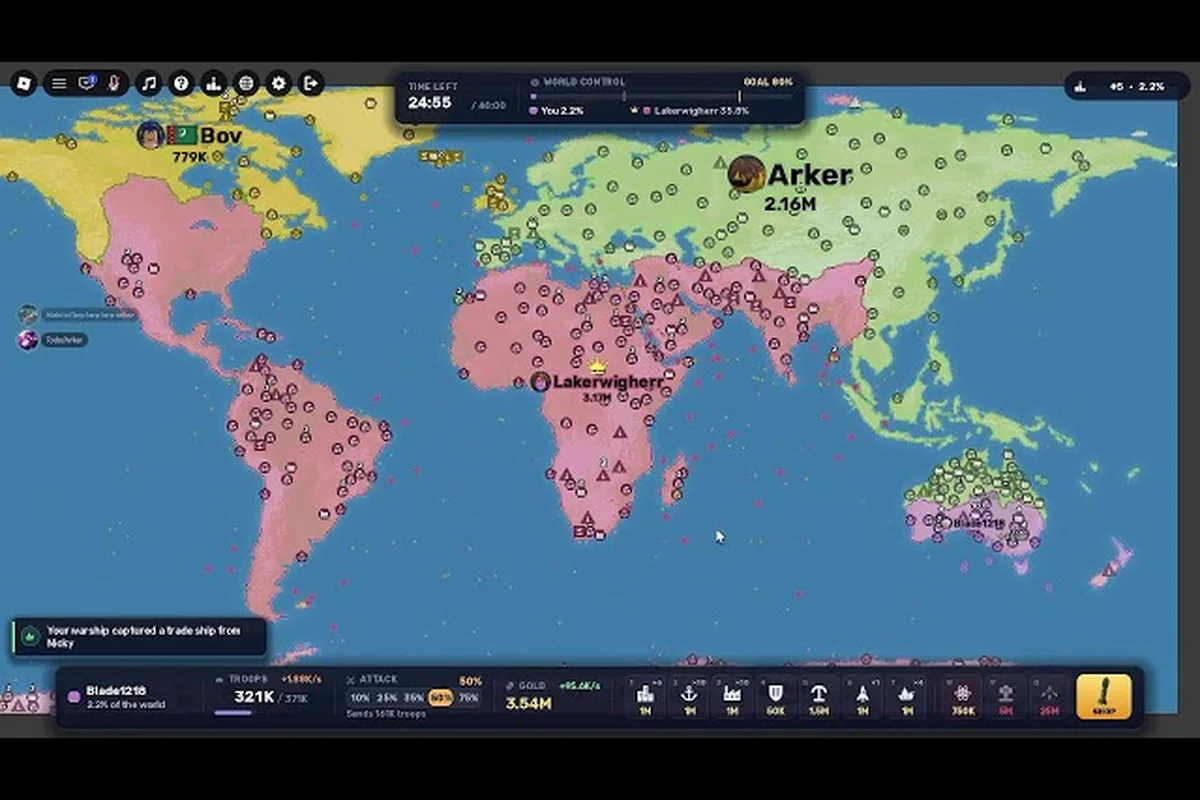
roWorld world map strategy matters because victory depends on connecting territory, economy, and expansion across seven regions, including the Europe Map, Asia Map, Africa Map, North America Map, South America Map, and Middle East Map. A practical example is to anchor your capital in a resource-rich corner of the roWorld Europe Map or roWorld Asia Map, then secure nearby territory before opening a second front. Protecting borders limits rival expansion, while pushing toward weaker neighbors can convert land access into additional income and production capacity.
What the shared world board actually contains
RoWorld is built around a large geopolitical map where nations and tribes compete for land, cities, ports, factories, alliances, and control. The official Roblox page describes servers of up to 55 players, with 88 player nations plus hundreds of tribes sharing the world. Controlling 80% of the world wins the match, so the best roWorld world map strategy is not simply about conquering the nearest neighbor; it is about creating a secure territory that can fund the next wave of expansion.
That distinction matters because every border adds both opportunity and risk. A capital near several land neighbors may begin with more potential expansion routes, but it can also become exposed if the player develops one front faster than the others. By contrast, a safer capital may provide room to build an economy before joining a larger conflict. The official Torrey Pines creator group on Roblox is the best verified public source for announcements, so treat unofficial patch details and balance claims cautiously until they appear on the game page.
The seven-region strategic framework
The full world board includes the Americas, Europe, Africa, Asia, and the Middle East, giving players several very different strategic environments. The regional breakdown below treats the roWorld Europe map, roWorld Asia map, roWorld Africa map, roWorld North America map, roWorld South America map, and roWorld Middle East map as distinct planning zones rather than claiming official map statistics.
| Region | General strategic value | Main pressure | Early planning focus |
|---|---|---|---|
| Europe | Dense connections and many possible neighbors | Fragmented fronts | Protect the capital and choose one clear expansion corridor |
| Asia | Broad landmass with varied coastal access | Long borders and multiple threats | Develop linked inland and coastal holdings |
| Africa | Large open spaces and varied coastal access | Logistics over long distances | Secure a defensible interior and dependable port access |
| North America | Strong north-south and coastal options | Exposure along several approaches | Anchor inland before committing to coast |
| South America | Compact west-east geography with coastal edges | Concentrated southern fronts | Create a central core and protect approaches |
| Middle East | Narrower corridors and strong chokepoint potential | Vulnerable to nearby rivals | Control routes before establishing broad borders |
This framework is intentionally qualitative. RoWorld does not publish official income rates, troop multipliers, attack values, building costs, or upkeep, so any guide that assigns exact percentages to a region would be inventing data. Geometry, border count, coastline access, and the distribution of neighboring settlements are more reliable planning inputs.
The three-stage territorial loop
A successful roWorld world map strategy follows three connected stages. First, establish a capital and develop its nearby economy, prioritizing low-risk expansion so the nation can fund armies and protect settlements. Next, connect that base outward by securing border approaches and useful cities; on the Europe, Asia, Africa, and North America maps, a coherent territorial block is safer than isolated claims. Finally, consolidate a broad region before committing to a distant front, using the regional economy to project power against one high-value rival rather than spreading forces across several fronts.
| Stage | Primary objective | Best action | Common mistake |
|---|---|---|---|
| Foundation | Create a defensible economic core | Expand into nearby low-risk land | Reaching for distant territory too soon |
| Consolidation | Turn scattered holdings into a connected region | Secure border approaches and useful cities | Ignoring weak inner borders |
| Projection | Use the regional base to pressure rivals | Select one high-value target at a time | Spreading attacks across several fronts |
This approach follows the gameplay loop shown in community recordings, where players begin with a starting nation, place a capital, expand into unclaimed land, meet neighbors, develop an economy, and then fight or negotiate. A RoWorld world domination community video illustrates how a small corner can develop into broad control when expansion and consolidation are balanced.
Choosing a Capital Across the World Map
Capital placement determines the shape of your entire campaign. A strong location does not need to be the largest or most aggressive; it should create several viable choices while giving you time to respond. Because RoWorld does not publish official territorial coordinates or a ranked list of spawn locations, evaluate capital candidates through the terrain and your preferred opening.
Border geometry and expansion options
A capital with several land borders offers more potential targets, but it can divide your attention. Compare a capital with many adjacent paths against one with a narrower approach and stronger access to unclaimed interior space. The roWorld world map strategy should favor flexibility, but not ambiguity.
| Capital trait | Strategic advantage | Strategic risk | Best opening |
|---|---|---|---|
| Multiple land neighbors | Several expansion choices | Attention becomes divided | Choose one corridor and stabilize it first |
| Few land neighbors | Easier border defense | Limited nearby targets | Strengthen the economy, then select one frontier |
| Coastal access | Possible port and trade value | Exposed to attacks from the sea | Secure nearby land before defending seaward approaches |
| Inland position | More room to build a regional core | Long routes to coastal assets | Connect interior holdings before pushing outward |
Start with the question: “Where can I make my next three moves without creating an exposed rear?” If one direction offers easy land and another offers a distant port, prioritize the land route while the capital remains stable. This does not mean ignoring valuable coastal targets forever; it means sequencing expansion so every new border supports the previous gains.
Coastlines, chokepoints, and strategic depth
Coastal capitals can be efficient when they offer a port, but they require a layered defense. An inland core is easier to shield, yet it may take longer to connect to ports and other economic assets. The best roWorld world map strategy often creates a route between the two: a protected interior base and a smaller, carefully defended coastal position.
On the roWorld Europe map, dense connections may produce a quick contest for central space, so a player should avoid overextending through several neighboring capitals. On the roWorld North America map or roWorld South America map, large distances can make inland control more stable, although spreading too thinly leaves few forces close to a threat. Treat the coastline as a route, not a prize detached from the rest of your territory.
A capital scorecard
Use this capital scorecard when comparing possible openings on the roWorld Europe, Asia, Africa, North America, South America, and Middle East maps. It does not generate a hidden win-rate percentage; it simply makes the decision more consistent by weighing nearby expansion paths, early defense, and access to cities, ports, or factories. For example, a central capital with two adjacent land routes and one defensible interior approach may offer better opening flexibility than a border capital that reaches a major port quickly but leaves every exposed flank vulnerable to a nearby player.
| Question | Strong answer | Warning sign |
|---|---|---|
| Can the capital support nearby expansion? | Several adjacent land paths | Only one easy target |
| Can it be defended early? | At least one defensible interior route | Every border is exposed at once |
| Does it connect useful features? | Cities, ports, or factories are reachable | Valuable assets are scattered too widely |
| Is the first route realistic? | A short march from the starting area | The opening requires a long vulnerable march |
The roWorld world map strategy becomes clearer when you separate a capital’s economic value from its combat value. A beautiful central location may be strategically strong, while a quieter border capital may be the better platform for patient expansion. Neither is universally correct because your route depends on the behavior of nearby players and the alliances available when the match begins.
Regional Expansion Routes for the roWorld World Map Strategy
Regional play changes the rhythm of conquest. Dense territories reward careful consolidation, while large open areas reward longer planning horizons. The following routes show how the roWorld Europe map, roWorld Asia map, roWorld Africa map, roWorld North America map, roWorld South America map, and roWorld Middle East map can shape a campaign without pretending to be official map statistics.
Europe: competition through density
Europe is naturally associated with close borders and multiple potential rivals. The central strategic problem is deciding which neighbor to reduce first. A broad opening in the roWorld Europe map may expose several fronts, so a capital with a stable rear and one clear offensive corridor is often easier to manage than a position surrounded by equal targets.
Use neighboring settlements to screen your approaches, then connect them to the capital. Cities can support your regional presence, while ports and factories should be treated as linked objectives rather than isolated prizes. If two enemies appear equally attractive, favor the one whose removal gives you safer borders instead of the one that merely looks easier to attack.
Asia: build connected corridors
Asia offers wide-ranging expansion possibilities, but a scattered collection of provinces may not function as a unified territory. In the roWorld Asia map, prioritize a route that links your capital to a port, an industrial area, or a sequence of settlements. That corridor can become a strategic spine for later campaigns.
A good roWorld world map strategy in this region is to expand in stages: secure the nearest unclaimed land, fill vulnerable gaps, and then reach a second economic feature. Avoid jumping from your home region to an isolated target on the opposite side of the board. A distant conquest without a connecting corridor can consume attention while your core remains exposed.
Africa: combine interior depth with coastal access
Africa rewards planning across long distances. The roWorld Africa map can suit a player who wants a broad interior base, but long routes create a danger: a border may be far from the capital and difficult to support. Build one connected zone before establishing several separated claims.
The strongest pattern is usually an inland core linked to a coastal asset. Use the coast to access useful features and the interior to provide room for defense. If your capital is already coastal, extend inward before taking another distant shoreline. This approach turns separate advantages into a network and reduces the risk of being punished from two directions.
North and South America: balance reach and cohesion
The roWorld North America map gives players several ways to interpret “north”: some may focus on northern territory, while others use the phrase simply to mean the continental region. The strategic principle is consistent—avoid assuming that the farthest objective is the best one. Build a defensible center and select the frontier that connects to the rest of your holdings.
The roWorld South America map adds a different geographic rhythm, with a long coast and a more concentrated southern area. A player who expands along both extremes without connecting the middle may create a fragile crescent. The stronger play is to build a central mass, secure nearby approaches, and extend only after the capital can support the new border. A broader RoWorld map guide can help establish which board is best suited to your preferred pace.
Middle East: chokepoints change priorities
The roWorld Middle East map is best treated as a corridor-and-chokepoint problem. Narrow routes can make nearby territory highly valuable, but they also make defense difficult if the capital is too close to a rival. Establish enough depth to absorb pressure before trying to hold several approaches.
The key is to prevent enemies from controlling the routes that connect your settlements. Move along a corridor only when your capital can reinforce the new position. If a target is separated by rival land, consider whether taking nearby territory first would make the eventual advance safer. The roWorld world map strategy in this region often rewards patience because a premature grab can block your own future route.
| Regional route | First priority | Second priority | Why it works |
|---|---|---|---|
| Europe | Secure one approach | Connect nearby holdings | Limits pressure from dense neighbors |
| Asia | Build a corridor | Reach secondary assets | Prevents scattered expansion |
| Africa | Establish interior depth | Link to a coastal feature | Balances defense with access |
| North America | Anchor the center | Extend one frontier | Maintains cohesion over long distances |
| South America | Strengthen the central core | Connect outer territory | Avoids a fragile split map |
| Middle East | Protect the corridor | Expand from secure depth | Prevents chokepoint isolation |
Securing Borders, Cities, Ports, and Factories
Land is useful only when you can protect it and use it. Cities, ports, factories, alliances, and nuclear weapons appear in the official feature list, but the game does not publish official building prices, output rates, or damage values. The roWorld world map strategy should therefore focus on functional value and connection quality, not unsupported numerical forecasts.
Build a connected economic network
Start with your capital and identify the nearest useful feature. Decide whether it should support defense, expansion, or resource access, then connect it before pursuing a second distant target. This creates a network in which every addition strengthens the previous one.
| Feature | Strategic role | Placement principle | Warning sign |
|---|---|---|---|
| City | Local control and regional presence | Near another settlement or a useful corridor | Isolated behind a vulnerable border |
| Port | Access to maritime routes and trade | Protected by nearby land and a clear route | Exposed without an interior connection |
| Factory | Industrial and military support | Inside the defended regional core | Far from the capital and difficult to reinforce |
| Capital | Administrative and territorial anchor | Behind the most stable approaches | Placed too close to several enemy fronts |
Do not treat a feature as valuable only because another player values it. Consider whether it fits your network. A port may be strategically excellent for a coastal empire but less urgent for a player building an inland sphere. A factory might extend your power, but only if your borders can support it. This is where the general RoWorld strategy guide can help connect map positioning with broader expansion and combat decisions.
Prioritize the most dangerous border
Rank your borders by reachability rather than raw distance. A neighbor with one open approach may be more manageable than a distant nation that can reach you through several routes. The dangerous border is the one where an attack can also expose your capital, a city, or a route to your main economy.
| Border priority | Situation | Response |
|---|---|---|
| Urgent | A direct route leads toward the capital or core assets | Reinforce and reduce nearby exposed land |
| High | The border threatens a key corridor | Secure nearby settlements and alternative routes |
| Medium | The border touches a secondary holding | Strengthen locally and monitor nearby rivals |
| Low | The border is remote and screened | Maintain a viable defense without overbuilding |
A useful community-reported tactic is to expand rapidly into unclaimed land, then pause and consolidate before engaging a larger rival. Although the speed and size of the opening vary, the underlying principle is consistent: territory that cannot be defended is not a durable advantage.
Use alliances without building around them
Alliances can reduce immediate pressure, but they should not determine your only expansion route. Keep an independent core and a clear line of retreat. If an ally holds a strategic corridor, verify that your capital and key assets do not depend completely on that ally’s survival.
For the roWorld world map strategy, alliances are best treated as flexible risk controls. They are useful when two nations face a larger shared threat, yet they can shift when the balance changes. Avoid tying your economy to a distant partner when you can connect a safer local asset instead. The official page does not publish alliance rules, so specific benefits should be treated cautiously unless clearly stated in-game.
Timing Expansion, Defense, and Conquest
The strongest roWorld world map strategy is adaptive. You need a clear opening, but you also need conditions for changing direction. Because the board is shared and other players react to your growth, a plan based on one imagined opponent will fail early.
Early game: secure a workable footprint
Your early objective is survival with options. Pick a capital, take nearby land, and connect at least one useful feature. Do not rush across the board for a distant capital if that leaves your starting region open. The purpose of the opening is to create a base that can defend itself, not to display maximum territory at all costs.
A practical opening order is to prioritize a defensible capital, claim nearby unclaimed tiles, and establish one connected economic feature before committing to a distant expansion. On the roWorld Europe map, this may mean linking a capital with a nearby resource tile; on the roWorld Asia map, it can mean securing several adjacent settlements to protect a narrow corridor. This staged opening reduces the risk of overextending across the roWorld Africa map or North America map, while preserving enough territory to respond to pressure on the roWorld South America map or Middle East map.
-
Choose a capital with a defensible rear and at least two workable expansion directions.
-
Expand into nearby unclaimed space while checking how neighboring players respond.
-
Connect the capital, first settlements, and one economic feature into a coherent region.
-
Secure vulnerable approaches before launching a long attack.
-
Compare your position with nearby rivals and identify the least disruptive target.
This sequence prevents one early conquest from determining the entire match because each local gain is treated as a probe rather than a commitment. For example, taking a resource tile on the roWorld Europe map can reveal whether a neighbor contests borders, defends a capital, or redirects expansion elsewhere. That response pattern often matters more than the tile’s immediate value: a silent rival may be preserving resources, while an immediate counterattack may expose a vulnerable approach. Watching these reactions before committing to a distant capital also keeps your capital, settlement network, and connected economic feature available for defense.
Midgame: consolidate before making a large push
Once your regional core is stable, identify one enemy whose territory would improve your network. A good target might sit between your holdings, block a corridor, or provide a useful city or port. The gain is not merely the enemy’s land; it is the strategic options created by removing that rival.
| Target type | Best reason to attack | Main caution |
|---|---|---|
| Fragmented rival | Several exposed sectors offer a realistic opening | One sector may conceal a strong response |
| Corridor holder | Removing it protects future movement | Attacking too early can create multiple fronts |
| Coastal rival | A port fits your economic direction | The enemy may have a strong land defense |
| Distant rival | Its territory offers a major strategic prize | Reinforcement across the map is difficult |
| Border rival | Expansion is geographically convenient | It may distract you from an internal rival |
RoWorld’s official victory condition is control of 80% of the world, so territory is the ultimate score. Still, scattered land can be less valuable than a compact, connected region. A capital with fewer holdings can be strategically stronger if it protects a broad economy, while an expansive player can become vulnerable if every distant border requires attention.
Late game: use one decisive front
When the board approaches the decisive stage, avoid opening several attacks at once. Pick the front that offers the best combination of reachable territory and manageable defense. Concentrate forces, capture a bridgehead, and then expand from that success. If the enemy redirects, adjust without abandoning your main axis.
A single decisive front is especially important in the roWorld world map strategy because pressure on one side often causes rivals to move their attention. A player with several active fronts may win local exchanges but lose control of the larger map. Concentrate where a victory produces a durable connection between regions.
Match-state decision rules
| If this is happening... | Change the plan to... |
|---|---|
| A nearby rival is expanding rapidly | Secure the shared border and develop a second corridor |
| Your outer settlements are isolated | Consolidate inward before claiming new land |
| A distant target is lucrative but weakly connected | Take a bridgehead or approach territory first |
| Several allies are fighting the same rival | Focus on a different border instead of duplicating effort |
| You hold many disconnected regions | Connect them and defend chokepoints before expanding |
These rules help prevent the common mistake of following a single plan through every phase. RoWorld changes as players act, and community observations emphasize a loop of expansion, contact, economic development, then conflict or negotiation. Adapt the sequence rather than forcing a predetermined conquest order.
Reading distance, crossings, and coastal value
Once the basic build and expansion loop is stable, look for map features that change the value of distance. A useful town, crossing, or coastal route can make a far position valuable, while a broad empty area may be easier to defend despite its size. Advanced positioning also helps when competing against players who are using different regional priorities.
Chokepoint control and reinforcement routes
A chokepoint is useful because it limits an opponent’s approach and can connect two parts of your territory. Do not occupy one merely because it is narrow. Confirm that the route links something you need and that you can reinforce it. A chokepoint far from any supply or settlement may be a distraction that creates another empty front.
| Chokepoint condition | Strategic interpretation | Recommended response |
|---|---|---|
| Connects two controlled regions | Internal defensive anchor | Hold firmly and reinforce regularly |
| Connects a core to an outer holding | Vital reinforcement route | Prioritize it over distant expansion |
| Separates two rival approaches | Defensive barrier | Build a layered defense |
| Leads into empty space | Potential bridgehead | Expand only if the route is supported |
| Ends at another player’s border | Contested gateway | Negotiate, bypass, or prepare a deliberate attack |
Your capital’s location determines which chokepoints you can realistically protect. A capital with a narrow rear can be strong, but the player must avoid becoming trapped behind the same terrain that initially seemed safe. A capital with several exits offers more routes, yet those exits become more valuable as your territory grows.
Territorial shape: compact core, controlled appendages
The ideal shape changes over the match. Early on, a compact capital with a few nearby holdings can be easier to defend. Later, strategic appendages may be worthwhile if they contain a major feature or connect two regions. The mistake is treating every extension as equally valuable.
A healthy regional shape has a protected core and purposeful extensions. The core supports reinforcement, while each extension has a clear function: corridor, port, city, factory, or bridgehead. Remove any claim that has no role and no safe route to the core. This simplification strengthens both defense and decision-making.
The RoWorld nation and map overview can provide additional context on how territorial identity and nation selection affect your opening. Remember that a country label is not the same as a guaranteed advantage; the surrounding geometry, neighboring activity, and your ability to expand matter more.
Reading opponent expansion patterns
Opponents reveal their intended routes through their building and movement patterns. A cluster of new settlements in one direction may indicate a planned regional push, while persistent fighting on another border suggests an immediate distraction. Track where opponents leave gaps, because a protected corridor or unused resource is often a sign of a planned connection.
| Opponent signal | Likely interpretation | Countermeasure |
|---|---|---|
| Rapid expansion on one side | Concentrated regional plan | Reinforce that shared border early |
| Cities placed far apart | Attempt to claim key nodes | Secure the connecting route first |
| Fighting on two distant fronts | Divided attention or deliberate distraction | Hold your core and avoid a costly race |
| Frequent movement near your border | Probe for weakness | Strengthen the nearest exposed approach |
| No visible expansion | Unknown objective or waiting strategy | Keep several routes open and remain alert |
These are observations, not rules guaranteed by the developers. Because RoWorld does not publish an official AI behavior profile, the table’s signals should be treated as conditional evidence rather than a fixed personality chart. For example, an opponent with cities far apart may be claiming key nodes on the Europe map, so securing the connecting route can prevent a late encirclement; on the Asia map, frequent movement near your border may instead signal a probe for an exposed approach. Successful play therefore depends on updating your read from each opponent’s settlement spacing, troop movement, and choice of attack fronts instead of assuming one strategy will persist.
Common Mistakes and Recovery Plans
Most map losses come from mismatched priorities, not a single disastrous battle. You may expand correctly but leave the capital exposed, or defend perfectly while surrendering every economic objective. Recovering requires identifying the broken part of your network before making another move.
Diagnose the position
If your territory is large but unstable, count connected regions instead of raw holdings. If your holdings are compact but passive, identify a safe pressure point. If the economy is strong but the front is weak, reinforce rather than expand. If the front is strong but disconnected, connect it before attacking again.
| Failure pattern | Early warning | Recovery action |
|---|---|---|
| Expansion ahead of defense | Empty gaps and exposed settlements | Pause attacks and rebuild the core |
| Defense without economic reach | Many forts but few useful features | Capture one connected city, port, or factory |
| Overconcentration | One capital supports distant claims | Establish a local stronghold and route |
| Delayed response | Enemies appear in several directions | Build a reserve and identify the main threat |
| Chasing a distant prize | Core borders remain unguarded | Return to the regional center first |
Avoid reversing course entirely after one setback. Small corrections—reclaiming an exposed border, connecting a settlement, or shifting one target—usually produce better results than abandoning an entire strategy. A map position is dynamic, so keep a limited set of priorities: secure the core, maintain a route to key assets, and choose one major target.
Use community knowledge without treating it as official
Community reports are useful for spotting recurring concepts such as rapid early expansion, regional consolidation, and careful border selection. They are not a substitute for official balance information. The verified public information indicates that the creator group is the authoritative community channel, while no official Discord, X account, Reddit community, or standalone website was confirmed during research. For that reason, keep numerical claims and patch changes out of your plan unless the official game page states them.
The community video linked earlier is especially useful for a before-and-after view of territorial growth. It demonstrates how control can change quickly and why a small opening can become valuable when the player expands in a coherent direction. Treat it as a tactical example, not proof that the same sequence will win every match.
Frequently Asked Questions
What is the best capital position in RoWorld?
The strongest capital position combines a defensible rear, several workable expansion directions, and a route to useful features. A location with many neighbors is useful only if you can protect one front while developing another. Always consider nearby players, available settlements, and your preferred regional path before committing.
Should players expand early or build a large defense first?
Expand far enough to establish a viable core, then consolidate before launching a major conquest. RoWorld’s world is competitive, so an unconnected collection of settlements can collapse under pressure. A balanced opening combines nearby land, one useful feature, and protected approaches.
Which region offers the easiest expansion in RoWorld?
No region is universally easiest because nearby activity and capital placement vary by match. Europe may create dense pressure, Africa and the Americas may demand longer routes, the Middle East may emphasize chokepoints, and Asia may reward connected corridors. Choose the region that matches your preferred risk and reinforcement distance.
How can a small nation compete against a larger player?
Avoid a direct race across the map. Secure a compact economic core, protect one corridor, and identify the larger player’s vulnerable border. Contest a useful city, port, factory, or connecting route rather than taking an isolated piece of land. The best strategy tier list can help frame broader strategic priorities, but map geometry remains decisive.
Is it better to occupy cities, ports, or factories first?
Prioritize the feature that connects your current strategy to the next one. Cities help establish regional presence, ports support coastal and maritime access, and factories fit an industrial core. A distant feature with no connection is less valuable than a nearby asset that strengthens the territory you already hold.
The roWorld world map strategy ultimately comes down to sequencing: secure a capital, connect a useful regional core, protect vulnerable borders, and concentrate attacks where they create lasting value. Across the Europe, Asia, Africa, North America, South America, and Middle East maps, geography changes the route, but disciplined expansion and sensible consolidation remain the foundation of every strong campaign.